
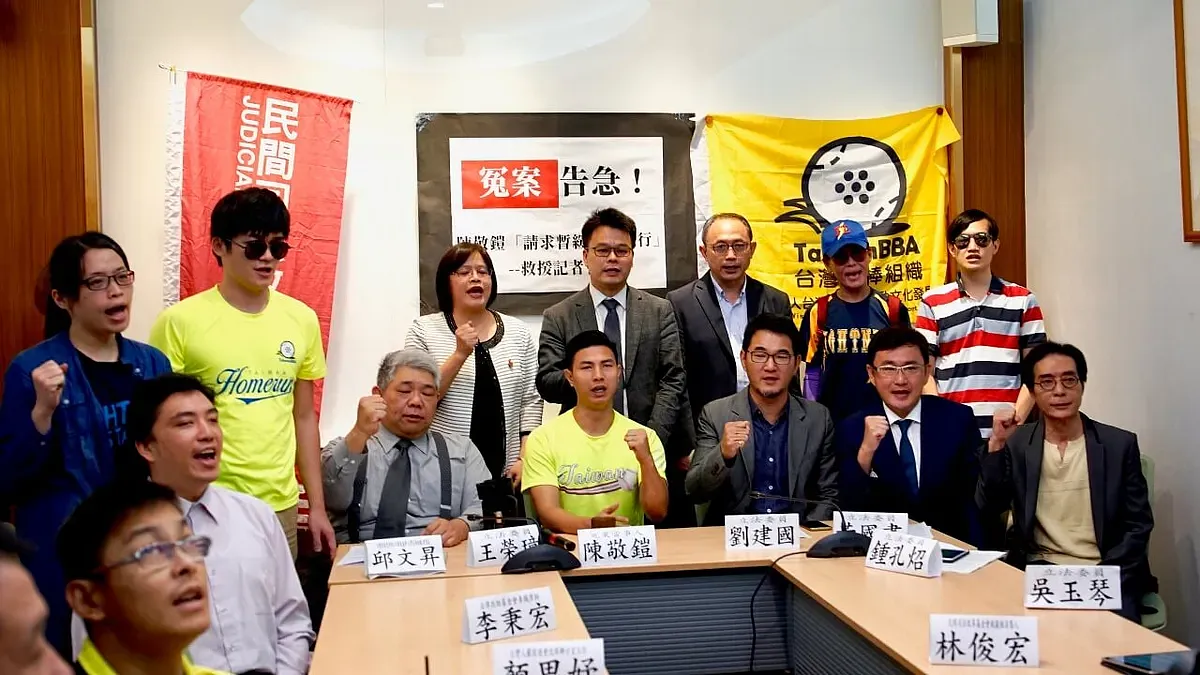
Wrongful Conviction Emergency! Ch'en Ching-k'ai's Press Conference on "Requesting a Stay of Execution of Imprisonment"
Last edited: 2026-07-27
Former handball national team member Ch'en Ching-k'ai was wrongfully convicted by the court of faking blindness to commit insurance fraud. He was sentenced to a total of 1 year and 2 months of imprisonment, which is commutable to a fine calculated at NT$1,000 per day. While the pro bono legal team has urgently sought rescue by filing for a retrial, Control Yuan members are also investigating the case. Despite his innocence, the Kaohsiung District Prosecutors Office recently issued an execution order demanding the payment of over NT$5 million in so-called "proceeds of crime" by June 14, otherwise commutation to a fine will be denied and he must be imprisoned. Civil society supporting groups today (June 11), together with four Legislators Wu Yü-ch'in, Wang Jung-chang, Huang Kuo-shu, and Chung K'ung-chao, urgently expressed solidarity with this case, earnestly pleading with the Kaohsiung District Prosecutors Office to recognize the wrongful nature of this case and grant a stay of execution!
The defendant in this case, Ch'en Ching-k'ai, became a patient with Cortical Visual Impairment (CVI) due to a traffic accident in 2009. This is a visual impairment caused by brain damage, where the visual processing center and visual pathways of the brain are disturbed. Simply put, the "signals" received by the eyeballs cannot be successfully transmitted to the brain. However, Taiwanese medical research, diagnosis, and treatment for CVI are only in their infancy. Even professional ophthalmologists are unable to make precise diagnoses, leading to CVI patients frequently suffering misunderstandings due to the prejudices of ordinary sighted people, and even being considered to be "faking blindness."
The Ch'en Ching-k'ai Case Has Major Flaws; Serving a Prison Sentence Will Result in a Miscarriage of Justice
During the trial process of this case, multiple scholars and experts presented scientific appraisals and professional opinions indicating that Ch'en Ching-k'ai's visual acuity is "below 0.01 on the international visual acuity scale." However, the court ignored the appraisal opinions, instead holding a narrow-minded perspective and arbitrarily determining that Ch'en Ching-k'ai's vision is normal based on the fact that he can still write and throw a frisbee, concluding that applying for more than NT$5 million in insurance claims from the insurance company constituted "insurance fraud." This seriously violates the rules of evidence and the presumption of innocence. Regarding the miscarriage of justice caused by the court's prejudice against the visually impaired, the pro bono legal team has already filed for a retrial, petitioned the Control Yuan, and is preparing to request the Prosecutor-General to file an extraordinary appeal. Under these circumstances, if there is insistence on sending Ch'en Ching-k'ai to prison for execution, it is none other than witnessing a miscarriage of justice occur with open eyes. We urge the Kaohsiung District Prosecutors Office to grant a stay of execution.
Confiscation Becomes an Obstacle to Commuting Imprisonment to a Fine
Ch'en Ching-k'ai is innocent! The road to exoneration has already been arduous and difficult. The court judgment originally allowed imprisonment to be commuted to a fine, but the execution order from the Kaohsiung District Prosecutors Office instead required the payment of criminal proceeds as a condition for granting commutation to a fine. This not only adds restrictions not provided for by law, violating the principle of legal reservation, but also violates the principle prohibiting improper connections. Furthermore, Ch'en Ching-k'ai was not given the opportunity to state his opinions beforehand, which also breaches due process of law. Therefore, we request the Kaohsiung District Prosecutors Office to revoke the disposition first and stay the execution; in addition, the pro bono legal team will also file a statement of objection with the court.
Prisons Should Provide Treatment Suitable for Visually Impaired Inmates
Finally, as a visually impaired person, Ch'en Ching-k'ai needs assistive devices such as a white cane for walking, needs time to adapt to unfamiliar environments, and requires assistance from others in daily life. However, whether Taiwan's prisons have environmental facilities suitable for blind inmates to serve their sentences remains unknown. Our country has long lacked comprehensive planning for the correctional treatment of persons with physical and mental disabilities. Directly placing visually impaired persons into sick wards or elderly wards fails to ensure the basic living standards of visually impaired persons in correctional institutions. If Ch'en Ching-k'ai is wrongfully imprisoned, we also demand that correctional institutions provide treatments suitable for the visually impaired to ensure that Ch'en Ching-k'ai does not suffer further adverse treatment in prison, impairing his personal dignity or even amounting to torture and abuse!
Attachments
Attending Representatives
Ch'en Ching-k'ai / Defendant in the Wrongful Case
Wu Yü-ch'in / Legislator
Wang Jung-chang / Legislator
Huang Kuo-shu / Legislator
Chung K'ung-chao / Legislator
Liu Chien-kuo / Legislator
Yeh Chao-min / Orientation and Mobility Specialist
Huang Sung-li / Convener of Covenants Watch
Yen Szu-yü / Director of the Northern Office, Taiwan Association for Human Rights
Ch'iu Wen-sheng / Chairperson of the Taiwan Non-Visual Sports and Culture Development Association (Taiwan Blind Baseball Organization)
Chang Yü-hsüan / Standing Supervisor of the Taiwan Non-Visual Sports and Culture Development Association (Taiwan Blind Baseball Organization)
Li Ping-hung / Full-time Lawyer, Legal Aid Foundation
Lin Chün-hung / Convener of the Rescue Division, Judicial Reform Foundation
Ch'en Yü-fan / Executive Director, Judicial Reform Foundation
Press Contacts
Judicial Reform Foundation Executive Director Ch'en Yü-fan (02)2523-1178
What Does Prison Look Like for the Visually Impaired? Speech Statement at the Press Conference to Support Blind National Athlete Ch'en Ching-k'ai's Case
Speech Statement by the Taiwan Association for Human Rights
Upon learning the news that Ch'en Ching-k'ai is about to be executed and imprisoned, we feel quite regretful and deeply concerned about the actions of the Kaohsiung District Prosecutors Office. The reason is that Taiwan's correctional institutions severely lack environmental facilities and manpower suitable for visually impaired individuals to serve their sentences.
First, can the white cane used by the visually impaired for orientation and mobility be used within correctional facilities? Under the reality where custodial security is prioritized, the correctional institution's focus is that assistive devices might be used as weapons for attack by other inmates, so they will be kept in custody before entering the cell. Daily living inside the cell, such as using the restroom, likely depends on whether cellmates are willing to lend a helping hand; or they might be assigned to a sick ward. Although each room is assigned a nursing assistant, the nursing assistant is also an inmate by status rather than a professional caregiver, and may lack correct understanding and assistance capabilities regarding the kind of assistance a visually impaired person needs. Especially when transitioning to a new environment, the presence of an orientation and mobility instructor to guide them and help rebuild the visually impaired person's mental map of daily life is even more necessary. May we ask if our correctional institutions can provide the resources of an orientation and mobility instructor, or allow the client's instructor to enter the correctional facility to assist?
Furthermore, the original architectural designs of all correctional facilities across Taiwan did not take inmates with physical and mental disabilities into consideration. Therefore, facilities most fundamental to assisting the visually impaired, such as tactile paving and barrier-free ramps, are almost completely nonexistent. Without tactile paving and unable to use a white cane, it is difficult for us to imagine how a visually impaired inmate can manage their daily life within a correctional facility! According to Article 11, Paragraph 1, Subparagraph 4 of the Prison Act, if an inmate has a physical or mental disability and is unable to manage their daily life upon entering prison, their admission should be refused.
The international human rights organization Human Rights Watch released an investigative report in February of this year regarding the neglect of treatments for inmates with physical and mental disabilities in Australian correctional facilities. The investigation period of this report lasted from September 2016 to January of this year, conducting a 10-week field study and interviewing 275 individuals related to correctional facilities, among whom 136 had physical and mental disabilities and were currently serving sentences or were recently released former inmates. The investigative report pointed out that persons with disabilities easily become targeted objects (easy target) in correctional facilities, are more likely than ordinary inmates to suffer verbal, physical, and sexual violence, and experience more frequent solitary confinement; moreover, cases requiring high levels of assistance may find that their prison-cares are simultaneously perpetrators or oppressors.
The recommendations proposed at the end of the report are respectively as follows:
Regarding Enforcement Authorities (Agency of Corrections, Ministry of Justice and Respective Correctional Institutions)
- Avoid imposing solitary confinement on inmates with physical and mental disabilities.
- Systematically screen out individuals with various types of disabilities during the new admission stage, provide reasonable living spaces, and ensure the accessibility of support systems and mental health service resources for inmates with physical and mental disabilities.
- Correctional facility managers should receive regular in-service training to foster gender and cultural sensitivity and learn how to interact with persons with disabilities.
Regarding the Central Government and Superior Supervisory Authorities (Ministry of Justice)
- Investigate the conditions of solitary confinement imposed on inmates with physical and mental disabilities across correctional facilities nationwide.
- Commission independent research to understand the treatment of inmates with physical and mental disabilities in prison (number of people, age, gender, type of disability, and required support in each prison).
If correctional facilities cannot provide treatments suitable for the visually impaired to ensure that the individual does not suffer doubled adverse treatment due to their disability status while their personal freedom is deprived, they should not rashly forward individuals with disabilities into correctional facilities. What should be done is to implement community-based diversion treatments at the front end of the judiciary, in order to truly respond to the rights that the Convention on the Rights of Persons with Disabilities Enforcement Act, passed by our country in 2014, aims to defend.
Speech Statement by the Covenants Watch
-
Convention on the Rights of Persons with Disabilities (CRPD) and Its Obligations
Article 13 of the CRPD, Access to Justice, requires that "1. States Parties shall ensure effective access to justice for persons with disabilities on an equal basis with others, including through the provision of procedural and age-appropriate accommodations, in order to facilitate their effective role as direct and indirect participants, including as witnesses, in all legal proceedings, including at investigative and other preliminary stages. 2. In order to help to ensure effective access to justice for persons with disabilities, States Parties shall promote appropriate training for those working in the field of administration of justice, including police and prison staff."
Although the CRPD has had domestic legal effect since 2014, judicial procedures—from investigation, trial, to execution—have failed to consider the circumstances of persons with disabilities and make necessary adjustments in practice. The way prisons treat persons with disabilities completely ignores their physical and psychological demands, causing individuals with disabilities to encounter harsher treatment and punishments during their imprisonment than others, thereby constituting state discrimination against persons with disabilities and violating the CRPD and the requirements of Article 4 of the CRPD Enforcement Act. It is distressing to see judicial and correctional organs taking the lead in violating the law.
-
Failure to Provide Reasonable Accommodation Constitutes "Cruel, Inhuman or Degrading Treatment or Punishment"
Paragraph 17 of the "General Comment on Article 14 of the CRPD," adopted by the Committee on the Rights of Persons with Disabilities in 2015, specifically mentions that living conditions and environments in prisons are inherently poor and full of difficulties for persons with disabilities. If accessibility facilities and services in prisons are poor, they likely fail to provide a humane and dignified living environment. The CRPD Committee also recommended that governments establish legal frameworks requiring prisons to provide reasonable accommodations to ensure that the dignity of inmates with physical and mental disabilities is upheld.
Although our country has not yet passed an "Enforced Convention against Torture and Other Cruel, Inhuman or Degrading Treatment or Punishment," the Executive Yuan is already deliberating on the enforcement act for this convention. Meanwhile, Article 7 of the International Covenant on Civil and Political Rights has long required that "No one shall be subjected to torture or to cruel, inhuman or degrading treatment or punishment." Since both Covenants have had domestic legal effect in our country since 2009, we demand that the government strictly comply with them.
-
The Agency of Corrections Caught in a Dilemma
The court judgment determining Mr. Ch'en Ching-k'ai guilty of defrauding insurance money is equivalent to denying Mr. Ch'en's visual impairment. Therefore, if the Agency of Corrections accepts the judicial judgment, it naturally will not regard Mr. Ch'en as visually impaired, nor will it proactively provide any accommodations and assistance during his imprisonment. However, if Mr. Ch'en unfortunately must enter prison to serve his sentence, we believe the Agency of Corrections will inevitably discover that Mr. Ch'en has a considerable degree of visual impairment. Under such circumstances, failing to provide reasonable accommodations would constitute "cruel, inhuman or degrading treatment or punishment" and discriminatory treatment. We expect the Agency of Corrections to respect the status of Mr. Ch'en and other inmates with physical and mental disabilities, and proactively provide necessary accommodations and assistance to fulfill the government's obligations under the CRPD.
This article is an AI-generated translation of the original Chinese text. In the event of any discrepancy, the Chinese version shall prevail.