
Reflections on Visiting the National Human Rights Museum's Jingmei Memorial Park—2018 Summer Intern Reflections
Last edited: 2026-07-27
"What I pursue in Taiwan is... first, democracy; second, democracy; and third, democracy still. Aside from democracy, there is only democracy." Every student in the Department of Political Science at Soochow University is familiar with this assertion by Professor Fu Cheng. Fu Cheng taught in the Soochow Department of Political Science for twenty years; prior to that, he had been imprisoned during the White Terror period. As a political science student, I often engaged in grand discussions with peers in class about Taiwan's democracy, freedom, and human rights. Yet, in reality, we knew very little about the origins of these values and the struggles and pursuits of our predecessors.
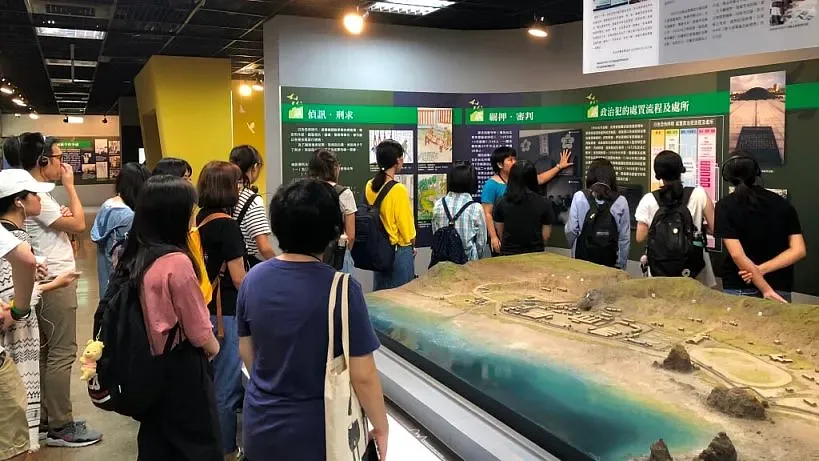
Stepping for the first time into the White Terror Memorial Park located in Jingmei, what came into view were the cells of political prisoners from back then, the courtrooms where they were put on trial, and even the execution grounds; I felt an incomparable heaviness. During the period of martial law, in order to consolidate the stability of its rule, the Kuomintang government purged dissidents in the name of anti-communism and patriotism, resulting in an absurd mindset among secret service agencies of "rather wrongfully arresting one hundred than letting a single one escape." During this period when freedom of speech and communication were deprived, many people were arrested inexplicably, such as Fu Cheng, Li Ao, Ch'en Chu, and Annette Lu. However, I was more eager to learn about the obscure, unknown political prisoners, because these ordinary masses, just like you and me, had weaker voices and less power, but their stories deserved the same attention. According to the docent's explanation, a woman was arrested and imprisoned simply because she was reported for participating in a reading club that possessed banned books. In addition, there were countless innocent, false, and wrongful cases, causing many people to suffer unfair trials, sacrifice their precious lives, and lose the ability to embrace their families ever again.
Witnessing the multi-person and solitary confinement cells of that era with my own eyes, under the docent's description, I tried to imagine what it was like to live inside them—the cramped space, the poorly ventilated environment, and the bodies stripped of freedom; it was quite agonizing. Walking into the visiting room, I tried to feel the pain and helplessness of family members talking to their loved ones across a window. Sitting in the audience seats of the courtroom for the Formosa Incident mass trial back then, viewing the photos of Chang Chün-hung, Huang Hsin-chieh, Ch'en Chu, and others on trial, I was able to truly comprehend how hard-won today's democracy, freedom, and human rights are. Every student, especially political science students, should visit the park in person to review history and realize that the values we now seem to take for granted were once out of reach for ordinary people in past Taiwan.
As the saying goes, "Using history as a mirror, one can understand the rise and fall." Visiting the Jingmei Memorial Park allows us to understand the efforts and painful costs paid by our predecessors behind the alternation of an era, enabling us today to enjoy numerous fundamental rights in a constitutional state. Most importantly, reviewing and facing past mistakes reminds us to care more about current issues, because only when the people are willing to pay attention and engage in reform can reform happen and society progress.

This article is an AI-generated translation of the original Chinese text. In the event of any discrepancy, the Chinese version shall prevail.