
The More You Do, the More You Can Do—Reflections from a 2008 Summer Intern
Last edited: 2026-07-27
As a college student majoring in political science with a double major in law, if I wanted to join JRF to actually participate in its operations and understand its various details, I could do so through two channels: one is through the internship programs JRF collaborates on with relevant departments of various universities, and the other is to participate as a volunteer. I chose the latter. On the one hand, I was under no pressure to fulfill internship hours; on the other hand, I felt that learning should inherently be proactive, as this is the only way to see more and participate more. Before coming to JRF, I had only heard the name of this NGO; I did not understand its actual operational methods, nor did I realize how broad the scope of its work truly is.
Participating in its actual operations up to today, I still cannot forget my first day stepping into JRF. It was vastly different from the office I had imagined, and I certainly did not expect it to be in an unassuming building. There were no flashy decorations or exaggerated furnishings; instead, there were warm yellow lights, rows of small and clever desks, and gentle smiles hanging on everyone's faces. Moreover, everyone present was generous in teaching, answering almost every question. Overall, it was a very heartwarming atmosphere.
One of the main reasons I wanted to volunteer at JRF was that I felt after studying in university for a few years, it all felt like mere armchair theorizing without any personal resonance. Sometimes I even doubted what the point of studying so much really was, growing weary of the repetitive cycle of going to classes and returning home. Another reason is that contemporary society generally tends to passively receive information conveyed by television media, newspapers, and magazines, while very few people further screen, filter, or even verify the information they receive. I think this is actually detrimental, because what distinguishes humans from machines is that humans possess the spirit of independent thinking. If people are unwilling even to think, I believe it is of little help to society as a whole or to national development. Combining these two points, I came to JRF. I believed that only by actually engaging with relevant people and events, and experiencing them firsthand, could I truly understand what this NGO does, what beliefs it strives for, what I could learn from this experience, and what I might change.
During this period, I participated in the following tasks: sitting in on and recording complainant interview sessions, writing case summaries and proposing handling recommendations, scanning and filing case files, participating in or attending legal team meetings, and personally attending various large-scale events (such as the 20th-anniversary fundraising and thanksgiving banquet hosted by the Taiwan Tongzhi Hotline Association), among others.
I still remember the words left to us students by the first complainant whose interview I encountered before they left: 'I hope you can all become good law enforcement officers in the future.' This sentence has stayed in my mind. I wondered, what does it take to be called a good law enforcement officer? Must a good legal worker cater to public opinion, operate purely according to statutory text, or insist on their own ideals, putting them into practice to bring about substantive change? I am still pondering this question, because I feel that the law is sometimes not very clear-cut; there are many gray areas, and depending on the angle of approach, different conclusions are reached.
However, when complainants come to appeal their cases, JRF is sometimes truly unable to help on the legal front—for instance, when a case cannot be remedied due to procedural regulations, such as deadlines having passed, failure to comply with litigation procedures, or non-legal issues (such as the complainant's psychological factors). What more can we do for the complainant? In fact, over this period, I found that even when we cannot help complainants on a legal level, we can still assist them in other ways. Sometimes, matters that we might deem minor or insignificant are extremely important to complainants, or even memories they can never erase for a lifetime. Therefore, we should all the more provide side-by-side advice based on the complainant's actual situation, offer deeper listening, and even accompany them. We hope the complainant can appropriately let go, rest, or distract their attention through other matters, hoping they do not exhaust all their mental energy on the case. After all, merciless time does not stop its pace for that; life must go on, right?
Furthermore, what left the deepest impression on me was that during my time as a volunteer, another classmate and I personally went to the Taipei Detention Center to visit Ch'i Ho-shun (hereinafter referred to as A-shun). Having never been to a detention center before, that day was truly an eye-opener for me. The plots played out in television shows or dramas were actually manifesting so vividly before my eyes. With a heart full of anxiety and trepidation, we finally met A-shun. A-shun is an internationally watched death row inmate who has been detained the longest in Taiwan's judicial history; an unfair trial made him spend tens of thousands of days in prison with grievance.... The reception number A-shun gave me was 222, which represents how many people have visited him thus far. My first impression of him was that he is a very optimistic and cheerful person. It is hard to imagine that someone detained for nearly 30 years could maintain such a positive attitude. In our conversation with him, he showered us with boundless encouragement. He excitedly told us that if he ever gets the chance to come out in the future, others must arrange an itinerary to take him to Taichung Miyahara Eye Hospital to eat ice cream, to Shihmen Reservoir to eat seafood, to Toronto, Canada, and to give lectures everywhere. We all felt that he still maintained a positive outlook on the future. Looking at the big smile on his face, it felt as though there truly was nothing in the world that could not be resolved! He said that life in the detention center is certainly bitter—when the weather is hot, the walls become scorching hot (on this day, the outdoor temperature approached 36 degrees Celsius; it is hard for us outside to imagine just how sweltering the living conditions are for A-shun inside the detention center)—but whenever he thinks of how so many people are fighting alongside him, he will continue to persevere, because this battle is only just beginning....
Finally, I want to say that perhaps everyone's upbringing, academic background, and life experiences are different, but this does not hinder everyone from holding an open heart and a willingness to listen to others' thoughts. Everyone has their own preconceived notions about various issues, but I believe that the most important thing is whether one is willing to open their mind, take that step forward, and try to think from another's perspective! Only by experiencing and engaging with things firsthand can one truly understand why such a large group of people continue to quietly cultivate certain causes—insights that textbooks will never teach. I have always believed in the saying, 'The more you do, the more you can do.' Only when the things we learn and experience continually expand can we discover that what we truly want to do, and are capable of doing, vastly exceeds our original imagination.

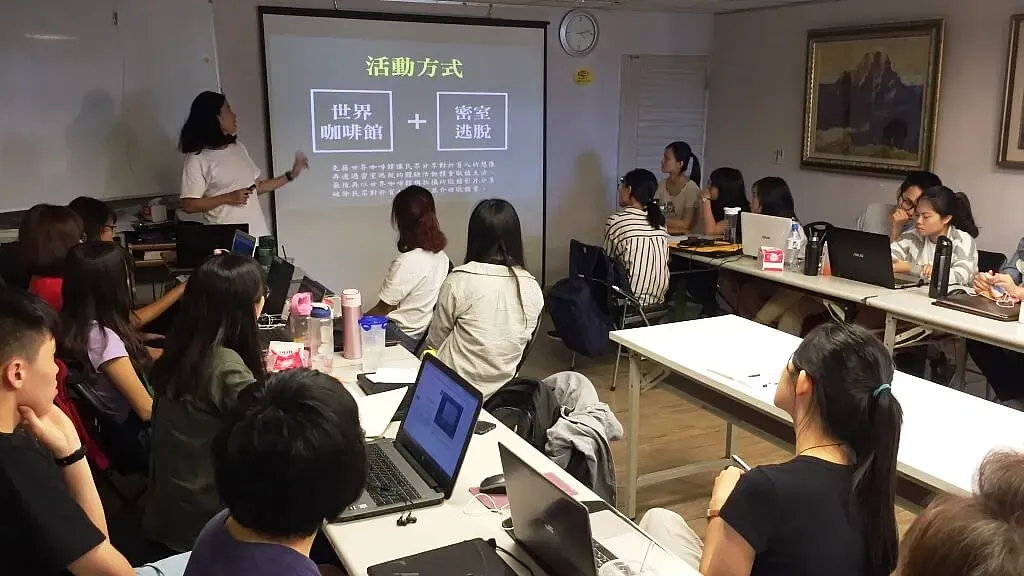
Photo / July 20, 2018: Joint visit to JRF by interns from the Taiwan Association for Human Rights, Taiwan Labour Front, Eco-Taiwan Association, and Syin-Lu Social Welfare Foundation
This article is an AI-generated translation of the original Chinese text. In the event of any discrepancy, the Chinese version shall prevail.