
The Final Mile of Justice—Reflections of 2018 Summer Interns
Last edited: 2026-07-27
Criminal Compensation: The Final Step of the Judicial Giant in Pursuing Justice
"A wrongful conviction is a mistake made by the judicial giant on its path of pursuing justice, and criminal compensation is the final step of the judicial giant in pursuing justice. It must face up to the mistakes it has made and rescue the clients and their families who were harmed as a result."
Attorney Li Hsuan-i elaborated during the criminal compensation hearing for the Cheng Hsing-tzu case.
Sixteen years of the Cheng Hsing-tzu case, just as writer Chang Chuan-fen noted in the afterword of Youth in Adversity: "Justice is bound to be belated, because justice always happens after injustice, otherwise you cannot even feel justice." Justice was late, so how can the pain and heartache accompanied by the prior injustice be compensated? How much perseverance does the vindication of a wrongful conviction require from the innocent person and their family and friends around them? Acquittal is not a bestowal by the judiciary, nor is it the end of justice; it is the life they ought to have enjoyed all along.
Stolen Time, Irreparable Flaws in Life
An acquittal is the first step for the judiciary to admit its mistake, and criminal compensation is the state's attempt to take responsibility for these mistakes. The Cheng case has gone through numerous court sessions over the years. Before the acquittal, discussions in the courtroom revolved around the events of the year the incident occurred, with prosecutors and defense attorneys debating back and forth over the legal issues of the case; the pursuit of truth is the focus of attention in a trial, but what about the lives shattered by it for the innocent person? All the battles fought in the courtroom were exchanged by the innocent person burning their faint life, and this entire process finally became three-dimensional at the criminal compensation hearing. Through the attorney's statements, I saw how much impact it will have on a person and a family when the judicial giant makes a mistake in the process of pursuing justice. From the investigative procedure to the trial process, every single mistake, big or small, will brew irreparable consequences. The youth and years lost by Cheng Hsing-tzu and the happiness that was once within reach, the indifference constructed in prison out of fear of hurting his family, the agonizing physical and mental pain suffered to prove his innocence, and the pressure and heartache borne day and night by his family—these are all losses that money cannot compensate.
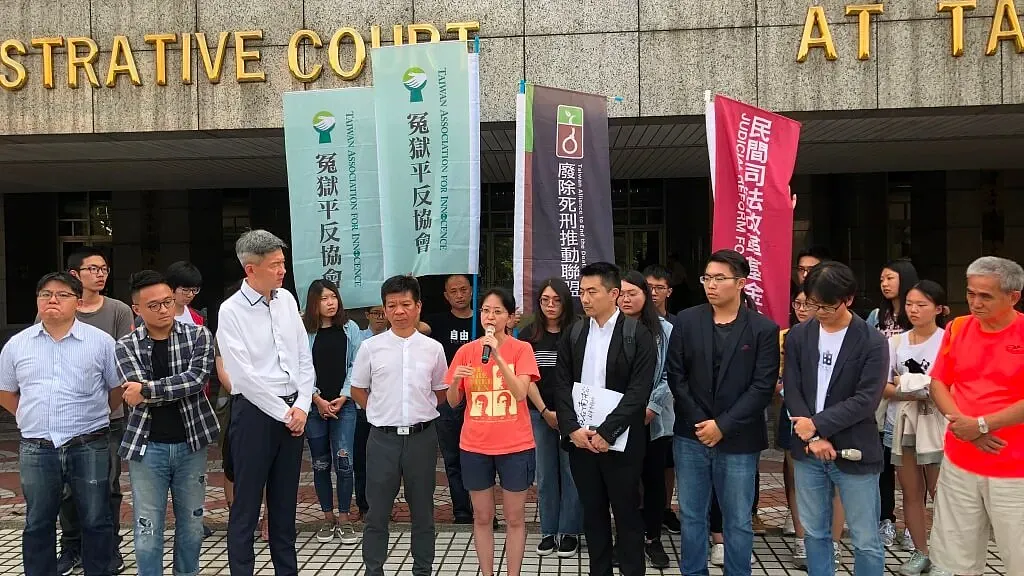
On the day of the hearing, many rescue groups concerned about Cheng Hsing-tzu gathered in the court, including the Taiwan Alliance to End the Death Penalty, Taiwan Association for Innocent Victims (TAIV), JRF, Yu-Li Kitchen, innocent person Chen Yen-fei, and students. Watching everyone's care and support for Cheng Hsing-tzu and his family, a warm current surged into my heart. I think these genuine emotions between people are truly the poultice that can heal the flaws.
Reviewing Cases in Two Dimensions, Understanding People in Three Dimensions
In our daily internship at the JRF, our primary work involved reviewing grievance letters and cases sent by clients. Our supervisor always reminded us: "Before reaching a conclusion on any case, as long as there is the slightest doubt, be a little more cautious and put in a little more effort—not only for the client, but also for yourself—to ensure you won't regret missing someone who needed saving or wrongly saving someone." After observing the criminal compensation hearing of the Cheng case, I gained a deeper realization of this sentence. A major criminal case often carries the weight of one life, an entire family, or even several families behind it. If we can always hold the mindset of seeing "a person" rather than "a case," could we reduce many possibilities of making mistakes? In the days of my internship at the JRF, I found that people here treat a case with the same seriousness as a person's life, attentively seeing the true inner needs of the client behind the litigation, and also seeing the client's real life and the social predicaments they might encounter outside of the litigation.
This article is an AI-generated translation of the original Chinese text. In the event of any discrepancy, the Chinese version shall prevail.