
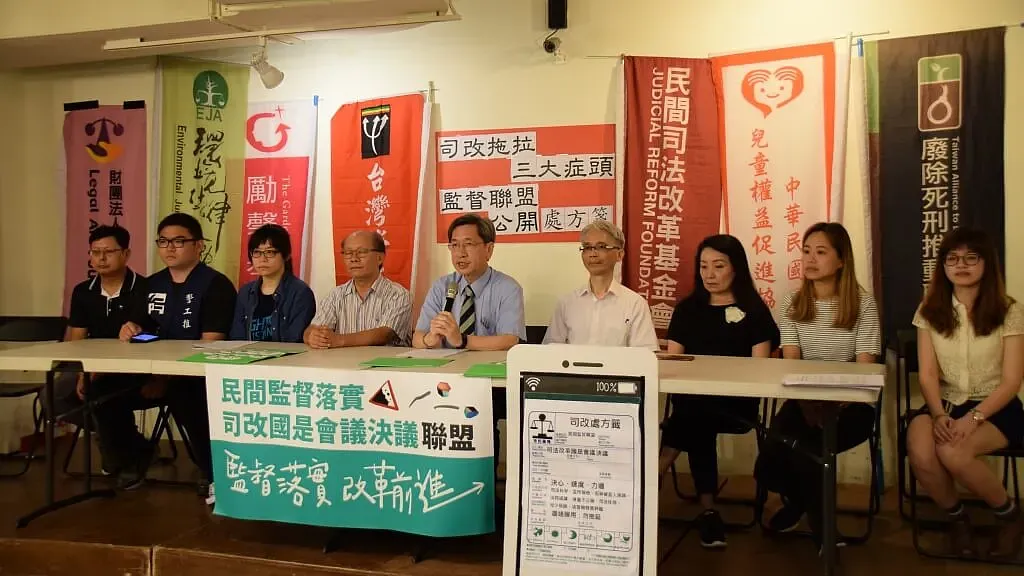
Three Major Issues Dragging Down Judicial Reform, Monitoring Alliance Releases Public Prescription—Press Conference of the Alliance for Civilian Monitoring and Implementation of the Judicial Reform National Consultative Conference Resolutions
Last edited: 2026-07-27
August 12 of last year marked the convening of the National Consultative Conference on Judicial Reform, and today marks one year since. The "Alliance for Civilian Monitoring and Implementation of the Judicial Reform National Consultative Conference Resolutions" has reviewed the Tsai Ing-wen administration's progress on judicial reform over the past year and put forward our views.
While the Alliance acknowledges the efforts of the Judicial Yuan, the Executive Yuan, and the Ministry of Justice in passing or amending up to 41 laws, a greater number of reform measures that do not require legislative amendments and can be implemented immediately have instead progressed slowly. Whether these measures are implemented depends on the willingness and determination of the responsible authorities. Only when implementation is efficient will the public truly feel judicial reform.
Today, the Alliance highlighted ten resolutions that can be implemented immediately, covering areas such as forensic science, correctional institution healthcare, crime victim protection, court interpretation, the principle of non-publicity of investigations, judicial gender equality, child and youth protection, and judge and prosecutor evaluation. Among them, most resolutions suffer from poor implementation efficiency that is too little, too late, or are headed in the wrong direction. In some cases, the implementation direction of the responsible agencies even fundamentally contradicts the resolutions of the National Consultative Conference, casting doubt on their determination to reform.
-
Failure to Follow the Spirit of Resolutions, Dragging Down Reform
The Alliance found that the National Police Agency (NPA) has refused to adopt the resolutions to establish a "Police Education Committee" and a "Police Projects and Performance Management Committee," agreeing only to set up meetings of a consultative nature. The "Police Projects and Performance Management Committee" is related to the police performance evaluation system. Because various standards lack scientific basis, performance evaluations have been reduced to a mere numbers game, failing to further improve the crime situation in our country. As the current performance system is already a heavy burden for frontline police officers, the NPA should reassess the possibility of establishing the committee, rather than being complacent and closing the door to cooperation with the outside world on reform.
Another case dragging down judicial reform is the authorities' continued violation of the principle of non-publicity of investigations. During the summer break this year, in a case involving a 10-year-old money mule, the police violated the principle of non-publicity of investigations by leaking screenshots of the child and youth mule's photos and personal information. Several print and electronic media outlets extensively reported on the case, publishing the suspect's photograph, personal data, surveillance footage at the time of apprehension, and evidence. Although the JRF filed a complaint through the NPA Director-General's mailbox regarding this serious violation of the principle of non-publicity, the Dajia Precinct replied that there was insufficient concrete evidence to establish misconduct by the handling officers.
All the above issues point to whether agencies possess the internal determination to reform. These measures can be swiftly implemented and yield reform outcomes without requiring legislative amendments. However, not only do the authorities fail to execute these resolutions, they also fail to take them seriously, disregarding public expectations for judicial reform. The Alliance expects the authorities to actively implement the resolutions and stop dragging down the reform process.
-
Poor Implementation Efficiency of Resolutions, Lacking Determination to Reform
The efficiency of resolution implementation serves as a magnifying glass for the public to examine how the resolutions of the Judicial Reform National Consultative Conference are being put into practice. Regarding miscarriage of justice relief, take the recent acquittal of Lin Chin-kuei (林金貴) through a retrial as an example: the Kaohsiung Branch of the Taiwan High Court ruled to initiate a retrial based on new evidence, using 3D forensic analysis to cross-examine surveillance footage and concluding that Lin Chin-kuei was not the perpetrator, thereby acquitting him. This case highlights the importance of scientific evidence in litigation, yet the authorities currently remain at the deliberation stage. They should promptly establish a "Forensic Science Committee" in accordance with the resolution and pass legislative amendments to enforce rigorous evidentiary rules.
Taking the correctional institution healthcare system as another example, in February 2018, two inmates at the Hualien Prison died of suspected respiratory infections. The Control Yuan censured the Hualien Prison for failing to arrange medical escort for treatment and failing to isolate infected patients, causing the outbreak to spread rapidly within the prison. The Alliance believes that the Agency of Corrections should review healthcare policies in correctional institutions, addressing issues such as insufficient hot water supply in winter and the lack of medical personnel at night and on holidays.
-
Resolutions Implemented, but Reform Momentum Must Be Strengthened
The implementation of resolutions should involve the setting of short-, medium-, and long-term goals. As the saying goes, distance tests a horse's strength; truly embodying the spirit of the resolutions is what makes reform tangible to the public. For example, as early as October 2017, the Judicial Yuan established the "Human Rights, Child Protection, and Gender Equality Committee" in accordance with the National Consultative Conference resolutions. The Alliance affirms the implementation efficiency, but how the committee operates moving forward is the key for the Judicial Yuan to put human rights, child protection, and gender awareness into practice. The Alliance expects the committee to strengthen judicial personnel's gender awareness, establish evidentiary rules applicable to sexual assault cases, and grant victims more litigation rights.
Regarding recent disciplinary and integrity issues involving individual judges and prosecutors, the Judicial Yuan and the Ministry of Justice have also activated self-regulation mechanisms, with the Personnel Review Committee resolving to refer them to the Control Yuan. The Alliance affirms the determination of the courts and ministries to weed out incompetent judges and prosecutors. However, turning to the systemic aspects of judge and prosecutor evaluation—including reforming the comprehensive evaluation system and extending the statute of limitations for individual case evaluations—the official legislative amendments have failed to adopt these changes. Therefore, even though the Judicial Yuan and the Ministry of Justice have submitted bills, the Alliance still believes that reforms must be substantive rather than superficial, so as not to erode public expectations for judicial reform.
The resolutions of the National Consultative Conference have forged the direction for the current stage of judicial reform. Many resolutions that do not require legislative amendments and can be completed independently by the responsible authorities need to be implemented with greater urgency. At the same time, attention must be paid to the quality of resolution implementation to avoid perfunctory execution that only deepens public distrust in the judiciary. The amendments to many major laws have now entered the Legislative Yuan awaiting review. The Alliance expects the Legislative Yuan to prioritize judicial-reform-related laws in the next session, implement the resolutions of the National Consultative Conference, and value the public's earnest expectations for judicial reform.
[Attendees Representing the Alliance for Civilian Monitoring and Implementation of the Judicial Reform National Consultative Conference Resolutions]
Chiang Ya-chu, Director, Xina (Inmate) Family Service Department, Republic of China Red Heart Association
Father Nguyễn Văn Hùng, Office of Vietnamese Migrant Workers and Brides, Catholic Diocese of Hsinchu
Yen Szu-yu, Office Director, Taiwan Association for Human Rights
Hung Chung-yen, Deputy Secretary-General, Taiwan Forever Association
Sun Yu-lien, Secretary-General, Taiwan Labour Front
Hsiao Jen-hao, Board Director, Taiwan Police Work Rights Advocacy Association
Lin Yung-sung, Chairperson, Judicial Reform Foundation
Ch'en Yü-fan, Executive Director, Judicial Reform Foundation
Professor Li Chün-i (Member of the National Consultative Conference)
Ms. Wang Wei-chün (Member of the National Consultative Conference)
Attorney Chang Ching-pei, Legal Aid Foundation
Lin Tzu-wei / Legal Affairs Director, Taiwan Alliance to End the Death Penalty
Chi Hui-jung, Executive Director, Garden of Hope Foundation
Liao Ya-chün, Advocacy Specialist, Garden of Hope Foundation
Chang Yü-yin, Chairperson, Environmental Jurists Association
Press Contact
Judicial Reform Foundation / Executive Director Ch'en Yü-fan (02)2523-1178
[Press Conference Photo Gallery] See Link
[Download Press Release and Attachments]
This article is an AI-generated translation of the original Chinese text. In the event of any discrepancy, the Chinese version shall prevail.