
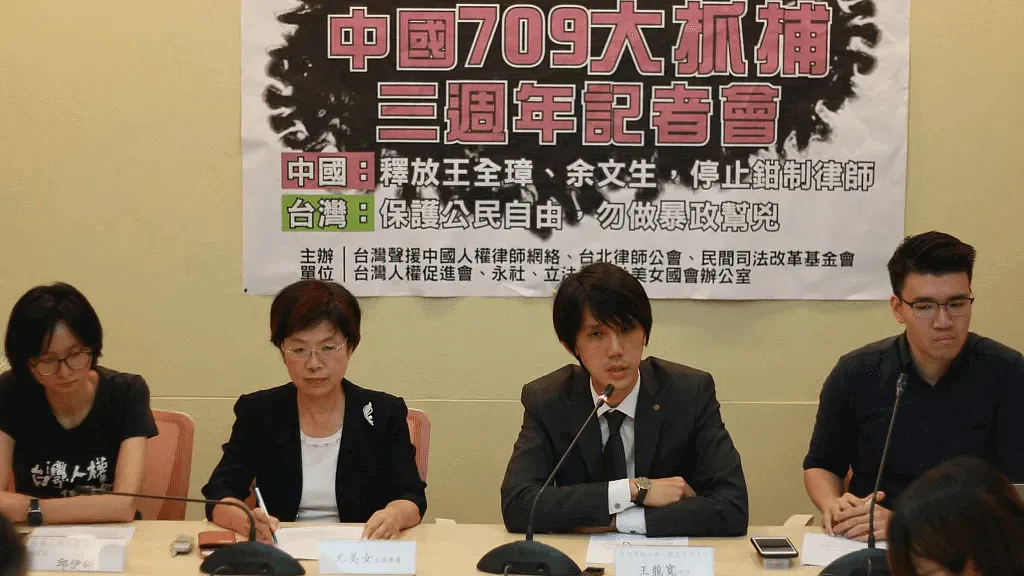
Global Joint Statement for the "Third Anniversary of the 709 Crackdown" and "China Human Rights Lawyers Day"
Last edited: 2026-07-27
July 9, 2018 marks the third anniversary of the Chinese government's large-scale crackdown—involving mass arrests, summonses, and disappearances—against human rights lawyers and related individuals (the "709 Crackdown"), as well as the second "China Human Rights Lawyers Day" initiated by civil society. Over the past year, we have witnessed the Chinese government's continuous suppression of human rights lawyers and various unconstitutional and illegal persecutions inflicted upon civil society under the guise of "rule of law." We strongly condemn these actions and demand the immediate and unconditional release of all human rights lawyers and related individuals imprisoned in the 709 crackdown, the unconditional revocation of administrative punishments that disbar or cancel the licenses of human rights lawyers, and an end to all controls and crackdowns against the community of human rights lawyers.
Following the 19th National Congress of the Chinese Communist Party ("19th Party Congress") in 2017, China entered a new era. It is a new socialist era under Hsi Chin-p'ing (Xi Jinping), and a new era in which China enters totalitarianism and Hsi Chin-p'ing's personal power reaches its peak. The Chinese authorities have sharpened their knives, sparing no effort to amend the constitution to consolidate power, promulgating draconian laws to strictly control civil society, and employing even more thorough and hypocritical methods to suppress the rights defense movement. Over the past three years, civil society's capacity to monitor the government has correspondingly diminished significantly. As Chinese human rights lawyers top the list of "new black categories" in the eyes of the government, they have inevitably borne the brunt of the oppression.
Overview of 709-Related Lawyers Over the Past Year
"China Human Rights Lawyers Day" was born precisely in response to this era. It affirms the courage and conviction of China's human rights lawyers while expressing to the world the human rights lawyers' resolute will not to submit to arbitrary power. The second "China Human Rights Lawyers Day" continues to focus on the 709 crackdown and the ongoing suppression that follows; the 709 incident is far from over. Over the past year, many individuals have been successively sentenced, and some 709 victims remain detained. For instance, Chiang T'ai-yung (Jiang Tianyong), who joined 709 family members in defending arrested lawyers, was convicted of inciting subversion of state power and sentenced to two years in prison; Wu Kan, who actively participated in citizen actions, criticized the judicial system, and explicitly stated in his criminal appeal that the people have the right to overthrow a dictatorial regime, was convicted of subversion of state power and sentenced to seven years in prison; Hsieh Yang (Hsieh Yang) was convicted of inciting subversion of state power and subjected to torture during his detention, including beatings, the "tiger bench," and sleep deprivation; Wang Ch'üan-chang (Wang Quanzhang) has been disappeared for over a thousand days since July 2015, denied visits from his family and family-retained lawyers for three years; Yü Wen-sheng (Yu Wensheng), who formerly served as Wang Ch'üan-chang's defense lawyer, sent an open letter during the 19th Party Congress calling for the removal of Hsi Chin-p'ing and the immediate amendment of the Chinese Constitution, and has been detained for five months, charged with inciting subversion of state power and obstructing official duties; Chou Shih-feng (Zhou Shifeng), director of the Fengrui Law Firm, was convicted of subversion of state power and sentenced to seven years in prison; Elder Hu Shih-ken (Hu Shigen), who has long been active in the citizen movement, was convicted of subversion of state power around the same time as Chou Shih-feng and sentenced to seven and a half years in prison, with his health currently deteriorating; Li Yü-han (Li Yuhan), defense lawyer for Wang Yü (Wang Yu), has been detained for over eight months, charged with picking quarrels and provoking trouble and fraud, and now suffers from multiple illnesses requiring her to take more than ten kinds of medication daily; furthermore, Yin Hsü-an (Yin Xuan) and Wang Fang were sentenced to three and a half years and three years in prison, respectively, for supporting the 709 lawyers, under the charge of picking quarrels and provoking trouble. No fewer than 321 people have been affected by the 709 crackdown to date, and countless others have suffered retaliatory administrative penalties and collective punishment.[1] Coupled with the frequent exposure of methods such as secret trials and torture through coerced confessions during past trials, the oppression inflicted by the Chinese government upon human rights lawyers severely violates the Chinese Constitution, the Criminal Procedure Law, and international conventions.
Continuation of 709 – Suppression Under the Guise of Administrative Discipline
Suppression has come wave after wave, the blade hanging over the heads of human rights lawyers remains unremittingly wielded, and now even the law—the sole weapon of lawyers—is increasingly being reduced to a tool to whitewash the regime's oppression. Following the promulgation of the revised "Measures for the Administration of Law Firms" and "Measures for the Administration of Lawyers' Practice" in 2016, the Ministry of Justice has used them to impose administrative disciplinary measures on lawyers. Since the 19th Party Congress, 16 human rights lawyers and 3 law firms have received notices of revocation and cancellation of their practice licenses, over half of whom are closely connected to the 709 cases.[2] Among them, the Ministry of Justice has even coerced law firms into dissolution, and exerted pressure on firms to dismiss lawyers. Meanwhile, the annual inspection system has further subjected lawyers to pressure; both the categories of cases handled by lawyers and their public statements online have become subjects of annual inspection reviews, subjecting lawyers' professional and non-professional conduct to surveillance. The Chinese government has pulled out all the stops, adopting more covert methods such as revoking and canceling practice licenses with the sole aim of reducing external backlash and more thoroughly eradicating the human rights lawyer community. The Chinese government seeks to directly control the economic livelihood of human rights lawyers—on one hand threatening their livelihoods, and on the other shrinking the size of the lawyer community, making it more difficult for human rights cases to find legal representation. Human rights lawyers play a critical role in the rights defense movement, and the new trend of revoking and canceling practice licenses will impact the survival of the rights defense movement.
Demands
We note that the core of the Chinese government's "rule of law" is to institutionalize and legalize its suppressive measures. We strongly condemn the Chinese government's incessant suppression and all persecutions arising from unconstitutional and illegal systems. Accordingly, we demand that the Chinese government:
- Immediately release all human rights lawyers and rights defenders imprisoned in the 709 crackdown, overturn their convictions, and restore justice to human rights defenders;
- Disclose the personal status of Wang Ch'üan-chang, Yü Wen-sheng, and Li Yü-han, guarantee their lawful litigation rights, and immediately release them unconditionally;
- Immediately and unconditionally rescind all decisions revoking, canceling, or otherwise disciplining the licenses of affected lawyers;
- Cease all controls and suppression against the community of human rights lawyers, and ensure that lawyers are not subjected to intimidation, obstruction, undue interference, prosecution, or administrative sanctions on account of their handled cases or expressed opinions.
Hope for the Rights Defense Movement
Although arbitrary power may seem impregnable, it was precisely because the human rights lawyer community expanded rapidly over the past three years and the force defending human rights gradually took shape that the dictators responded with the 709 crackdown. Thanks to the active response of the international community and the rising new generation of human rights lawyers, the Chinese government has been forced to bear immense public pressure. Furthermore, this has driven family members to step onto the front lines: Wang Ch'üan-chang's wife, Li Wen-tsu (Li Wenzu), protested dozens of times before judicial authorities and walked thousands of li to Tianjin in search of her husband; Yü Wen-sheng's wife, Hsü Yen (Xu Yan), exhausted all legal avenues to defend her husband, enabling the rights defense movement to persist. Even if the regime's dark hands cover the sky, as long as there are still people upholding justice and harboring an indomitable will, a single spark can be lit in the darkness.
June 26, 2018
Initiating Organizations:
China Human Rights Lawyers Concern Group
Taiwan Support China Human Rights Lawyers Network
Petition Link: https://goo.gl/RzbpPm
[1] [709 Crackdown Progress Report] Latest data and case developments as of 18:00 on May 17, 2018: https://goo.gl/98diwW
[2] [Global Legal Organizations Joint Statement—Strongly Condemning the Chinese Government's Continued Suppression of Human Rights Lawyers Through Revoking and Canceling Lawyers' Practice Licenses]: https://goo.gl/FuPPBC
This article is an AI-generated translation of the original Chinese text. In the event of any discrepancy, the Chinese version shall prevail.