
[Statement of the Voluntary Legal Team Against the Cross-Strait Trade Agreement in Secret] Regarding the Taipei District Court's Dismissal of the March 24 Executive Yuan Violent Eviction Self-Prosecution Case
Last edited: 2026-07-27
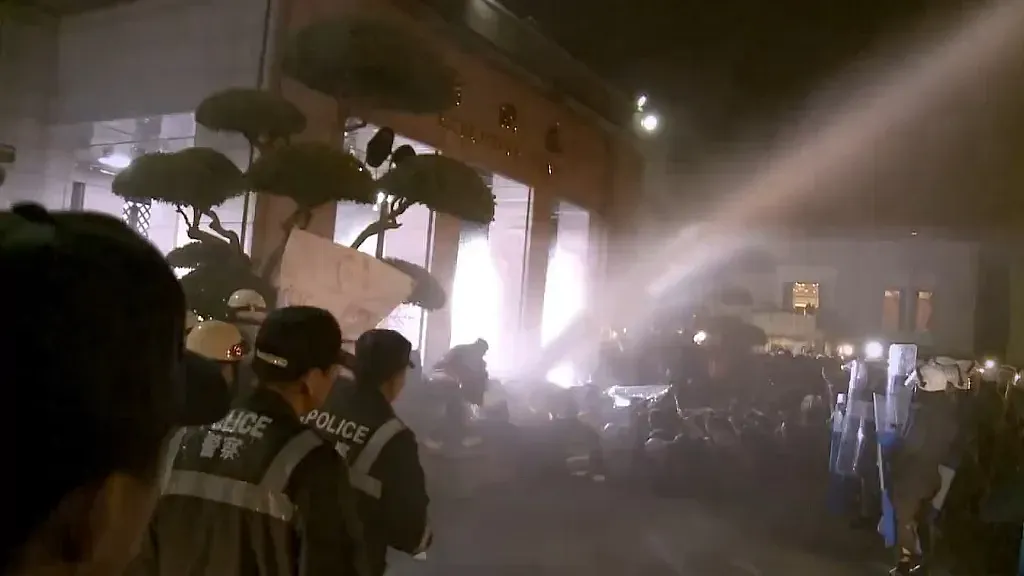
Regarding the March 24 Executive Yuan occupation and violent eviction incident, Taipei District Court Ruling 104-Su-Ken-(1)-Zi No. 1 dismissed the private prosecution filed by Chou Jung-tsung and 29 others accusing Ma Ying-jeou, Chiang Yi-huah, Wang Cho-chun, Fang Yang-ning, and others of attempted murder. The Voluntary Legal Team Against the Cross-Strait Trade Agreement in Secret believes that the court, without conducting concrete investigations and trials, directly concluded that the police's clearance and eviction actions on that day complied with the principle of proportionality and were not illegal. This is evidently a hasty judgment, and the legal team deeply regrets the ruling for the following reasons:
-
The judge assigned to this case never investigated the evidence submitted by the private prosecutors
Throughout years of proceedings in this case, the judge never investigated the various pieces of evidence submitted by the private prosecutors and the legal team. Investigation hearings were held months apart, repeatedly asking the same question: "Are you going to sue Ma Ying-jeou?" This highlights the judge's lack of intention to explore the facts of that night's state violence. When private prosecutors are unable to reconstruct the events of that night through the court's investigative procedures, holding specific individuals accountable is out of the question. This time and again demonstrates the court's passive attitude toward state lawlessness and its tacit approval of violence.
-
The eviction operation violated the principle of proportionality
The court held that the Executive Yuan is a restricted zone under the Assembly and Procession Act and that the eviction operation did not exceed statutory powers. The legal team considers this a ridiculous distortion of the regulations concerning restricted zones and of the requirement that police law enforcement must be bound by the principle of proportionality. Since citizens were peacefully assembling, the police should not have arbitrarily evicted them, and the use of violence can never be tolerated. Taking the 2015 Lin Ming-hui case, which was awarded state compensation, as an example, the court found that beating someone on the head with a baton simply because the crowd was unwilling to leave was clearly excessive and violated the principle of proportionality.
-
Fragmenting the chain of command is an exculpation of state violence
Since the majority of private prosecution cases filed against unidentified police officers have been dismissed by the courts, the court's ruling in this case that Ma Ying-jeou and others bear no responsibility for the violent eviction practically sets the tone that, starting from Chiang Yi-huah down to Wang Cho-chun and all police officers acting under the pressure of "clearing the area within a time limit," no one needs to bear criminal responsibility for the "violent eviction." This undoubtedly endorses state violence. The court's rash conclusion that the initiators at the front end did not request violent eviction, coupled with the inability to hold anyone accountable at the backend because the executors cannot be found, results in everyone hiding under the umbrella of division of labor, avoiding facing the fact that they are part of state violence.
In summary, the legal team deeply regrets the court's ruling. It not only fails to value the people's right to assembly and procession guaranteed by the Constitution, but also acknowledges that superiors need not bear responsibility for the mistakes of frontline personnel. Upon receiving the written ruling, the legal team will deliberate on an interlocutory appeal strategy. Furthermore, as there are still ongoing cases involving state compensation, Chou Ni-an's lawsuit against then-Taipei City Police Department Commissioner Huang Sheng-yung, and unidentified police officers, we expect the court to bravely shoulder its responsibility and put an end to state violence.
Press Contact
JRF Executive Director, Attorney Ch'en Yü-fan
JRF Legal Policy Researcher, Ho Yu-lun 02-25231178 #25
This article is an AI-generated translation of the original Chinese text. In the event of any discrepancy, the Chinese version shall prevail.