
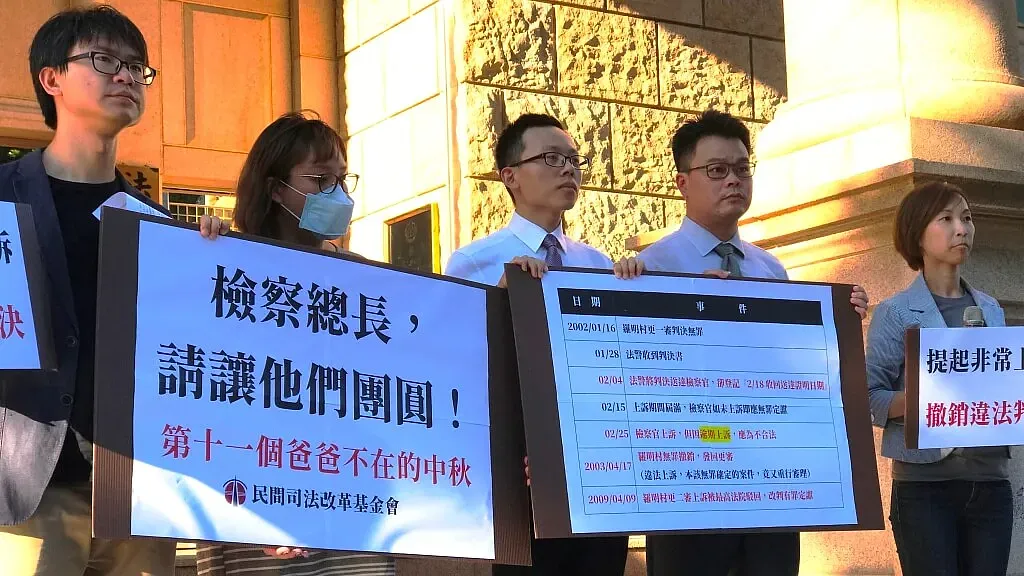
Prosecutor-General, Please Let Them Reunite—The 11th Mid-Autumn Festival Without Dad: Press Conference on the Lo Ming-ts'un Case
Last edited: 2026-07-27
In 1997, Lo Ming-ts'un, former head of the criminal investigation division of the Hsintien Police Precinct, was accused of taking bribes in breach of official duties. In the retrial of the first remand at the High Court, Lo Ming-ts'un was once acquitted. Although the prosecutor subsequently filed an appeal, it was an illegal "late appeal." However, the Supreme Court not only failed to spot this major flaw, but also revoked the acquittal and remanded the case for retrial, leading to Lo Ming-ts'un being sentenced to 13 years in prison. He had no choice but to flee overseas alone, separated from his family for over 10 years.
Proclaiming his innocence all along, Lo Ming-ts'un saw the retrial court summon the bailiff from back then to testify this August. The court determined that the prosecutor had appealed late, pointed out that relief should be sought through an "extraordinary appeal," and dismissed the motion for a retrial. Today (the 19th), the Judicial Reform Foundation, together with Mr. Lo Ming-ts'un's daughter, held a press conference in front of the Supreme Prosecutors Office, earnestly petitioning the Prosecutor-General to file an extraordinary appeal for Lo Ming-ts'un and to stop letting the wrongfully accused wander endlessly between the courts and prosecutors' offices without relief.
An Acquittal Killed by Judicial "Custom," Adding 16 Years to a Wrongful Conviction
According to the Code of Criminal Procedure, after receiving a court judgment, a prosecutor shall file an appeal within the statutory period of "10 days." In this case, the retrial court summoned the bailiff responsible for serving the judgment back then to testify. He stated that on February 4, 2002 (Monday), he served the judgment to Prosecutor Liu Ching-wan of the handling division. However, following "custom," the proof of service could only be retrieved from the prosecutor's office two weeks later. Therefore, the bailiff did not retrieve the proof of service until February 18, and the prosecutor filed an appeal against the acquittal on February 25.
Since the judgment was served on the prosecutor on February 4, under the law, the prosecutor should have filed an appeal by February 15 (originally February 14, but extended by one day due to the Lunar New Year holiday). However, the prosecutor in this case delayed filing the appeal until February 25, making it an unlawful appeal filed beyond the appeal period.
As for the "custom" mentioned by the witness bailiff, investigations by the retrial court revealed that it was actually an "agreement" reached under Proposal No. 1 of the 1st Business Coordination Meeting for Strengthening Operations between the High Court and the High Prosecutors Office in 1994. Its purpose was to avoid delaying the opportunity for private prosecutors and victims to request the prosecutor to appeal. Service to the prosecutor was postponed by 10 days compared to private prosecutors and victims, and following the bailiff's operational custom, the date of service to the prosecutor was calculated as the actual date of service plus 14 days (High Court Letter Yuan-Wen-Lien-Tzu No. 6812 dated June 2, 1994, and Proposal No. 1 of the 1st Business Coordination Meeting for Strengthening Operations between the High Court and High Prosecutors Office in 1994).
In this case, Lo Ming-ts'un, the other defendants, lawyers, and public defenders all received the judgment between January 30 and February 1, 2002. According to the witness bailiff, the judgment in this case was in fact delivered to the prosecutor's office as early as February 4, but due to the aforementioned custom, it became February 18 as the date of service to the prosecutor. Comparing the two, it is clear that this "custom" disguisedly extended the prosecutor's appeal period, giving them more than ten days longer to appeal than the defendant. This gravely violates legal provisions, lacks fairness, and infringes upon the defendant's right to litigation!
The courts and prosecutors formed a "custom" through an "agreement" in violation of the explicit provisions of the Code of Criminal Procedure, requiring the bailiff to fill in the date of service two weeks later after delivering the judgment to the prosecutor, and prohibiting them from retrieving the certificate of service until two weeks after serving the prosecutor. Such unfair practices caused Lo Ming-ts'un, whose acquittal had already been finalized, to be resentenced and convicted due to a late appeal. This vainly added 16 years of wrongful imprisonment to his life, and he continues to suffer from the torment of litigation to this day.
Divergences in Legal Interpretation Should Not Be Obstacles to Wrongful Conviction Relief
For years, Lo Ming-ts'un and his family have continuously proclaimed his innocence, petitioning the Prosecutor-General to file an "extraordinary appeal" as many as 49 times. Regarding the extraordinary appeal filed this year, the former Prosecutor-General also deemed the prosecutor's appeal to be lawful and rejected Lo Ming-ts'un's petition for an extraordinary appeal.
However, after the High Court held a retrial hearing and investigation at the end of August this year, it determined that the prosecutor had received the judgment on February 4 and had indeed appealed late. The finalized guilty judgment is flawed and should be void, meaning it cannot serve as the basis for a retrial, and Lo Ming-ts'un should seek relief through the "extraordinary appeal" procedure.
At this point in the case, due to differing legal opinions between the court and the Prosecutor-General, Lo Ming-ts'un has been wandering back and forth between the court and the prosecutors' office, locked out of the door to wrongful conviction redress with no way to enter. We earnestly implore the Prosecutor-General to file an extraordinary appeal for Lo Ming-ts'un, to provide an opportunity to overturn the unlawful finalized guilty judgment in Lo Ming-ts'un's case, to grant relief to the innocent, and to allow Lo Ming-ts'un, who is fleeing overseas alone, to return home soon and reunite with his family for the Mid-Autumn Festival.
Attending Representatives
Ms. Lo / Family member of the wrongful conviction defendant
Lin Chun-hung / Standing Executive Committee Member, Judicial Reform Foundation
Lo Hsi-hsiang / CEO, Taiwan Association for Innocence
Lin Fu-hao / Pro Bono Lawyer, Rescue Division, Judicial Reform Foundation
Chen Yü-fan / CEO, Judicial Reform Foundation
Press Contact
Chen Yü-fan, CEO, Judicial Reform Foundation (02)2523-1178
Appendix—Simple Chronology
| Date | Event |
| 2002/01/16 | Lo Ming-ts'un acquitted in the first remand retrial |
| 2002/01/28 | Bailiff receives the written judgment |
| 2002/02/04 | Bailiff serves the judgment to the prosecutor, but records "2/18 as the date of retrieving proof of service" |
| 2002/02/15 | Expiration of the appeal period; if the prosecutor has not appealed, the acquittal should be finalized |
| 2002/02/25 | Prosecutor appeals, but because it is a late appeal, it should be deemed unlawful |
| 2003/04/17 | Lo Ming-ts'un's acquittal revoked and remanded for retrial (Due to an unlawful appeal, a case that should have had a finalized acquittal was subjected to retrial again) |
| 2009/04/09 | Lo Ming-ts'un's appeal in the second remand retrial dismissed by the Supreme Court, changing the verdict to a finalized conviction |


This article is an AI-generated translation of the original Chinese text. In the event of any discrepancy, the Chinese version shall prevail.