
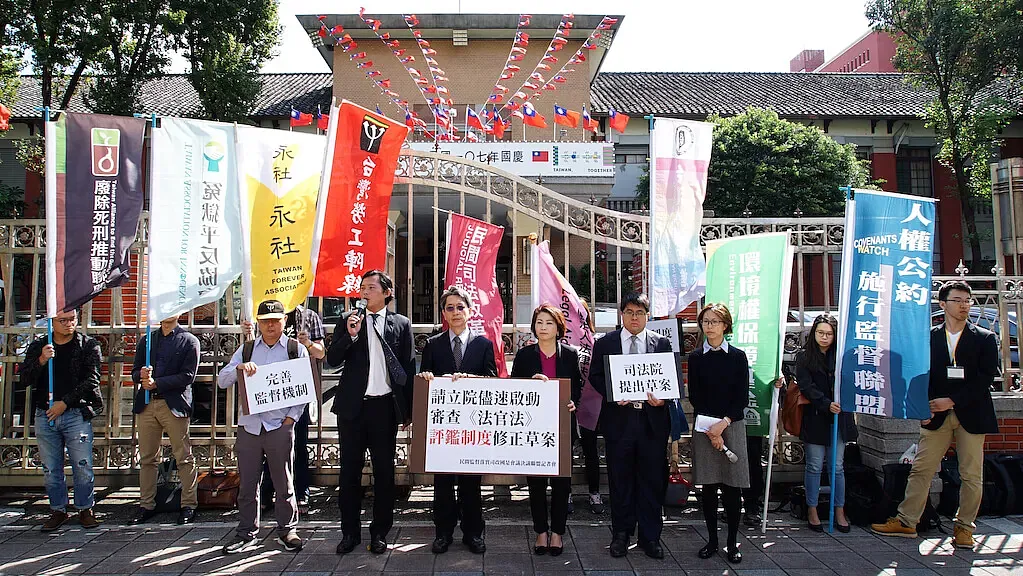
Press Conference Urging the Legislative Yuan to Promptly Initiate Review of Amendments to the Judges Act Evaluation System
Last edited: 2026-07-27
 Photo / From left to right: Legislator Huang Kuo-ch'ang, Attorney Lin Yung-sung, and Legislator Chou Ch'un-mi
Although the Judges Act has been in force for over six years since 2011, news regarding incompetent judges and prosecutors continues to emerge endlessly. Taking 2018 as an example, there were cases involving sexual harassment by judges, taking unauthorized leaves for sex work, inappropriate contact with parties to litigation, and fraudulently claiming overtime pay. As for prosecutors, the incident involving a Hualien prosecutor trespassing at a kindergarten shocked the entire nation, highlighting the urgency of reforming the oversight mechanisms for judges and prosecutors. Although the Judicial Yuan has promised to amend the "evaluation system" therein, it has yet to submit the draft to the Legislative Yuan for review, and it remains unclear how much longer this will be delayed. Today, the Civil Alliance for Monitoring and Implementing the Resolutions of the National Judicial Reform Conference held a press conference in front of the Legislative Yuan, urging legislators to heed the public's earnest expectations for weeding out incompetent judges and prosecutors, to promptly review the draft amendments to the Judges Act during this legislative session, and to prevent technical issues from delaying the reform schedule.
-
The Necessity and Urgency of Amending the Evaluation System under the Judges Act
Aside from the aforementioned individual incidents involving incompetent judges and prosecutors, the current "individual case evaluation system" has proven ineffective. Over the span of more than six years (January 2012 to July 2017/07), the Judges Evaluation Commission accepted only 61 cases. Among the 53 cases already concluded, evaluations were substantiated in 21 cases, yielding a substantiation rate of 39%. As for the Prosecutors Evaluation Commission, while the number of received cases was not made public, among the 50 concluded cases, evaluations were substantiated in 13 cases, resulting in a rate of 26%. Regarding the "comprehensive review" conducted twice, because the results were not made public, the outside world only knows that no judges or prosecutors were referred for individual case evaluation, and how poorly performing judges and prosecutors are dealt with remains unknown.
In response to this, the National Judicial Reform Conference proposed numerous amendment suggestions. For instance, increasing the number of external members on the evaluation commissions, with sources striving for diversity and heterogeneity. In fact, civil society organizations once held a press conference regarding the evaluation commission's resolutions lacking gender awareness, hoping that the future composition of the evaluation commission would enhance its diversity and heterogeneity, transforming the current legal-professional-dominated status quo, and comprehensively evaluating the suitability of judges and prosecutors through diverse viewpoints and non-traditional perspectives.
Furthermore, under current law, the statute of limitations for initiating prosecutor evaluations is too short, frequently resulting in citizens discovering that the time limit has expired when they attempt to request a prosecutor evaluation after the conclusion of a trial; the National Judicial Reform Conference also recommended extending this period. Moreover, allowing citizens to request evaluations is a shared demand of the Conference resolutions and civil society, and the Judicial Yuan does not oppose it. Unfortunately, the aforementioned amendments cannot make it to congressional review, and the reform of the evaluation system can be said to be still walking in a dark tunnel with no exit in sight.
-
Gaps Still Exist Between the Judicial Yuan's Draft and the National Judicial Reform Conference Resolutions
In addition to the slow legislative progress, the content of the draft announced by the Judicial Yuan on July 20 this year also contains many provisions that fail to conform to the spirit of the National Judicial Reform Conference resolutions. For example, under the current system, those deemed by the evaluation commission to be subject to disciplinary action must still undergo review by the Control Yuan before advancing to the Disciplinary Court for trial. Because the procedure is overly protracted, the National Judicial Reform Conference resolved that those subject to disciplinary action should be directly referred to the Disciplinary Court without going through the Control Yuan. However, the Judicial Yuan's draft did not adopt this resolution, merely revising the Disciplinary Court from a single-tier single-instance system to a single-tier two-instance system, without resolving the protracted nature of the preliminary procedures. In truth, different systemic proposals inherently require congressional discussion and review, but if such discussions are never initiated, there is no way to debate them, let alone complete institutional reform.
-
Authorities Should Reference Civil Society's Reform Proposals
In addition to the aforementioned issues of limitations periods and the simplification of the evaluation system, the Legislative Yuan is also urged to reference civil society recommendations in carrying out legislative amendments. These include shifting the comprehensive evaluations currently administered by the Judicial Yuan and the Ministry of Justice over to the evaluation commission, and reasonably and moderately publicizing the results to help build a trustworthy judicial system. Additionally, to cope with the institutional reform of citizens directly initiating evaluations, full-time evaluation commissioners and dedicated staff should be added to provide the evaluation commission with resources to properly handle evaluation cases. Moreover, under circumstances where the government is actively deliberating a system of citizen participation in trials, citizen judges should be allowed to participate in Disciplinary Court trials to eliminate current public doubts regarding judicial protectionism within the Disciplinary Court.
Weed-out of incompetent judges and prosecutors has always been the judicial reform item of utmost concern to the public. If this problem is not resolved, incompetent judges and prosecutors will continue to gnaw away at the credibility of the judiciary from the shadows, which is all the more unfair to dedicated and conscientious judges and prosecutors. Therefore, the Alliance urges Congress to promptly schedule bills for review during this session to keep the progress of judicial reform moving forward.
Participating Groups / Representatives
Legislator / Chou Ch'un-mi
Legislator / Huang Kuo-ch'ang
Taipei Society Vice Chairperson / Attorney Huang Ti-ying
Taiwan Association for Human Rights / Director Yen Szu-yu
Taiwan Association for Innocence / Executive Director Lo Shih-hsiang
Taiwan Labor Front / Secretary-General Sun Yu-lien
Taiwan Alliance to End the Death Penalty / Director Lin Tzu-wei
Legal Aid Foundation / Attorney Chang Ching-pej
Environmental Jurists Association / Researcher Fan Chih-tien
Garden of Hope Foundation / Executive Director Chi Hui-jung
Judicial Reform Foundation / Chairperson Attorney Lin Yung-sung
Judicial Reform Foundation / Executive Director Attorney Ch'en Yü-fan
Press Contact
Judicial Reform Foundation, Executive Director Ch'en Yü-fan 02-2523-1178
This article is an AI-generated translation of the original Chinese text. In the event of any discrepancy, the Chinese version shall prevail.