
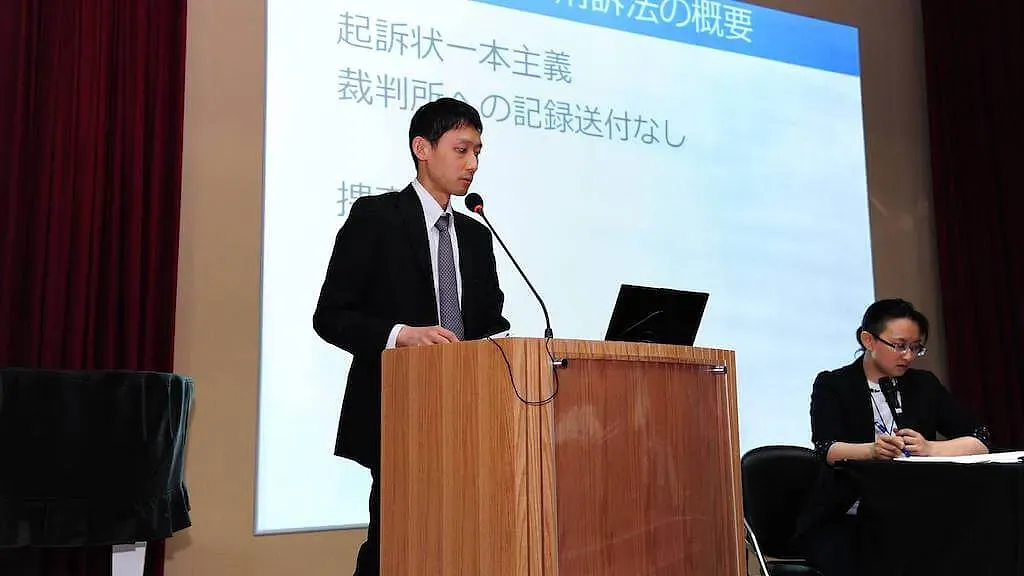
The Rules and Practice of Evidence Disclosure in Japan (Part 2) Practical Responses — Attorney Yamamoto Takanobu
Last edited: 2026-07-27
Editor's Note: The JRF held the "International Symposium on the Lay Participation Trial System - Evidence Disclosure" this year (2018). One of the keynote speakers was Attorney Yamamoto Takanobu of Japan, who is one of the drafters of the Japan Federation of Bar Associations' "Guidelines for Retrial Evidence Disclosure." This article summarizes Attorney Yamamoto's presentation at the symposium, divided into two parts: system introduction and practical responses, to help everyone understand the norms and practices of Japan's evidence disclosure system.
This article explains how Japanese defense attorneys navigate the current, imperfect system. It discusses how attorneys can request evidence disclosure even when they do not know what evidence exists.
The Dilemma of Japanese Attorneys
In Japan, failing to handle evidence disclosure properly is a trouble for many attorneys. The biggest problem is that we must request specific evidence without knowing what kind of evidence exists. The concerning issues are as follows:
- What kind of evidence generally exists?
- What kind of evidence exists in that specific case?
- After knowing what kind of evidence might exist, is that evidence useful?
Upon taking a case, we first assess what evidence typically exists and what evidence might exist in this particular case, guess whether "such evidence" would help the case's defense, request all these possibilities, and embark on a guessing-game-like evidence disclosure request.
Taking an injury case as an example, upon seeing the prosecutor's request for evidence stating "the victim claims to have been injured," if the defense attorney wishes to contest it, we will request the "victim's statement protocol regarding the injury condition." Assuming that at the crime scene, "the victim and the defendant had some conversation in the store," we would guess at the clues that might exist in the store and request related evidence, such as "the victim's statement protocol on the store's condition," "statement protocols of other people in the store," "if there is a surveillance camera in the store, the photo-taking report of the equipment," and so on. Next, guessing whether the victim went to the hospital, we would request the "victim's medical examination protocol and medical records during the hospital visit." We request whatever evidence comes to mind, think about it after receiving the evidence from the prosecutor, and then make another request, continuing this constant back-and-forth.
Japanese attorneys proceed in this vague manner, and this process results in numerous omissions. In the example given above, I might only obtain a fraction of the victim's statement protocols because, without making a request, I would not receive the "store's on-site inspection protocol," the "physician's statement protocol," and the "clothing worn by the victim at the time of the victimization," missing a lot of evidence. Moreover, these missed pieces of evidence, such as the "store's on-site inspection protocol" and the "physician's statement protocol," are not trivial pieces of evidence, but foundational and important ones. Furthermore, because we request whatever comes to mind and go back and forth making numerous requests, attorneys often lose track of what they have actually requested. This process generates many omissions. In the end, the defendant is the one who suffers the disadvantage, and this situation is extremely common in Japan.
Methodology of Evidence Disclosure
When I first started practicing as an attorney, I often made such omissions and found no good solutions when asking senior colleagues. The law firm I work for is very famous in the Japanese criminal law community, but even in such a firm, there was still no solution. Therefore, I began to ponder the methodology of evidence disclosure, shared it with the attorneys around me, conducted training sessions, and gradually established the methodology. Currently, it is great that Taiwan can view all records without using this method, but if Taiwan were to truly adopt Japan's evidence disclosure system, I offer this "evidence disclosure methodology" to you all.
Table 1 Facts Intended to be Proved
- In the hospital, there are Room 301, Room 302, Room 303, and the nurse's office.
- The hospitalized patients in Room 303 include the victim, A, B, and C (nurse in charge a).
- A and C are in hospital beds. The victim is sitting in a wheelchair.
| Category | Content | Possible Evidence |
| Person | Nurse a Victim A, B, C |
Statement protocol of nurse α, etc. Victim's statement protocol, etc. Statement protocols of A, B, C, etc. |
| Place | Rooms 301, 302, 303 Nurse's office |
On-site inspection protocols for 301, 302, 303, etc. On-site inspection protocol for nurse's office, etc. |
| Thing | Hospital bed Wheelchair |
Photo-taking report of the hospital bed, etc. Photo-taking report of the wheelchair, etc. |
First, "not knowing what kind of evidence exists" is the biggest problem. Let us conduct a simple "finding evidence" experiment. Table 1 shows the facts intended to be proved by the prosecutor. Can we find the evidence to be disclosed by looking only at these facts intended to be proved? Please try to find them. In these facts intended to be proved, we try to find persons, places, and things. The results are shown in Table 2: "Persons" include the nurse, the victim, and A, B, and C; "Places" include Rooms 301, 302, 303, and the nurse's office; "Things" include the hospital bed and the wheelchair.
Next, from "persons, places, and things," we try to derive evidence. The "person" part may have "statement protocols of the nurse, the victim, A, B, and C" (in Japan, a "statement protocol" includes three things: 1. things written down by the person themselves, 2. things recorded from a third party hearing the speaker's words, 3. audio and video recordings of the aforementioned two items). The "place" may have "on-site inspection protocols for rooms 301, 302, 303, and the nurse's office." The "thing" can bring to mind "photo-taking report certificates of the hospital bed, photo-taking report certificates of the wheelchair," and so on. Matching "persons, places, and things" with "types of evidence" and applying this rule can yield a very broad scope of evidence and find the evidence to be disclosed.
Rule 1: All evidence is linked to "persons / places / things"
Rule 2: "Persons / places / things" × "Types of evidence" can uncover specific evidence
Limits of Evidence Disclosure
There are four limits to evidence disclosure:
 Figure 1 Working Process
- Not knowing what kind of evidence exists
- Knowing the title but unable to see the content of the evidence
- It takes some time to realize whether this evidence is ultimately favorable or valuable
- Once the pre-trial proceedings are over, requests can no longer be made
We find methods starting from these four limits. Because we do not know the evidence, we must not hold preconceptions or presuppose whether the evidence is useful or not; instead, we must hold the mindset of encompassing a certain range of evidence. First determine a scope, and absolutely make sure no omissions occur within this scope. Briefly explaining the working process (Figure 1): find the evidence, determine the scope to be disclosed, create "identification matters" to complete the evidence disclosure request form, then check the prosecutor's response, and make the next request. What must be kept in mind during the process is that—the request is only a part of the whole.
Five Methods for Finding Evidence
| Category | Content |
| Persons / Places / Things | Facts intended to be proved, evidence |
| Extended Thinking | Deriving from "persons / places / things" Search evidence checklist |
| Following the Vine to Find the Melon / Catalog | Citations within evidence Seized property catalog |
| Imagine the Investigation Process | Investigation timeline Imagine the police's actions |
| Administrative Regulations | Various official rulings and rules |
Introducing five methods for finding evidence: First and most importantly, using the prosecutor's facts intended to be proved and the evidence requested by the prosecutor as clues, as introduced earlier, list out all "persons, places, and things" without any omissions, and find the most important evidence from them. Moreover, "persons, places, and things" will appear consecutively; make good use of imagination. For example: when someone calls the police, what figures will appear? There should also be the police officer who received the report. Exercising imagination in this way finds more roles. To give another example, when knowing that police officers are at the scene, what persons, places, and things are related to "police officers at the scene"? Photographs must have been taken, right? Therefore, the evidence might include "photographs." Continuing to imagine, this is a crime-investigation scene, so there might be appraisals, leading to an "appraiser." Just like this, imagine one after another to find more persons, places, and things.
 Figure 2 Extended Thinking to Find Evidence
Next, introducing the method of extended thinking: rearranging and combining "persons, places, and things" and then extending them can lead to finding more evidence. Taking statement evidence as an example, in Japanese practice, police officers taking statements from an interviewees usually take notes while questioning. The act of "interrogation" produces "notes," sometimes with audio or video recordings, and police will make an "investigation report" based on their own notes, and then produce a "statement protocol" based on the investigation report. Inspection protocols are similarly evidence derived from other evidence. In addition, there is another type of document, which is a new document compiled from all written materials, such as police data collating why an interviewee changed their story. Physical evidence can also use the same line of thinking. After obtaining physical evidence, the police will have photographs, documents, and send it for appraisal. With an appraiser, an appraisal report will be obtained, and based on the results of the appraisal report, new documents may be produced, or questions may be asked of the appraiser to obtain a response from the appraiser. These are all derived from the original evidence.
"Following the vine to find the melon" is also an auxiliary method. For instance, some evidence cites other evidence; for example, a statement protocol cites text from a certain investigation report, making one aware of that investigation report. Alternatively, there are cataloged written materials, such as search and seizure protocols listing catalogs of seized property, thereby revealing what physical evidence exists. Next, introducing the method of "imagining the investigation process": imagine a story starring police officers, how the police conducted the investigation, what evidence was produced, when, where, and what was done, and an investigation timeline can be constructed based on this.
The final item is "utilizing administrative regulations," which will be explained in detail later.
Omnibus Type and Issue Type
 Figure 3 Working Scene
When searching for evidence, there are two ways of thinking: the omnibus type and the issue type. The "omnibus type" extends and develops from persons, places, and things to search for evidence, without considering legal issues or the defendant's arguments, searching for evidence in a more objective manner with as few omissions as possible. The "issue type" considers what is to be contested right from the start, searching for evidence in places where there are disputes and doubts. Both ways of thinking are necessary. Using the omnibus type can eliminate many omissions, but the omnibus type often fails to find trivial pieces of evidence. To find these trivial pieces of evidence, one still needs to think about what the legal issues are. Therefore, combining both approaches is the best method: use the omnibus type to maintain a broad horizon and eliminate loopholes, and use the issue type to dig deep.
The photo in Figure 3 was taken when I was working on finding evidence for a case. On the left is the prosecutor's fact-finding statement, and on the right are my notes, where I wrote down persons, places, and things, and used lines to indicate the things that were derived and connected.
Recording Identification Matters
 Figure 4 Making Identification Matters
After finding the scope of evidence to be requested, the next step is to make "identification matters." The scope of evidence requested is the yellow-circled portion in Figure 4, which is illustrated below with practical examples.
Japan often has writing styles like Example 1, but this style of writing actually has problems. The problem lies in the fact that the literal meaning of "the situation of the defendant beating the victim" narrows the scope of evidence. For instance, "the situation after witness W left the scene," "records of moving to the crime scene," "W was at the scene, but the beating situation was not written down," or other site simulations of different scenarios—these might all fail to be disclosed because they are not covered. So what do we truly want? What we should want is "all of W's statement protocols."}
Example 1 Common Writing Style
Regarding the situation of the defendant beating the victim, the on-site simulation inspection protocol witnessed and observed by witness W.
Example 2 Improved Practical Example
- W's statement protocols, etc.
- On-site inspection protocols containing W's statements, etc.
- Investigation reports containing statements regarding W, etc.
Example 2 is likely to encompass all written materials that would appear regarding W's statements. A very important principle: do not place restrictions on the content, as this narrows the scope of disclosure. Although "beating" is a key issue, do not easily write it into the text; carefully think about what evidence is truly needed, and then utilize the appropriate wording.
 Figure 5 Improved Approach
 Figure 6 Practical Example Using the Superordinate Concept of "Person"
Referring to the improved thinking approach in Figure 5, do not restrict the scenario, but directly set the scope as "all statements of W." Similarly, if you want to understand the inspection conditions of scene A, set the scope as "all inspection protocols of scene A." In addition, since Japan has a large number of documents, if I write "regarding W's statements, statement protocols, protocols before the judge, victim's report of victimization, case inquiry reports, telephone inquiry reports, opinion letters authored by W, statements, etc.," I might miss listing "audio and video recordings of W's statements, on-site simulation inspections of W's statements." Therefore, the writing method of Example 2 is the best.
To summarize, referring to the top two items on the left side of Figure 6, "document contents and audio/video recordings" can both be covered by "W's statement protocols, etc.," while "case investigation-related materials" can also be covered by "investigation reports recording statements, etc." Use the superordinate concepts of "persons / places / things" introduced earlier to properly arrange and combine them, making correct distinctions.
※Trivial names are marked with "(including XX)"}
The key point here is not to rely on bullet points. If bullet points are used to list items one by one, it creates the illusion that "a lot of evidence has been requested," but in fact, listing more does not mean there are no omissions. No matter how many bullet-point items are added, it is difficult to encompass all evidence, and listing them one by one makes it easy to lose track of what evidence has already been requested, resulting in omissions. If you distinguish the scope of requests using the method introduced earlier, you can clearly know that what is within the scope has been requested, and what is outside the scope has not yet been requested. I also remind everyone that the first disclosure request is extremely important and the "omnibus type" method should be used to make requests for the maximum possible scope. In current Japanese practice, 80% of the evidence can be obtained during the first request; after the second request, the "issue type" method can then be used to uncover trivial materials.
Example 1 mentioned earlier is a case I actually handled in the past. At that time, I requested category evidence disclosure 6 times and claimed-related evidence requests twice. Despite making so many requests, I still missed a lot of evidence, and the missed evidence consisted of very important and foundational on-site inspection protocols. Looking back, I made many mistakes back then; I first thought about the issues to be contested right at the beginning instead of first using the omnibus type to make the maximum range of requests, continuously making issue-type requests instead, and ultimately losing track of what I had requested. In later cases, I used this method, requesting category evidence twice, and then requesting claim-related evidence disclosure twice to obtain the parts not acquired during the category request. Overall, I obtained 95% of the evidence during the category evidence request, and by the end of the trial, there were no issues of insufficient evidence. Of course, this is also related to the prosecutors, as different prosecutors may yield different results.
The Function of "Claim-Related"
Claim-related evidence disclosure requests are an auxiliary tool. Based on my practical experience, claim-related evidence accounts for only about 10% of the volume. Therefore, the maximum scope must be acquired during the category evidence disclosure stage.
Summary
The above is a sharing of practical experience regarding Japan's evidence disclosure system. However, the content that can be conveyed through a lecture is quite limited. The main target audience of this lecture is attorneys, so I provide the handouts for the "Seven Rules of Evidence Disclosure," which were completed in February of this year (2018). The handouts record the key points of evidence disclosure and provide practical cases (p. 41) for your reference. Page 43 of the handout lists data derived from "persons / places / things," which can help us search for more trivial evidence.
Now let us look back at the worries of Japanese attorneys raised at the beginning:
- What kind of evidence generally exists?
What kind of evidence exists in that specific case?After knowing what kind of evidence might exist, is that evidence useful?
You can find that the second and third worries are unnecessary. The second can be found by rearranging and combining "persons / places / things," and trivial evidence can be pondered and requested after receiving some of it. Meanwhile, the third point must actually not be considered; one must first see the content of the evidence before making a judgment.
Utilizing Administrative Regulations
 Figure 7 Document Header of "On-Site Inspection Protocol"
Prosecutors and police handle cases with many internal administrative documents and materials. In Japan, the "Information Disclosure Act" can be used to obtain some of these administrative materials. Figure 7 shows the document header of an "on-site inspection protocol." Please look at the circled note on the upper left, which reads "Form No. 46 (Article 197 of the Code of Criminal Procedure)." At first, other Japanese attorneys and I did not understand what this meant when we saw it, until one day, while reading a book published for police in a bookstore within the Osaka Prosecutors Office, I learned of the existence of the "Basic Form Examples for Judicial Police Officers' Investigation Documents," and thus I came to know that "Form No. 46" was the numbering of an internal official ruling. Because I was interested in this, I tried requesting disclosure under the "Information Disclosure Act" and successfully obtained the sample formats for these administrative documents.
This administrative document sample collection published by the Supreme Public Prosecutors Office organizes over 50 types of investigation document templates, including common and uncommon format templates. Aside from containing common on-site inspection protocols, it even has document formats we have never seen before. Because Japan does not have dossier-transmittal, many internal administrative documents have never been seen by us. With this information, we can know what happened in the prosecutor's office, police department, and detention center.
When is this information useful? It is extremely helpful when we want to make requests to administrative agencies. Not only that, but it is also very helpful for evidence disclosure. Since then, I have regularly requested disclosure under the "Information Disclosure Act," and from 2011 to the present, I have obtained approximately 700 document templates, scanned them into PDF files, and established a database for management to facilitate use (so far, no practitioners or researchers in Japan have systematically collected these).
The administrative documents I have obtained can be roughly divided into the following types: official rulings, rules, regulations, format sample collections, and practical manuals. "Official rulings, rules, and regulations" have differences in names due to different agencies, but these are all internal rules of administrative agencies. "Format sample collections" were introduced earlier, and "practical manuals" record the practices of administrative personnel; for example, the
Having these administrative documents allows one to understand the internal operations of administrative agencies and query them when needed. Moreover, because the formats and examples of various documents are known, when applying for evidence disclosure, especially when requesting "claim-related evidence," because the requested evidence is more trivial, it is necessary to know the name of the document, making this extremely helpful. In addition, I suspect that even in a system like Taiwan's dossier-transmittal, some things such as police internal management records or internal documents would not be in the dossier. At that time, having these administrative document materials could be an effective tool.
Views on Taiwan's Introduction of Three-Stage Disclosure
I believe that Taiwan's introduction of "three-stage disclosure" is completely unnecessary. The background when Japan introduced three-stage disclosure was under the circumstances of the 1969 ruling mentioned in the previous article, where the scope of evidence disclosure in Japan at that time was extremely narrow—an abnormal situation. Under such an abnormal state in Japan, the introduction of three-stage disclosure brought progress. But for Taiwan, Taiwan already has dossier-transmittal; you can originally see all evidence sent to the court, and there is no need to turn back the clock.
In addition, after reading some materials from Taiwan, I found that if Taiwan introduces three-stage disclosure, there may be constitutional violation issues. Taiwan's Constitution stipulates the principle of due process of law. When people may suffer disadvantages due to the state, sufficient information must be provided to allow people to exercise reasonable and effective defense and advocacy, which is a requirement of the Constitution. In the "Code of Criminal Procedure," this is materialized by "allowing the defendant to inspect evidence." Thus, the focal points are "when to provide evidence for inspection?" and "what scope of evidence to provide?">
I read Taiwan's Grand Justices' Interpretations Nos. 737 and 762. According to my understanding, following Interpretation No. 737, during the detention interrogation proceedings, Taiwan must allow the defense counsel to view all evidence. Although there is a scope for classified documents, this cannot be used as the basis for detention. And Interpretation No. 762 further allows the defendant to also view all evidence under the premise that the defense counsel can view all evidence. If relying on these two Grand Justices' Interpretations, the defendant should be able to view all evidence, and be able to view it while detained. Meanwhile, under Taiwan's current "Code of Criminal Procedure," in principle, all evidence can be inspected after prosecution. Under such circumstances, does introducing a new bill for three-stage disclosure meet these requirements?
In terms of the reality of Japanese evidence disclosure practice, if prosecutors possess 100 items of evidence, the scope requested by prosecutors for disclosure in the first stage is less than 10 items; in the second stage (category evidence disclosure), depending on the attorney's ability, roughly 30 to 40 items can be obtained; in the third stage (claim-related evidence disclosure), about 10 items or so are obtained. Walking through the entire evidence disclosure procedure, an attorney can only obtain half of the evidence. Even a very diligent and hardworking attorney who spends a lot of time can only obtain 80% of the evidence at most, and it is almost impossible to reach 100%.
Furthermore, there is the issue of when the evidence is obtained. Requests, back-and-forth exchanges, discussions by attorneys, and re-requests for evidence disclosure in Japan all require a significant amount of time. An ordinary case takes 3 months, and major cases require over a year. Spending so much time yields only a portion; these unobtained or untimely obtained evidence items cannot be used for defense preparation. For instance, if the evidence contains information related to the defendant's alibi, but the attorney only sees it half a year after prosecution, then perhaps the store's surveillance footage originally existed, but when searched for after half a year, the store often no longer retains it. Such problems may occur when the disclosure time is prolonged. Viewed from this perspective, three-stage disclosure contradicts Taiwan's Grand Justices' Interpretation No. 762.
If Taiwan truly introduces this system, the pessimistic scenario is that when prosecutors find that non-disclosure is advantageous to themselves, they may choose not to disclose. In the post-war period, during the early stage when Japan changed the dossier-transmittal system, Japanese attorneys could still view all evidence for a period of time, but afterwards, prosecutors gradually changed their practices. The possible reason is that prosecutors gradually realized that non-disclosure of evidence was more advantageous to themselves.
In addition, if prosecutors can choose whether or not to disclose, it also shows that prosecutors' influence over the judgment results increases. Originally, the court judged whether the prosecutor's prosecution was correct—guilty meant the prosecutor's prosecution was right, and not guilty meant the prosecutor's prosecution was wrong. However, as long as prosecutors hide evidence favorable to the defendant and refuse disclosure without facing criticism, the judgment results tend toward guilt; the more they refuse disclosure, the easier it is to get a guilty verdict. This creates a paradoxical phenomenon: prosecution almost equals guilt, as if indicating that prosecutors' prosecutions are all correct judgments. But in reality, because evidence is hidden, it forms a cycle of "prosecutor refuses disclosure → judgment tends toward guilt → prosecutor's prosecution is correct." Without evidence disclosure, there is no acquittal. I believe that the reason evidence disclosure in Japan has become so difficult is precisely because of this chain.
In Japan, prosecutors would say, "Collecting evidence is the responsibility of the parties; why do we need to disclose it?" and "Because it is an adversarial system, disclosure is unnecessary." I believe this is a problematic statement. When a case occurs, prosecutors conduct investigations at the crime scene and seize evidence such as DNA, but this evidence is then regarded as evidence collected by the prosecutor's side, so it does not need to be given to the attorney. In reality, it is merely because the prosecutors contacted the case a step earlier than the attorney, yet the evidence seized at the crime scene is monopolized by the prosecutors.
Do not be influenced by the phrase "collecting evidence is the responsibility of the parties." Japan has long used "adversarial system" as an evasion, but the party undertaking the defense inherently needs to obtain evidence. Before the introduction of the principle of single-charge-sheet, Taiwan currently goes to court to view evidence. If the principle of single-charge-sheet is introduced, because evidence will not be sent to the court, the attorney would view evidence at the prosecutor's office. The key point is that a defense requires materials; Taiwan originally could view the entire dossier, yet wants to narrow the scope of inspection simply due to the introduction of the principle of single-charge-sheet, which is unreasonable.
Attachments
Lecture Slides "Practical Techniques of Evidence Disclosure in Japan" by Yamamoto Takanobu
This article is an AI-generated translation of the original Chinese text. In the event of any discrepancy, the Chinese version shall prevail.