
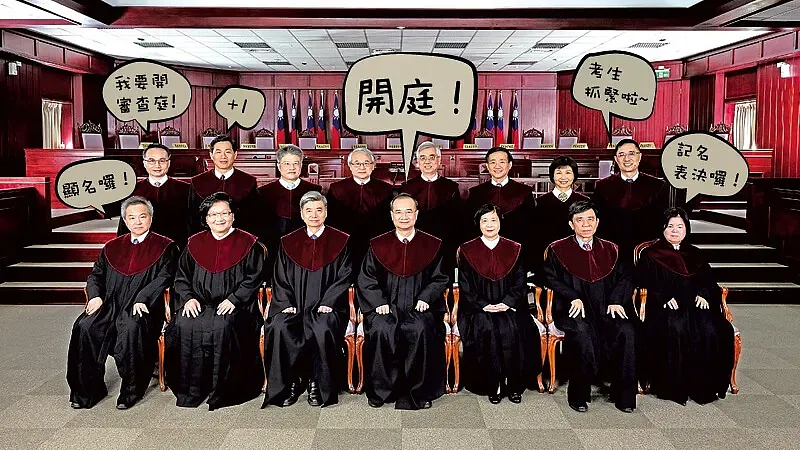
Justices, It's Time for a Hearing! The Constitutional Court Procedure Act Passes Third Reading!
Last edited: 2026-11-03
Photo Source / Grand Justices, Judicial Yuan
The draft Constitutional Court Procedure Act (current law: Constitutional Interpretation Procedure Act) passed its third reading in the Legislative Yuan today (12/18) and will take effect three years after promulgation by the President. In addition to lowering the threshold for legislators to file a petition from one-third to one-quarter, the draft highlights three major changes: the introduction of the system of constitutional review of judicial decisions, the establishment of review panels with a lowered concurrence threshold, and the disclosure of the authoring Justice and voting records.
-
Introduction of the "System of Constitutional Review of Judicial Decisions"
In the past, petitions by citizens for constitutional interpretation were limited to whether the laws applied in a specific case were unconstitutional. That is to say, if the law applied in a judicial decision was not unconstitutional in itself, but the judge's interpretation or application of the law conflicted with constitutional values, the Grand Justices were unable to address the matter under the then-current Constitutional Interpretation Procedure Act, creating a loophole in the protection of human rights. For example, in the judgment of the eleventh retrial of the Ch'i Ho-shun (邱和順) case by the High Court, it was stated: "The disadvantage of the loss of evidence should not be borne by the victim and their family members," which clearly violates the presumption of innocence guaranteed under the right to judicial remedy and due process of law. Another example is informal housing settlements on state-owned land (commonly known as illegal constructions): when a judge orders parties to demolish houses and return the land pursuant to Article 767 of the Civil Code, there are concerns as to whether the judgment conflicts with the constitutional protection of the right to housing.
To remedy this situation, the system of constitutional review of judicial decisions was born. The new law provides that, in addition to petitioning for an interpretation based on the unconstitutionality of the laws applied in the original judgment, the judgment itself may also become the object of interpretation. Beyond safeguarding human rights, the importance of the system of constitutional review of judicial decisions lies in realizing constitutional spirit within lower courts, urging judges to interpret and apply laws in specific cases in accordance with the Constitution.
JRF CommentaryThe constitutional review of judicial decisions is generally not retroactive, meaning that cases arising prior to the law's entry into force still cannot be submitted for constitutional review of judicial decisions. Many wrongful conviction cases, such as that of Ch'i Ho-shun, continue to suffer from unconstitutional judgments infringing upon people's fundamental rights to this day due to the lack of this system. This is indeed a regrettable shortcoming of the current legislative amendment.
-
Efficiency-Enhancing Review Panels and Concurrence Thresholds
Whether to accept a citizen's petition for constitutional review will first be decided by a review panel composed of three Grand Justices through a unanimous decision, eliminating the need for all 15 Grand Justices to decide every single case. Furthermore, the threshold for Grand Justices to rule on the unconstitutionality of a law after deliberation has been lowered from two-thirds to a simple majority, preventing deadlocks where a judgment cannot be rendered.
JRF CommentaryThere is only one Constitutional Court nationwide, and citizens waiting for a final decision face timelines ranging from one to two years on the short end to four to five years on the long end. Therefore, establishing a review panel mechanism for the prompt screening of cases is necessary to allow the Constitutional Court to function effectively. Moreover, the previous two-thirds concurrence threshold often resulted in deadlocks because neither the pro-constitutionality nor the unconstitutionality positions reached the threshold. The passage of the draft will enable judgments to be rendered more smoothly, enhancing the efficiency of the Constitutional Court.
-
Authoring Justice and Transparent Roll-Call Voting
The draft stipulates that judgments must indicate the name of the authoring Justice and record the names of the Justices who voted in agreement or disagreement with the holding, making judgments more open and transparent.
JRF CommentaryCurrently, the authoring Justice is not publicly named, which means every single sentence in the legal reasoning must be subjected to a vote, resulting in disjointed argumentation and internal inconsistency. In the future, requiring explicit naming will preserve the integrity of the reasoning, and paired with recording the names of concurring and dissenting Justices, it will allow the public to understand each Justice's opinion and the degree of support the holding received from other Justices.
This article is an AI-generated translation of the original Chinese text. In the event of any discrepancy, the Chinese version shall prevail.