
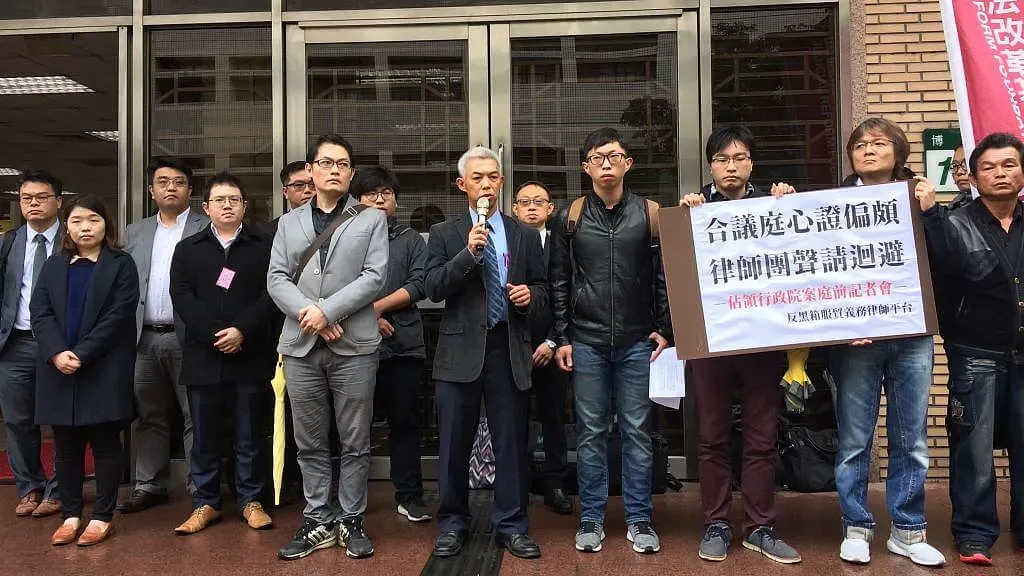
Panel of Judges Shows Bias, Defense Counsel Files Motion for Recusal ~ Press Conference by the Volunteer Legal Team for the Anti-Black Box CSSTA Case
Last edited: 2026-07-27
Today (Dec 25), the High Court continued hearings for the March 24 Executive Yuan Occupation case. The defendants were indicted by prosecutors for offenses including obstruction of justice and instigating others to commit crimes. Following the first-instance judgments which convicted some and acquitted others, the case was appealed to the High Court. On December 22, the volunteer legal team filed a motion with the High Court requesting the panel of judges to recuse themselves from hearing this case. We believe that the panel's judicial mindset is biased, full of hostility toward the defendants, and that the presiding judge's litigation management has repeatedly violated the Code of Criminal Procedure. When judges presiding over a case fail to maintain an objective attitude and listen neutrally, we have no choice but to file a motion for judge recusal. We demand a fair trial and hope that the judiciary can genuinely prevent the state from using legal proceedings to suppress people's protests out of malicious intent.
During the preparatory hearing stage of the second instance, the assigned judge repeatedly questioned the defendants about matters irrelevant to the case, such as asking them to explain what "separation of powers" and "last resort" mean. If a defendant could not answer precisely, the judge would show impatience, as if questioning how someone who doesn't even know such basic concepts could dare take to the streets. These questions consistently highlight how the judges deliberately use so-called "professionalism" to obscure people's lived experiences. The posture assumed by the judge demonstrates a complete misunderstanding of the constitutional values of freedom of speech and freedom of assembly: implying that if one does not understand the separation of powers, one cannot advocate for freedom of speech, and if one does not understand the last resort principle, one cannot take to the streets to protest.
Upon entering the trial stage, the first hearing made a grand display of summoning all 17 defendants, only to conclude immediately after asking the defendants their opinions on the prosecutor's appeal. At the second hearing (Dec 18), the judge ex officio summoned six police officers to testify, without letting the defendants and defense counsel state their opinions beforehand, and without noting this in the hearing notice. When defense counsel asked the court about the purpose of the summons and the facts to be proven, the presiding judge tried to brush it off by saying, "I want to understand the overall facts of that night." After repeated objections from the lawyers, the presiding judge stopped insisting that the witnesses must be questioned that day, but then stated that since everyone was already here, to avoid wasting court time, these individuals should be allowed to describe their duties that night. When the lawyers questioned the status of these individuals in court, the judge went so far as to call the police officers "victims of obstruction of justice." As the police officers left, the judge even reminded them to bring their injury diagnosis certificates to the next hearing and to prepare to recount the process of their injuries.
It is baffling that such courtroom proceedings still exist in 2018. Following the 2002 amendment to the Code of Criminal Procedure, which introduced "modified adversarial system," the role of the judge has transformed into that of a neutral and objective listener, with the burden of proof falling upon the prosecutor. Yet in this case, the judge's unlawful litigation management, hostility toward the defendants, and the prosecutor's use of profanity in court—loudly rebuking the legal team for wasting judicial resources—cannot help but make people wonder: just how far are we from a fair trial?
To secure the opportunity for a fair trial, the defendants and the volunteer legal team filed a motion for judge recusal with the High Court on December 22. We believe that only before an impartial court can the question of whether the defendants' actions constituted obstruction of justice or instigation of crime be fairly examined. Based on the principle of a fair tribunal, judges must preside over trials from an objective, fair, and aloof standpoint. Only unbiased judges can avoid becoming accomplices to judicial prosecution and truly defend constitutional values such as freedom of speech and freedom of assembly.
Speakers
Wei Yang / Defendant
Hsu Che-jung / Defendant
Yu Po-hsiang, Esq. / Convener of the Volunteer Legal Team for the Anti-Black Box CSSTA Case
Media Contact
Ho Yu-lun / Legal Policy Researcher, JRF
This article is an AI-generated translation of the original Chinese text. In the event of any discrepancy, the Chinese version shall prevail.
