
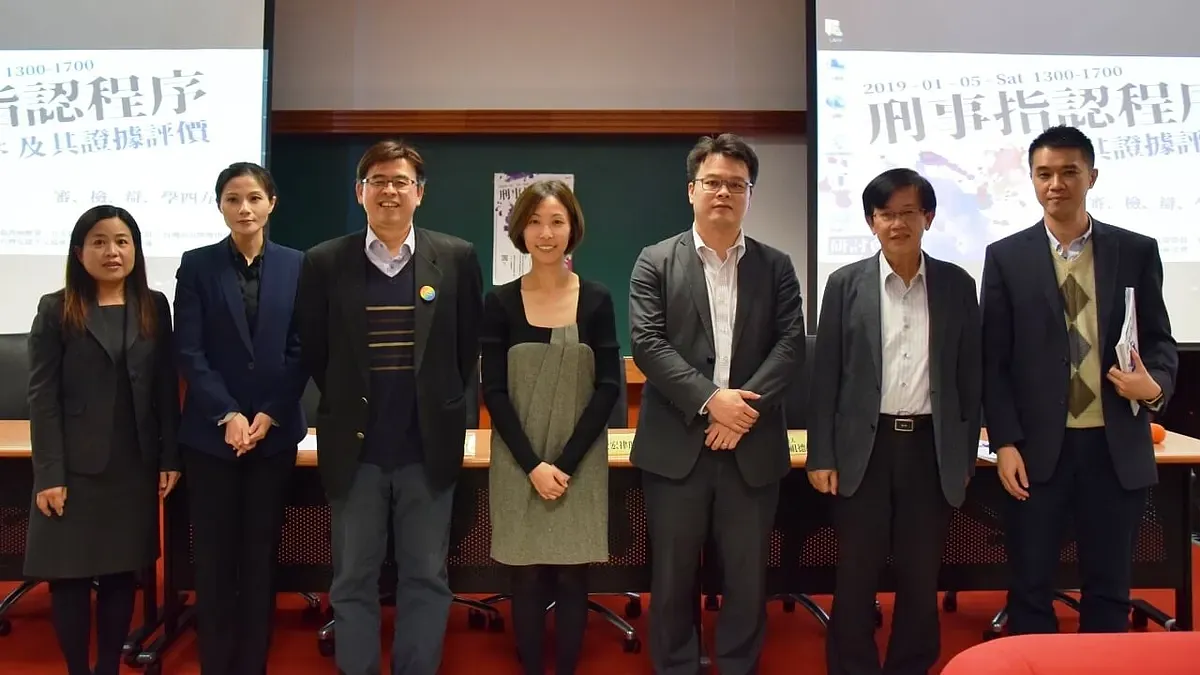
Event Record | 2019 Symposium on Criminal Identification Procedures and Their Evidentiary Evaluation
Last edited: 2026-07-27
※ Click the "" icon in the upper left corner of the video above to view the complete playlist of the symposium.
On January 5, 2019, the Judicial Reform Foundation co-organized the "Symposium on Criminal Identification Procedures and Their Evidentiary Evaluation" alongside the Judicial Reform Committee of the Taipei Bar Association, the Taiwan Criminal Defense Lawyers Association, the Taiwan Association for Innocence, and the Supreme Prosecutors Office.
Mistaken identification is a major contributing factor to judicial miscarriages of justice. We believe that improvements to identification procedures must encompass at least two aspects: the regulation of identification methods during investigations, and the evaluation of admissibility of evidence in litigation. In particular, identification methods that fail to comply with proper procedures should not be granted admissibility.
Identification procedures have had different standards across different eras. Therefore, we hope to combine theory with practice by inviting representatives from the judiciary, prosecution, defense, and academia to jointly discuss the proper regulations required for identifications and the legal evaluation of mistaken identifications. This will allow us to re-examine current domestic identification procedures and cooperatively promote the improvement of the judicial system. The content of this symposium will also serve as a reference for future legislative advocacy.
Opening Remarks

Guest Chiang Hui-min / Prosecutor-General
"Seeing is believing," but what the eyes see is not necessarily the truth. Many cases in practice show that testimony given with certainty by witnesses initially is subsequently overturned by scientific evidence such as DNA. This symposium brings together the four sectors of the judiciary, prosecution, defense, and academia to discuss identification procedures, applying problems discovered in academic theory to practical operations to review which operational steps encounter issues and prevent miscarriages of justice.
Session I Regulation of Identification Methods During Investigations

Presenter Wên Tsu-tê / Assistant Professor, School of Law, Shih Hsin University
When witness memory is faulty, its impact cannot be effectively remedied through the protection of the right to cross-examination and confrontation. Therefore, reforms must be made to the identification procedure during investigations, including the implementation of double-blind procedures and sequential lineups, coupled with audio-visual recording, while avoiding confirmatory feedback.

Panelist Chu Chao-liang / Prosecutor, Supreme Prosecutors Office
Identification pertains to short-term memory, which is easily forgotten, distorted, or reconstructed. Therefore, it should comply with the one-time identification principle, while paying attention to issues causing mistaken identifications such as the weapon focus effect, unconscious transference, cross-race identification difficulties, and the cognitive limitations of children and individuals with mental disabilities.

Session II Evaluation of Admissibility of Evidence in Litigation

Presenter Wang I-t'ing / Attorney, Board Member of the Taiwan Association for Innocence
The courts hold that identification procedures violating administrative rules do not constitute a violation of statutory procedures and do not require the exclusion of evidence. This allows flawed identification procedures to enter the court system from the outset, putting judges through an agonizing balancing test when deciding on exclusion.

Panelist Ch'ien Chien-jung / Judge, Criminal Division, Taiwan High Court
Admissibility of evidence when identification violates statutory procedures. Opinions of the Supreme Court differ on whether identification rules constitute statutory procedures; however, under the constitutional due process of law, courts can establish concrete due process procedures without relying on statute.

Panelist Chêng Chia-hsin / Attorney, Taiwan Criminal Defense Lawyers Association
Frontline case handlers feel sympathy for victims, which turns into anger toward the perpetrator, thereby influencing the suggestiveness of the identification procedure.
Plenary Session Q&A and Responses

FAQ
Moderator Ch'en Yü-fan, CEO
Panelists
- Lin Jün-hung, Attorney
- Wên Tsu-tê, Professor
- Chu Chao-liang, Prosecutor
- Chêng Chia-hsin, Attorney
- Wang I-t'ing, Attorney
- Ch'ien Chien-jung, Judge
Co-organizers
Presenter Wên Tsu-tê / Assistant Professor, School of Law, Shih Hsin University
When witness memory is faulty, its impact cannot be effectively remedied through the protection of the right to cross-examination and confrontation. Therefore, reforms must be made to the identification procedure during investigations, including the implementation of double-blind procedures and sequential lineups, coupled with audio-visual recording, while avoiding confirmatory feedback.
Panelist Chu Chao-liang / Prosecutor, Supreme Prosecutors Office
Identification pertains to short-term memory, which is easily forgotten, distorted, or reconstructed. Therefore, it should comply with the one-time identification principle, while paying attention to issues causing mistaken identifications such as the weapon focus effect, unconscious transference, cross-race identification difficulties, and the cognitive limitations of children and individuals with mental disabilities.
Presenter Wang I-t'ing / Attorney, Board Member of the Taiwan Association for Innocence
The courts hold that identification procedures violating administrative rules do not constitute a violation of statutory procedures and do not require the exclusion of evidence. This allows flawed identification procedures to enter the court system from the outset, putting judges through an agonizing balancing test when deciding on exclusion.
Panelist Ch'ien Chien-jung / Judge, Criminal Division, Taiwan High Court
Admissibility of evidence when identification violates statutory procedures. Opinions of the Supreme Court differ on whether identification rules constitute statutory procedures; however, under the constitutional due process of law, courts can establish concrete due process procedures without relying on statute.
Panelist Chêng Chia-hsin / Attorney, Taiwan Criminal Defense Lawyers Association
Frontline case handlers feel sympathy for victims, which turns into anger toward the perpetrator, thereby influencing the suggestiveness of the identification procedure.
Plenary Session Q&A and Responses
FAQ
Moderator Ch'en Yü-fan, CEO
Panelists- Lin Jün-hung, Attorney
- Wên Tsu-tê, Professor
- Chu Chao-liang, Prosecutor
- Chêng Chia-hsin, Attorney
- Wang I-t'ing, Attorney
- Ch'ien Chien-jung, Judge
Co-organizers
Judicial Reform Committee of the Taipei Bar Association
Taiwan Criminal Defense Lawyers Association
Taiwan Association for Innocence
Judicial Reform Foundation
Supreme Prosecutors Office
(Ordered by stroke count)
This article is an AI-generated translation of the original Chinese text. In the event of any discrepancy, the Chinese version shall prevail.