
JRF Statement Regarding the Prosecutors Evaluation Committee Decision (107th Year, Chien-Ping-Tzu No. 1)
Last edited: 2026-08-29
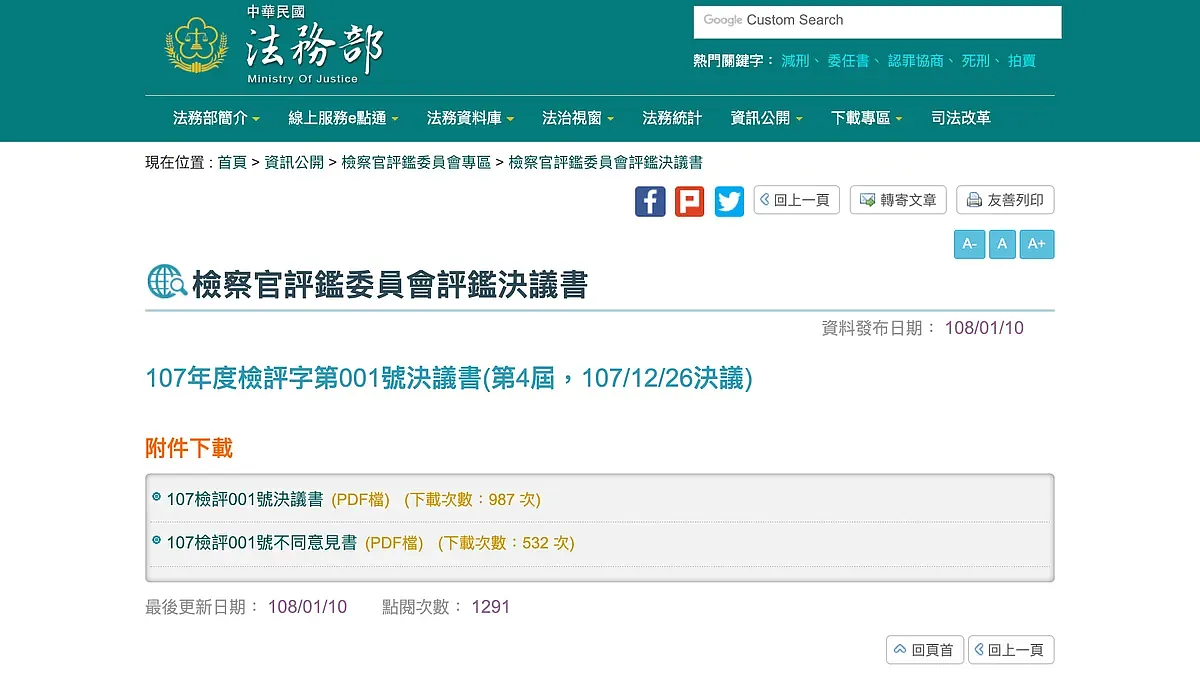
On the 10th, the Ministry of Justice's Prosecutors Evaluation Committee announced the decision for 107th Year, Chien-Ping-Tzu No. 001 regarding the Kaohsiung Bar Association's request for an individual case evaluation of Prosecutor Tung of the Kaohsiung District Prosecutors Office, resolving not to submit the case for evaluation, alongside a dissenting opinion. Our association issues the following statement:
-
Facts of the Evaluation Case
In 2016, while interrogating a corruption suspect, Prosecutor Tung of the Kaohsiung District Prosecutors Office prohibited defense counsel from taking notes on the interrogation contents during the interrogation session and confiscated the counsel's notes on the spot, without presenting objective and reasonable evidence that defense counsel was colluding with witnesses or violating the non-publicity of investigations, sparking controversy. Last November, the Control Yuan issued an investigation report on this matter, pointing out that the prosecutor's restriction and confiscation of notes based merely on the "strange defense" given by another co-defendant in the same case was truly inappropriate. However, the decision announced by the Prosecutors Evaluation Committee today bails out the prosecutor, absurdly concluding that the prosecutor's actions did not obstruct the exercise of the right to counsel and resolving not to submit the case for evaluation.
-
High Controversy Surrounding the Evaluation Decision Leads to the First-Ever "Dissenting Opinion" in the History of the Prosecutors Evaluation Committee!
The controversy surrounding this evaluation decision was so great that it resulted in the release of a "dissenting opinion" for the first time in the 7-year history since the establishment of the Prosecutors Evaluation Committee. Four evaluation members disagreed with the majority opinion of the Committee. The dissenting opinion pointed out that the prosecutor's actions were indeed illegal, and that the majority opinion failed to conduct a substantive review of whether the handling prosecutor's coercive measures against the defense counsel met the constitutional requirements of the principle of proportionality. Furthermore, it failed to establish the rule-of-law standards that prosecutors ought to follow when exercising their duties in this case for future compliance, which may lead prosecutors in the future to arbitrarily use the non-publicity of investigations as an excuse to restrict defense counsel's right to be present or take notes.
-
Low Efficiency of the Prosecutors Evaluation Committee Fails to Function in Ousting Unfit Prosecutors
The evaluation system tasked with ousting unfit judges and prosecutors has been in implementation for over 7 years since 2012. As of July 19, 2018, the case intake volume of the Prosecutors Evaluation Committee had never been made public; among the 56 cases concluded, evaluations were established in only 19 cases, an establishment rate of approximately 33%, showing a lack of effectiveness. Moreover, the term of the current (4th) session of the Committee is already more than half over, yet it has only completed 2 decisions—one of which was referred to the Ministry of Justice's Personnel Review Committee for review, while the other is this very case of "not submitting for evaluation." The current session of the Committee has taken a rigid view of the facts requested for evaluation, failing to effectively supervise and oust unfit prosecutors, and has even suffered from delays in handling cases, thus failing the public's expectations of the Committee.
-
The Evaluation System Must Be Reformed Immediately; the Composition of the Judges and Prosecutors Evaluation Committees Should Be Diversified
The Judges Evaluation Committee and the Prosecutors Evaluation Committee are currently established under the Judicial Yuan and the Ministry of Justice, respectively. Such a setup within the courts and ministries has raised widespread doubts regarding their lack of independence. Coupled with the aforementioned statistical figures, their effectiveness is indeed lacking, and criticisms of mutual protection among officials have even arisen. In addition, the composition of the committees, where legal professionals account for more than half of the members, further raises concerns of a narrow perspective (taking the Prosecutors Evaluation Committee as an example: it is composed of 3 prosecutors, 1 judge, 3 lawyers, 4 scholars, and socially impartial figures). The composition of evaluation committees should be more diversified and heterogeneous (including gender, psychology, forensic science, management, etc.), and the proportion of external members should be increased to think from perspectives different from those of legal practitioners and reflect the opinions of a diverse community.
Effectively supervising judges and prosecutors is the judicial reform item that the public cares about the most. On March 26, 2018, our association proposed a draft amendment to the Judges Act, suggesting that the Prosecutors Evaluation Committee should be composed of 1 prosecutor, 1 judge, 2 lawyers, 1 legal scholar, and 6 representatives from scholars and social groups who have long participated in judicial reform, human rights, public interest, or disadvantaged issues. As for the selection of external members, the Judicial Yuan and the Ministry of Justice should no longer intervene. From the perspective of democratic legitimacy and checks and supervision, a selection committee could be formed by socially impartial figures nominated by Parliament, and the selection committee would then choose non-legal evaluation members. However, the amendment of the Judges Act has seen no substantive progress to date. Our association once again calls on the Legislative Yuan to swiftly initiate the review of the Judges Act, demonstrate its determination to improve the evaluation and Disciplinary Court systems through action, and restore public trust in the elimination mechanism for judges and prosecutors.
Press Contact
Yu-Fan Chen / Executive Director, Judicial Reform Foundation
This article is an AI-generated translation of the original Chinese text. In the event of any discrepancy, the Chinese version shall prevail.