
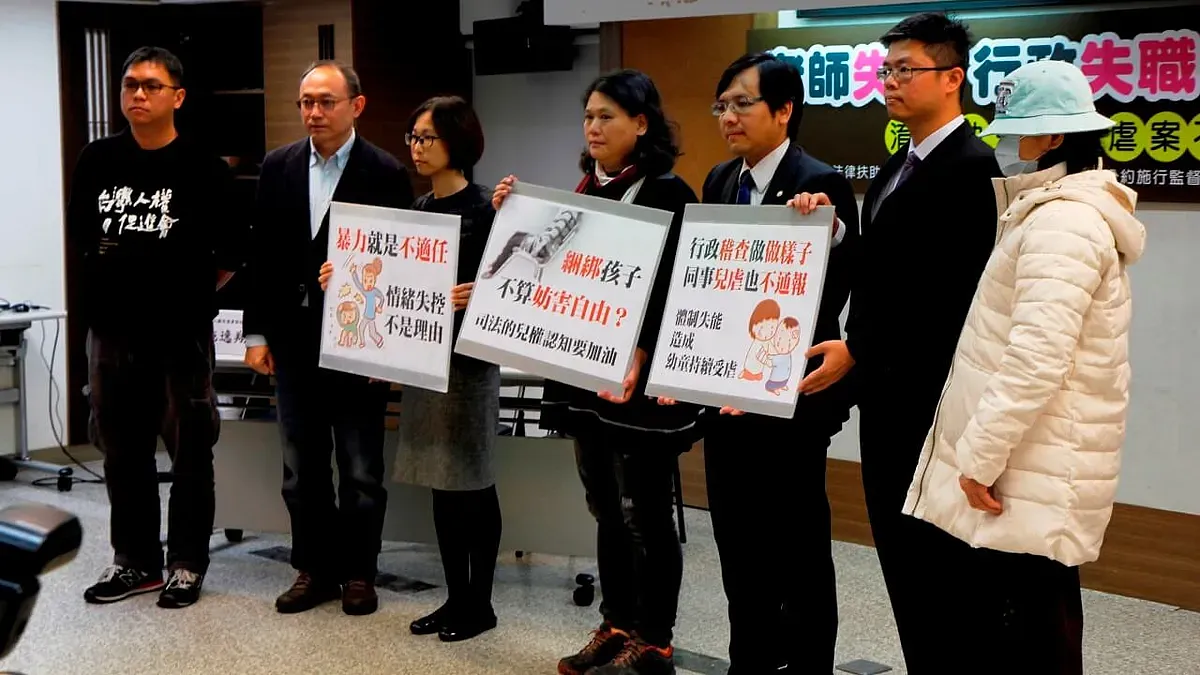
Teachers Out of Control, Administrative Negligence, and Judiciary, Step It Up! The Child Abuse Case at Yuh-Hsin Kindergarten Is Not an Isolated Incident
Last edited: 2026-08-29
On January 17 (Thursday), the Legal Aid Foundation, the Association for Autonomy in Education, and the Judicial Reform Foundation held a press conference titled "Teachers Out of Control, Administrative Negligence, and Judiciary, Step It Up! The Child Abuse Case at Yuh-Hsin Kindergarten Is Not an Isolated Incident" in response to recent child abuse incidents at infant care centers, such as a child care worker beating a one-year-old child's soles with a wooden spatula and stuffing a child into a cabinet for solitary confinement. The Legal Aid Foundation, the Association for Autonomy in Education, the Covenants Watch, the Taiwan Association for Human Rights, and the Judicial Reform Foundation unanimously stated that the child abuse incident at Yuh-Hsin Infant Care Center is not an isolated case. Many child care institutions not only have problems with violence against young children, but also commit abusive behaviors such as verbal abuse, dragging, tying up, forced feeding, food deprivation, providing unclean food, and neglect (Appendix 1). Therefore, the Control Yuan should conduct an investigation into this matter and, in accordance with General Comment No. 13 of the Convention on the Rights of the Child and the reports of the aforementioned independent experts, carry out a systematic investigation and correction regarding the prevention of child abuse in private kindergartens and related accountability mechanisms.
Teachers Out of Control: The Yuh-Hsin Kindergarten Incident Is Not an Isolated Event
In April 2017, a two-year-old child at a private kindergarten in Chiayi was tied to a chair with clear tape by the class teacher, Teacher Chao (who was later found to lack the qualifications of an early childhood educator and was merely a staff member, yet was assigned as the homeroom teacher by the kindergarten), leaving him to sit alone in a corner of the classroom watching others attend class and participate in activities (Appendix 2). Because the teacher refused to apologize, the parents filed a complaint with the Taiwan Chiayi District Prosecutors Office, but were subsequently informed by the Social Affairs Bureau that they had to wait until a criminal judgment was finalized before investigating and penalizing the child abuse part in accordance with the Protection of Children and Youths Welfare and Rights Act. Although the Taiwan Chiayi District Prosecutors Office concluded that Teacher Chao did indeed tie up the child, it twice issued non-prosecution dispositions on the grounds that the action was for the discipline, protection, and care of the child, and thus lacked the intent to deprive personal liberty. The parents argued that the determination made by the Taiwan Chiayi District Prosecutors Office violated early childhood education professionalism and the United Nations Convention on the Rights of the Child. However, the Tinan Branch, Taiwan High Prosecutors Office not only rejected the motion for re-examination, but completely failed to respond to the arguments regarding the Convention on the Rights of the Child raised in the motion. The case was subsequently aided by the Legal Aid Foundation, which retained attorney Wei-Yen Chen to file for forcible prosecution. Nevertheless, the criminal division of the Taiwan Tainan District Court still held that "on a certain day in March 2017 and on April 12 of the same year, the defendant Chao XX bound Child A to a chair with tape, and subjectively lacked any intent to deprive Child A of his freedom of movement," turning a deaf ear to the arguments in the reasoning document stating that the original non-prosecution disposition violated the Convention on the Rights of the Child.
Professor Yu-Ling Hsu of the Department of Early Childhood Education at National Tsing Hua University previously provided professional opinions on this case, stating: "Two-year-old children cannot immediately exhibit socially expected behaviors; this is normal development, and precisely why early childhood education is needed. If disciplining young children requires tying them up with tape, then the regulations on the qualifications of kindergartens and early childhood education and care personnel seem to have no reason to exist. Such practices not only harm the young child, but also seriously disregard the state's training requirements and regulatory norms for early childhood education and care personnel" (Appendix 4, Professional Opinion Letter). The prosecutor and criminal court judges handling this case failed to respect children's rights and early childhood education professionalism, unanimously concluding that tying up a child does not constitute deprivation of personal liberty, which will further deteriorate the living environment for young children in the country. Tying up a dog with tape would be called animal abuse and penalized under the Animal Protection Act; why is tying up a toddler with tape treated as a disciplinary act?
Administrative Negligence
The Association for Autonomy in Education stated that these inappropriate behaviors by early childhood care personnel and kindergartens toward young children reveal the true dilemmas of the child care and education environment: ignorance of the physical and mental development of young children, disregard for early childhood education professionalism, and total indifference to children's rights. Early childhood education must be based on the cognition and needs of young children, helping them understand the outside world and changing their behaviors through environmental arrangements and behavioral modeling. The realization of children's rights should be the professional core of early childhood education. If early childhood educators remain indifferent to a toddler being tied up, are they still fit to assume the responsibility of caring for young children? If the Education Bureau merely treats inspections and evaluations as routine chores without pondering the true effectiveness of audits, how can it understand the actual plight of children in kindergartens? If the Social Affairs Bureau shifts the responsibility of determining child abuse to the judiciary, how can it promptly safeguard the safety of children? If our judiciary is aware that a child was tied up, yet still deems it lawful discipline that does not violate the Convention on the Rights of the Child and does not constitute deprivation of personal liberty, who will serve as the final guardian of children's physical and mental safety?
Judiciary, Step It Up!
The Judicial Reform Foundation stated that the non-prosecution disposition by the prosecutor at the Taiwan Chiayi District Prosecutors Office in this case deemed "tying and securing to a chair with tape" as a "disciplinary measure" belonging to the education, protection, and care of young children. Even during the forcible prosecution proceedings, when early childhood education experts provided professional opinions explaining that tying up a toddler with tape is not a reasonable early childhood education method, the Taiwan Chiayi District Court still dismissed the motion for forcible prosecution on the grounds that "encircling and restricting [the child] to a chair with tape" was a disciplinary measure to prevent the child from getting hurt or from disturbing and harming other children, concluding that the defendant lacked "subjective intent to deprive personal liberty." The facts and expert opinions in this case were clear; the judges and prosecutors handling this case lacked awareness of children's rights protection and rationalized the behavior under the pretext that the defendant was acting out of discipline and "educational professionalism." If the victim today were an adult, it would clearly be a deprivation of personal liberty; yet precisely because the victim is a toddler, such behavior can be rationalized in the name of "discipline." This demonstrates that the handling judges and prosecutors still harbor insufficient understanding of the Convention on the Rights of the Child, and that children's rights still need a stronger push to be adequately protected within the judiciary.
CRC Convention on the Rights of the Child
Professor Sung-Li Huang of the Covenants Watch (Taiwan) stated that Article 19 of the United Nations Convention on the Rights of the Child requires governments to "take all appropriate legislative, administrative, social and educational measures to protect the child from all forms of physical or mental violence, injury or abuse, neglect or negligent treatment, maltreatment or exploitation, including sexual abuse, while in the care of parent(s), legal guardian(s) or any other person who has the care of the child." The Committee on the Rights of the Child advocates the prohibition of all forms of corporal punishment. Severe corporal punishment naturally causes physical and mental trauma to children, but even mild corporal punishment or inappropriate treatment should be prohibited because "all corporal punishment is degrading." Sung-Li Huang also pointed out that the Ministry of Education should concretely implement the aforementioned spirit in all laws and administrative orders. However, Article 3 of the Regulations for Implementation of Early Childhood Education and Care Services in Kindergartens stipulates the regulations that early childhood education and care personnel must observe when implementing services, with the fifth item stating: "Shall not, for the purpose of punishment, personally, order the child himself/herself, or a third party to apply physical force to the child's body, or order the child to adopt specific bodily movements, causing the child physical and mental suffering or harm." Due to the condition of "for the purpose of punishment," early childhood education and care personnel are afforded much room for defense.
I-Hsiang Shih, Deputy Secretary-General of the Taiwan Association for Human Rights, emphasized that central and local governments completely omitted the rampant phenomenon of child abuse in private kindergartens when responding to the parts concerning zero corporal punishment in the initial review of the Convention on the Rights of the Child. If the government chronically lacks concrete action plans, more cases of violent harm and humiliation of children's dignity occurring in private kindergartens may happen in the future. Furthermore, what even more heavily violates the human rights protection values of the CRC is that if these educational professionals on campus long become accustomed to inflicting various forms of violence—including classroom management and disciplinary measures based on fear, threats, humiliation, or corporal punishment—they are actually conditioning children in the educational setting to the impact of violence, thereby potentially learning to use violence to solve problems.
Finally, the groups participating in this press conference call upon the public: the frequent occurrence of child abuse cases in private kindergartens has highlighted the out-of-control state of the educational system, the negligence of the relevant competent government agencies, and the dysfunction of the judicial organs. The Control Yuan should conduct an investigation into this matter and, in accordance with General Comment No. 13 of the Convention on the Rights of the Child and the reports of the aforementioned independent experts, carry out a systematic investigation and correction regarding the prevention of child abuse in private kindergartens and related accountability mechanisms.
Appendices
- Compiled List of Inappropriate Behaviors Committed by Child Care Institutions or Teachers Against Young Children Over the Past Three Years
- Photograph of a Young Child Bound to a Chair with Clear Tape
- Timeline of the Chiayi City Private XX Kindergarten Child Tying Case
Attendees
Parents of the victim child
Han-Wei Chou / Executive Director, Legal Aid Foundation
Chiao-Ian Feng / Executive Director, Association for Autonomy in Education
Yu-Fan Chen / Executive Director, Judicial Reform Foundation
Sung-Li Huang / Convener, Covenants Watch
I-Hsiang Shih / Deputy Secretary-General, Taiwan Association for Human Rights
Wei-Yen Chen / Full-time Attorney, Tainan Branch, Legal Aid Foundation
Press Contacts
Hung-Ju Liang / Legal Aid Foundation
I-Hsin Shih / Association for Autonomy in Education
Organizers
Legal Aid Foundation
Association for Autonomy in Education
Judicial Reform Foundation
Covenants Watch
Taiwan Association for Human Rights
This article is an AI-generated translation of the original Chinese text. In the event of any discrepancy, the Chinese version shall prevail.