
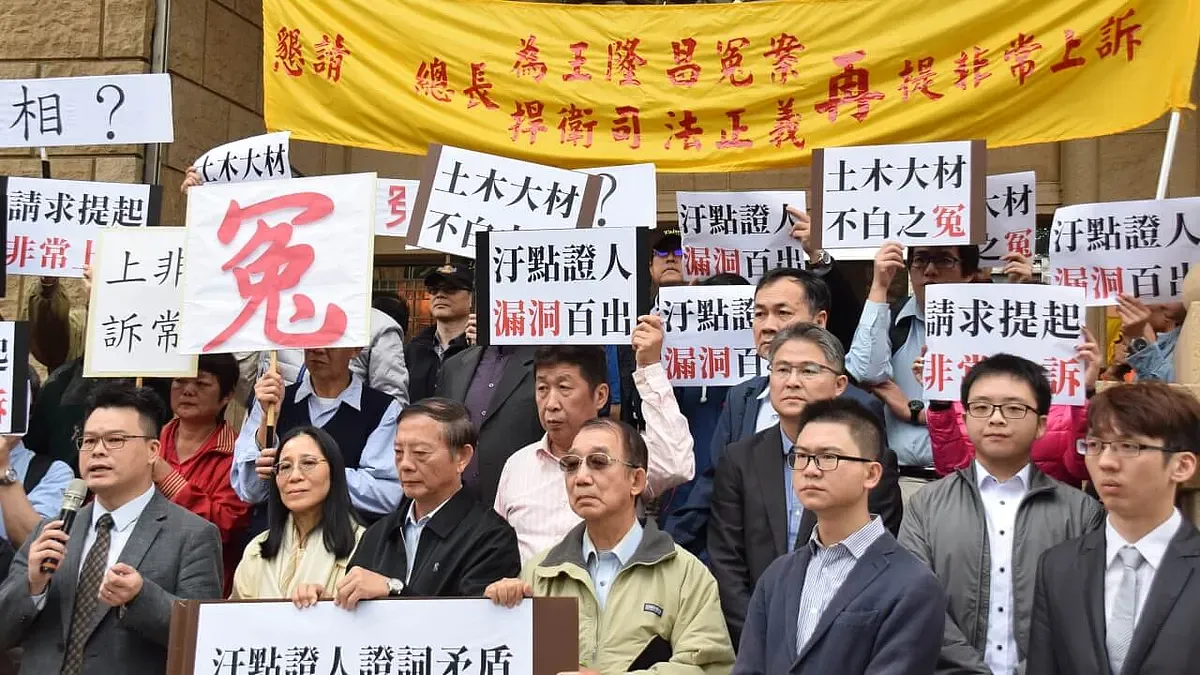
Contradictory Testimony from a Turning-State's-Evidence Witness Saddles a Professor with a Corruption Record: Press Conference on Filing for Retrial and Extraordinary Appeal for Lung-Chang Wang
Last edited: 2026-08-29
The defendant Lung-Chang Wang, former Grand Justice Yu-hsiu Hsu, Judicial Reform Foundation's Case Rescue Team Convener Chun-Hung Lin, pro bono lawyer Chia-Hsin Cheng, and professors from the Department of Civil Engineering including Chou Nan-Shan, Chuan-Wei Wu, Yu-Feng Lee, and Hao-ming Hsieh, held a joint press conference in front of the Supreme Prosecutor's Office today (February 15) to file for a retrial and an extraordinary appeal on behalf of Lung-Chang Wang, who was framed in the Nangang Exhibition Center corruption case. They hope that the courts and the Supreme Prosecutor's Office will face the numerous flaws in the testimony of the turning-state's-evidence witness in this case and return innocence to Lung-Chang Wang.
In 2003, while serving as a professor at the Institute of Civil and Disaster Prevention Engineering at National Taipei University of Technology, Lung-Chang Wang was appointed as one of the 17 evaluation committee members for the Nangang Exhibition Center construction project. The 17 committee members resolved to award the bid to Ruentex Group (Li-t'o Company). In 2008, the Special Investigation Division concluded during its investigation that Ruentex Group had obtained the list of committee members prior to the bidding and bribed 8 committee members, including Lung-Chang Wang. In 2009, the Taipei District Court convicted Lung-Chang Wang of accepting bribes in breach of official duties, sentencing him to 7 years and 8 months in prison. In 2012, the Supreme Court dismissed Wang Lung-ch'ang's appeal, finalizing the conviction.
However, this case contains numerous doubts. Aside from the complete lack of physical evidence proving that Lung-Chang Wang accepted bribes, the sole turning-state's-evidence witness— Wei-An Huang, special assistant to the chairman of Ruentex Group—claimed that he bribed Lung-Chang Wang; yet his testimony was self-contradictory, inconsistent, and completely unable to withstand scrutiny.
First of all, Lung-Chang Wang had never met nor did he know Wei-An Huang. Huang claimed that he took Lung-Chang Wang's class in a civil engineering technician association industry-academia cooperation program and had seen Wang at a seminar held by the association. However, Lung-Chang Wang never taught classes in the industry-academia cooperation program, and Wei-An Huang's name appeared neither on the student enrollment list nor on the seminar sign-in sheet.
The crucial evidence upon which the court convicted Lung-Chang Wang was Wei-An Huang's testimony. Yet, a careful comparison of Wei-An Huang's successive interrogation records reveals that his testimony constantly shifted. For example, regarding the location where the bribe was given, he first stated that the initial upfront payment was made at a Dante Coffee shop. However, after prosecutors presented a receipt from Ts'ui-lin Restaurant, he changed his statement, claiming that they first met at Ts'ui-lin where the upfront payment was given, and the subsequent payment was made at Dante Coffee near the school. Yet, once prosecutors presented the transportation expense records for Ts'ui-lin, Huang changed his story again, placing the upfront payment at Dante and the subsequent payment at Ts'ui-lin. Aside from the location of the bribery, critical testimonies regarding the number of meetings with Lung-Chang Wang, the times of the meetings, the reasons for the meetings, and the amounts of the bribes all varied with three to five different versions back and forth. Moreover, much of the testimony only emerged after viewing the evidence presented by the prosecutors, amounting to "telling a story based on pictures" and altering the original content of his statements, clearly lacking credibility.
In fact, the prosecutors seized key physical evidence such as Wei-An Huang's cell phone and PDA (personal digital assistant, the predecessor to smartphones), which very likely contained Wei-An Huang's communication logs and calendar. Yet, Huang surprisingly told prosecutors that he forgot his phone password and had already deleted all data on his PDA. At this point, the prosecutors inexplicably failed to retrieve the phone's communication records, nor did they restore the deleted data on the PDA, and the court failed to investigate the matter thoroughly. Consequently, the Control Yuan issued a corrective measure regarding this, requesting the Ministry of Justice to restore the deleted data on the PDA to clarify the methods of communication between Huang Wei-an and Lung-Chang Wang; however, the Ministry of Justice replied that it was unnecessary.
Furthermore, a total of 17 evaluation committee members evaluated the 3 competing bidding companies for the Nangang Exhibition Center project, and almost all of them gave Ruentex Group the highest scores, showing that Ruentex Group's presentation performed the best. Moreover, the score variances given by Lung-Chang Wang among the 3 companies were only 1 point, which was the smallest score gap among all committee members, making it fundamentally impossible to guarantee that Ruentex Group would win the bid. Conversely, committee members whose scoring gaps reached over a dozen points were not investigated.
In 2013, the Control Yuan's investigation opinion pointed out the doubts in this case, and in 2015, the Prosecutor-General also filed an extraordinary appeal. Regrettably, the Supreme Court still dismissed the extraordinary appeal, leaving Lung-Chang Wang to continue proclaiming his innocence even after serving his prison sentence in full. The grounds for filing the extraordinary appeal this time are that Wei-An Huang admitted to the crime of offering a bribe and should be listed as a co-defendant in this case. Pursuant to Article 156, Paragraph 2 of the Code of Criminal Procedure, a co-defendant's confession must be corroborated by supporting evidence. However, this case convicted Lung-Chang Wang based solely on Wei-An Huang's confession, which constitutes a judgment contrary to laws and regulations. As for the grounds for a retrial, there are two interrogation records of Wei-An Huang at the Taipei District Prosecutors Office where Huang stated that he did not know who the evaluation committee members were and did not recognize them even upon seeing their names—a matter the judgment failed to consider and which directly contradicts the factual finding in the judgment that Huang knew and bribed Lung-Chang Wang. Furthermore, looking at the audio recording transcripts, they are clearly different from the original records, raising suspicions that the prosecutors predetermined the answers and then induced Wei-An Huang to follow along and assent.
Because of this case, Lung-Chang Wang had to leave National Taipei University of Technology, where he had taught for 39 years, and all his past policy research on national public infrastructure was interrupted. This has not only severely damaged his personal reputation and innocence but also caused immense losses to the construction and development of the entire nation and society. It is hoped that the Prosecutor-General and the courts will face this case squarely and return innocence to Lung-Chang Wang.
Attachments
Attending Representatives
Lung-Chang Wang / Defendant in this case, former Professor at the Institute of Civil and Disaster Prevention Engineering, National Taipei University of Technology
Yu-Hsiu Hsu / Former Grand Justice of the Judicial Yuan
Lin Chun-Hung Lin / Convener of the Case Rescue Team, Judicial Reform Foundation
Chia-Hsin Cheng / Defense Attorney in this case
Shih-Hsiang Lo / Executive Director, Taiwan Association for Innocence
Chou Nan-shan / Professor, Department of Civil Engineering, National Taiwan University
Chuan-Wei Wu / Associate Professor, Department of Civil Engineering, National Taipei University of Technology
Yu-Feng Lee / Professor, Department of Civil Engineering, National Taipei University of Technology
Shui-Lung Chen / Professor, Department of Civil Engineering, National Taipei University of Technology
Li-Hsien Chen / Professor, Department of Civil Engineering, National Taipei University of Technology
Hao-Ming Hsieh / Associate Professor, Department of Civil Engineering, National Central University
Chun-Yen Lin / Professor, Institute of Technological and Vocational Education, National Taipei University of Technology
Cho-Hsun Sun / Professor, Department of Electronic Engineering, National Taipei University of Technology
Yen-Hsuan Chen / Full-time Attorney, Judicial Reform Foundation
Support from Civil Engineering Professionals from Various Fields
- Wen-Lu Wang (Inspector, Ministry of Education)
- Min-Lin Liu (Alumnus, Institute of Civil Engineering)
- Pao-Hua Peng (Former Section Chief, Construction and Planning Agency)
- Kang Lee (Director-General, Department of Transportation and Tourism, Keelung City Government)
- Feng-Hsin Chiang (Professor, National Taipei University of Technology)
- Chun-Lin Lee (Secretary, President's Office, National Taipei University of Technology)
- An-Hsiang Kao (Adjunct Teacher, Department of Civil Engineering)
- Chao-Lin Feng (Director, Public Works Department, New Taipei City Government)
- Pao-Chung Peng (Section Chief, Bureau of Mines, Ministry of Economic Affairs)
- Tien-Chien Chen (Chairman, Kuang-fa Construction)
- T'ien-ts'u Shen (Civil Engineering Technician)
- Han-Hui Yen
- Po-Jen Huang
- I-Heng Lin
- Ching-Wen Lee
- and others
Press Contact
Shang-Yu Tsai, Specialist, Judicial Reform Foundation
This article is an AI-generated translation of the original Chinese text. In the event of any discrepancy, the Chinese version shall prevail.