
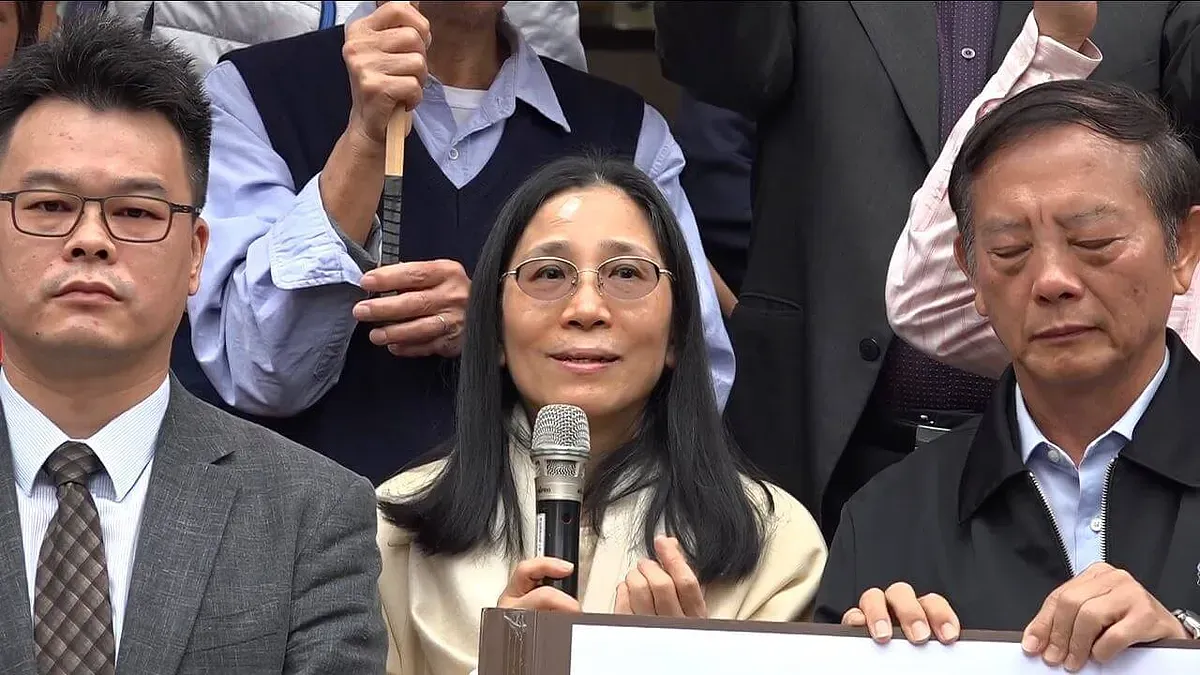
The Judiciary is a Place to Vindicate the Wronged, Not Create Miscarriages of Justice: Remarks by Former Grand Justice Hsü Yü-hsiu
Last edited: 2026-08-29
-
Turncoat Witness: The story was already fabricated with loopholes everywhere, yet who knew the judge could still find the innocent defendant guilty
-
Perjury? Incitement to perjury?
Last month, a video titled "A University Professor Failed by the Truth" began streaming online, featuring an interrogation room recording clip. The defendant's lawyer repeatedly asked the witness whether he met and bribed Professor Lung-Chang Wang in the morning or the afternoon. The prosecutor interjected, "Just say whether it was daytime or nighttime." The turncoat witness then stated definitively that it was during the day. When the lawyer asked a few more questions and the turncoat witness struggled to respond, the prosecutor actually interjected again, saying, "It doesn't matter, just say you don't remember."
The truth of the matter was that on that day, Professor Wang was busy all day at an academic seminar organized by the Council of Indigenous Peoples. There was no meeting during either the daytime or nighttime.
If a prosecutor asks "Did you forget?," it is already an impermissible leading question, yet the prosecutor actually said, "It doesn't matter, just say you don't remember." Turning a nonexistent fact into merely not remembering the precise meeting time—what is this called? Perjury? Then what is the prosecutor doing? Incitement to perjury?
-
There is no evidence that Professor Wang and the turncoat witness ever knew or met each other
Actually, this case is not difficult to clarify. If the two people never knew each other and never met, there would be no subsequent story.
Wei-An Huang claimed that he knew Professor Lung-Chang Wang before the bidding case, but the physical evidence he submitted overturned his own testimony. Huang Wei-an said he had taken Professor Wang's class and knew Professor Wang beforehand, but according to the certificate of course completion for the extension program he submitted, there were no courses taught by Professor Wang, and among the courses Professor Wang had taught, Wei-An Huang's name did not appear on the enrollment list.
On the contrary, about three and a half months before Professor Wang's case was registered for investigation for accepting bribes on October 15, 2008 (97), when the Nangang Exhibition Center case was registered for violation of the Government Procurement Act on June 25, 2008 (97), the prosecutor had shown several professors' names and asked Wei-An Huang if he knew them, and Wei-An Huang said he did not know Professor Wang. However, this testimony was never brought out for investigation in the subsequent bribery case.
Wei-An Huang also did not present any concrete evidence that he had met with Professor Wang. It was the prosecutor who took dining receipts seized from the Rito Company and questioned him one by one. The prosecutor set the facts and questioned Wei-An Huang, resulting in four versions of how many times they met (ranging from two to four), five versions of when they met and what they did during the meetings, and three versions of where they met. The reason there are so many versions is that they were gradually overturned, to the point that in the trial court, all the meeting dates in the prosecutor's interrogation records were dismissed as "not remembered."
So where does the problem lie? Obviously, the qualification of a turncoat witness depends entirely on the prosecutor's whim. No matter how riddled with loopholes the testimony is, as long as the prosecutor is willing, anyone can be a turncoat witness. Once someone becomes a turncoat witness, even if they go to the trial court and claim they don't remember any of the meeting dates in the prosecutor's record, their testimony remains solid, credible, and possesses full probative force.
To Professor Wang, this turncoat witness committed perjury from beginning to end, but I cannot help wondering: Might this turncoat witness say, "Although I fabricated the story to obtain deferred prosecution, I had already made the story so full of loopholes, and had already used 'not remembering' to lower the credibility of my testimony—how could I have imagined that the judge could still find Professor Wang guilty?"
-
Perjury? Incitement to perjury?
-
Starting from a willingness to understand the grievances of those crying out for justice
-
Doing the work of investigating and evaluating evidence well will earn public trust
My heart is extremely heavy coming here today. I never imagined that one day I would also have to voice support for defendants in wrongful conviction cases in front of prosecutorial offices or courts. But a year ago, when Professor Lung-Chang Wang came to tell me the story of his wrongful imprisonment, that heartbreaking feeling made me decide that no matter how heavy my steps, I had to come.
Professor Wang's case forces us to face the reality that it is not just defendants who appear unlikable—such defendants often refer to those struggling at the bottom of society—even a university professor whom the state has invested many resources to cultivate and who holds themselves to high moral standards cannot escape the clutches of judicial malice. Is our survival as legal professionals really built upon other people's shattered lives?
In Professor Lung-Chang Wang's case, what is horrifying is that no matter how lacking in evidentiary basis a testimony is, the indictment and judgment use one set of rhetoric when they want to believe it, and change to another set of rhetoric when they don't want to believe it.
Just a year ago, before the Lunar New Year, this case led me to make a major resolution: to launch an evidentiary law research project. This project includes compiling an evidentiary law code, writing evidentiary law teaching materials, promoting the inclusion of evidentiary law as a mandatory course in university law schools and judicial practice training institutions, and establishing mechanisms for exonerating and rescuing wrongful convictions.
What is the work of prosecutors and judges? It is nothing more than investigating and evaluating evidence. How do wrongful convictions come about? Why do people not trust them? It is because the prosecutorial and judicial systems have not done the work of investigating and assessing evidence well. To restore judicial credibility, I believe we only need to do this one thing well.
-
Gaining trust lies in empathizing with the grievances of others
Quite a few prosecutors and judges believe that society misunderstands them. In truth, they are no different from the defendants crying out for grievances here. They should be able to understand the predicament of being wrongly accused, and understand the desire to see injustices redressed. If prosecutors and judges hope that society can understand their own grievances, could they first sincerely understand the grievances of defendants crying out for justice? If they are willing to work hard to understand, or even vindicate the grievances of others, they will naturally win gratitude, and gaining the trust of others will become much easier.
Since I have come here today, I have a suggestion: I hope the Supreme Prosecutors' Office and the judicial system can prepare a space for those who come to them crying out for injustice, allowing them to sit down properly and state their grievances. This would be much more expressive of a willingness to understand than leaving those treated unfairly to cry out in the cold wind outside the door.
-
Doing the work of investigating and evaluating evidence well will earn public trust
This article is an AI-generated translation of the original Chinese text. In the event of any discrepancy, the Chinese version shall prevail.