
Judicial Reform Final Exam: How to Amend the Judge/Prosecutor Ousting Mechanism?
Last edited: 2026-07-27
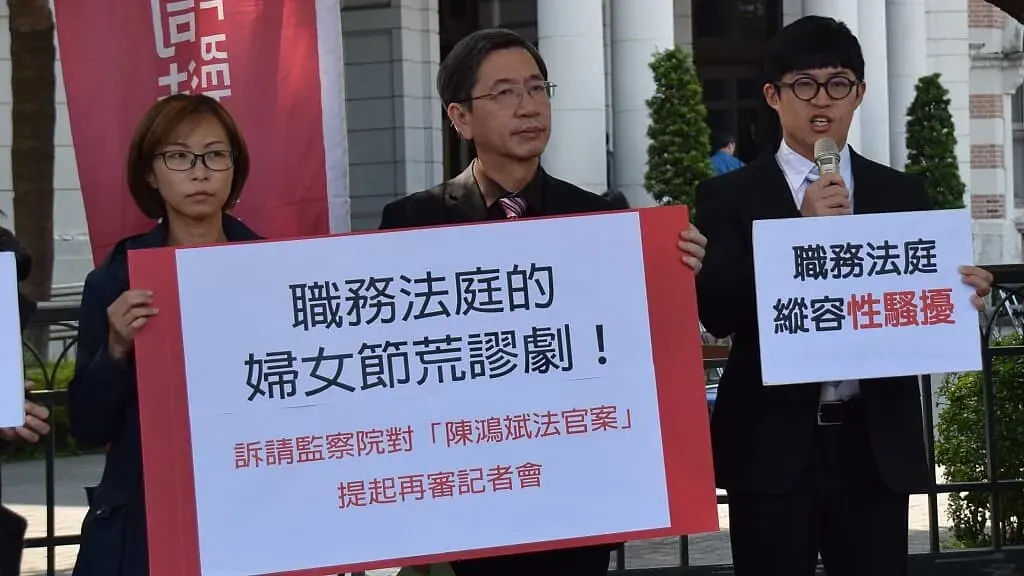
Photo / Press conference held by the JRF on March 12, 2018, petitioning the Control Yuan to file for a retrial in the "case of Judge Ch'en Hung-pin harassing a female assistant without being dismissed."
Following the controversy last year, voices from both official and civil society sectors emerged calling for amendments to the Judges Act and the strengthening of supervisory mechanisms. Yet nearly a year later today, the official draft amendment to the Judges Act still has not been submitted to the Legislative Yuan, and there remains much room for improvement. Our recommendations are as follows:
-
Introduce External Members to the Review Committees and the Disciplinary Court
The Judges Review Committee and the Prosecutors Review Committee are each composed of eleven members, among whom "legal professionals"—namely judges, prosecutors, and attorneys—account for seven members, while the Disciplinary Court is composed entirely of judges. However, the cultivation of legal talent in Taiwan often exhibits a strikingly high degree of homogeneity, inevitably leading to overly narrow perspectives during deliberation.
Taking Resolution No. 3 of the 106th Year of the Prosecutors Review Committee (hereinafter the PRC) as an example, the prosecutor under review in that case opined that because the victim did not bite the assailant's penis during forced oral sex, it must have been consensual, thereby demonstrating the prosecutor's susceptibility to the "ideal victim myth" in handling the case and a severe lack of gender awareness. Unexpectedly, after review proceedings were initiated, the PRC shielded the prosecutor, self-servingly inferring that a trust relationship must have existed between the assailant and the victim; otherwise, why would the assailant "have been at ease putting his genitalia into Victim A's mouth without fear of injury from sharp teeth," thus concluding that the prosecutor did not warrant discipline.
From the aforementioned case to the Disciplinary Court's judgment commuting Judge Ch'en Hung-pin's dismissal to a salary reduction, we can observe that the gatekeepers of the ousting mechanism for judges and prosecutors also suffer from a lack of gender awareness. This highlights the fact that legal expertise does not equate to omnicompetence. Only by enhancing the diversity of members composing the review committees and the Disciplinary Court, incorporating professionals from diverse fields, and allowing non-legal professionals to hold more than half of the seats can we prevent bias in their decisions.
Although the version of the draft amendment to the Judges Act recently proposed by the Judicial Yuan increases the number of external members on the Review Committee from four to six, "legal professionals"—judges, prosecutors, and attorneys—still account for seven members. With legal professionals holding a majority, deliberation results are likely to remain dominated by legal professionals, making it difficult to expect the Review Committee under this revised version to differ from the status quo. Furthermore, external members should similarly be introduced to the Disciplinary Court to alter the current situation where trials are conducted entirely by professional judges, thereby responding to external doubts regarding official protection of fellow officials.
-
Comprehensive Evaluation Should Be Conducted by Review Committees and Results Made Public
In addition to case-by-case reviews of judges and prosecutors, the Judges Act requires the Judicial Yuan and the Ministry of Justice to conduct a "comprehensive evaluation" every three years to comprehensively review the performance of judges and prosecutors. However, since 2011, two comprehensive evaluations have been conducted, yet not a single judge or prosecutor has ever been referred for a case-by-case review. Compared with the recent string of judicial integrity cases and the public's distrust of judicial personnel, the performance of judicial personnel does not seem as flawless as the results of the "comprehensive evaluation" suggest.
Moreover, the competent authorities in charge of comprehensive evaluations are the Judicial Yuan and the Ministry of Justice—which can be described as insiders reviewing insiders. Coupled with the fact that the results are not made public, outsiders actually find it difficult to examine the evaluation indicators and actual evaluation conditions. Therefore, comprehensive evaluations should be entrusted to the more objective Review Committee. Moreover, if the Review Committee discovers judges and prosecutors who ought to be referred for case-by-case review during its examination, it may also immediately initiate review proceedings. Furthermore, the results of comprehensive evaluations should be disclosed to a certain extent for public review. Beyond uncovering incompetent judges and prosecutors, this would conversely encourage dedicated judges and prosecutors. However, in the version recently proposed by the Judicial Yuan, no reform plans whatsoever regarding the "comprehensive evaluation" system are to be seen. When it comes to supervising judges and prosecutors, outsiders are still left guessing in the dark!
-
The Ousting Mechanism Procedure Should Be Streamlined
The draft amendment to the Judges Act proposed by Yamaha hopes to reform the Disciplinary Court into a two-tier, two-instance system to protect those under trial. However, the current ousting mechanism for judges and prosecutors is already protracted: a review request must first be submitted to the Review Committee, and upon substantiation, the case must be referred to the Control Yuan for review and impeachment, after which it is tried by the Disciplinary Court. The entire process is time-consuming.
If the Disciplinary Court is to be reformed into a two-tier, two-instance system, corresponding amendments should be made to the regulation requiring Review Committee resolutions to be referred to the Control Yuan for review, allowing Review Committee resolutions to directly enter Disciplinary Court proceedings while simultaneously retaining the Control Yuan's power of impeachment, thereby establishing a "dual-track system" where both the Review Committee and the Control Yuan can submit cases to the Disciplinary Court, thus balancing procedural efficiency and procedural protection for the parties involved.
Fairly speaking, most judges and prosecutors in Taiwan work conscientiously to safeguard the people's rights and interests. It is not what we wish to see if the public develops distrust in the judiciary because of the unlawful handling of cases or inappropriate speech and conduct by a minority of judges and prosecutors. Precisely for this reason, the supervisory and ousting mechanisms for judges and prosecutors are of such vital importance. When we can efficiently weed out incompetent judges and prosecutors, the people will discover that there are still many excellent judges and prosecutors handling cases diligently within the judicial system. This will undoubtedly rebuild public trust in the judiciary and fulfill the public's expectations for judicial reform.
※ This article was published in ETtoday News Cloud on Feb 20, 2019
This article is an AI-generated translation of the original Chinese text. In the event of any discrepancy, the Chinese version shall prevail.