
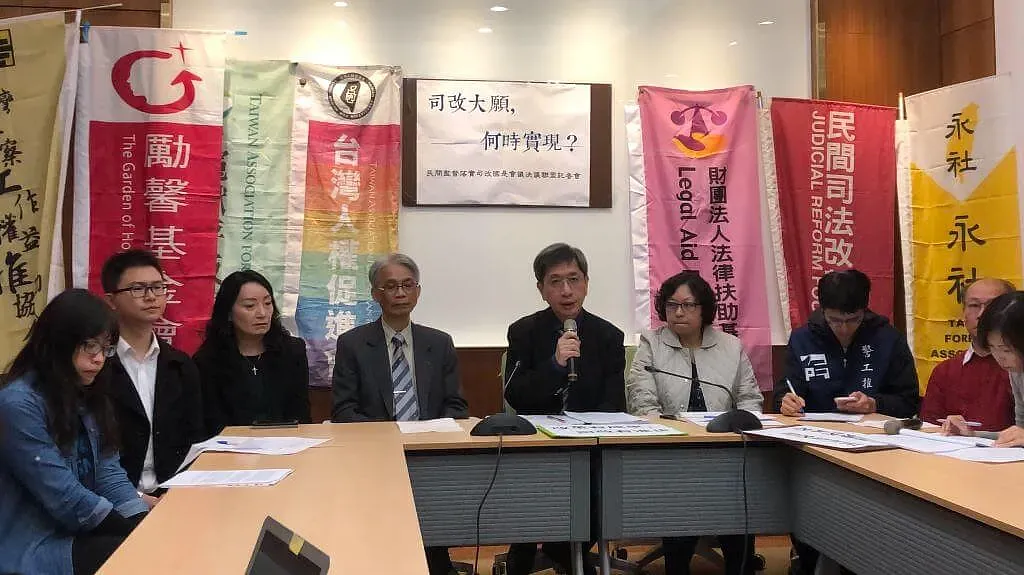
When Will the Grand Vision for Judicial Reform Be Realized? Press Conference of the Alliance for Civil Monitoring and Implementation of the National Congress on Judicial Reform Resolutions
Last edited: 2026-09-01
The National Congress on Judicial Reform concluded in August 2017, and President Tsai Ing-wen promised to release progress reports every six months. February 25 marks the official third semi-annual report. After reviewing the government's implementation progress, the "Alliance for Civil Monitoring and Implementation of the National Congress on Judicial Reform Resolutions" noted that while the government has worked hard to implement reforms, if the cold numbers in the semi-annual report cannot be directly translated into a warm, tangible judicial reform, the public will not feel the results no matter how many laws are amended or supplemented. The Alliance hopes the government will pursue pragmatic, perceptible reforms to respond to public expectations.
Reform Has Results, Judicial Reform Has Progressed
With the release of this semi-annual report, the Alliance affirms the official efforts in many areas. The introduction of numerous bills is the first step toward reform, and the Alliance looks forward to concrete implementation results.
Taking the expert testimony system in the Code of Criminal Procedure as an example, the Judicial Yuan will propose a draft amendment clearly stipulating that lie detector tests shall not be used as evidence, limiting the use in court of lie detector tests that have repeatedly sparked controversy, reducing the use of questionable science, and contributing to the transition of forensic science. In addition, adding provisions for privately appointed experts also constitutes a landmark reform. The Judicial Yuan's draft version has adopted many conclusions from the National Congress on Judicial Reform, which the Alliance affirms, and it also calls on the Ministry of Justice to respect the spirit of the National Congress resolutions and jointly complete the amendment of the expert testimony system.
Regarding prison system reform, the Executive Yuan has drafted the Prison Act draft to focus on safeguarding inmates' right to litigation, stipulating that legal remedies for grievance cases in correctional institutions shall follow the summary procedure of the Administrative Court. However, the current NT$2,000 court fee for administrative litigation summary procedures may be unaffordable for most inmates, and legal remedies risk becoming illusory. The draft stipulates that for legal remedies regarding correctional institution grievances, the court may dispense with oral argument, leaving it questionable whether inmates' right to a hearing is adequately safeguarded.
In addition, the draft on victims' participation in litigation under the Code of Criminal Procedure has been submitted to the Legislative Yuan awaiting review, but regrettably, the National Congress on Judicial Reform's call to identify the plight of the socially disadvantaged in the judicial system and provide relevant protective services and measures has yet to see practical implementation.
No Progress in Reform, Judicial Reform Falls Short
Although the government has made efforts, the pace of reform has been slow, and there have even been instances of disrespecting the resolutions of the National Congress on Judicial Reform. The issue of child abuse, which has frequently occupied headlines recently, was originally a subject of concern at the National Congress, during which multiple resolutions were passed. Currently, however, we only see the government continuing to use the existing social safety net as an excuse, lacking substantive progress on how to implement the resolutions. Civil society organizations demand the establishment of an Executive Yuan-level child protection office to integrate policies and resources, establish a more comprehensive child protection mechanism, and particularly focus on preventive work so that through social relay efforts to assist vulnerable families before violence and abuse incidents occur, tragic cycles can be prevented from repeating.
On the other hand, police personnel, who rank highest in satisfaction polls, certainly work very hard as front-line judicial personnel. However, ranking first does not mean perfection, and the resolutions of the National Congress should still be faithfully implemented. For instance, regarding the Police Performance Management Committee, the government remains overly reliant on statistical figures and fails to understand the importance of reform; the composition of the committee lacks progress, lacks third-party scholarly oversight, and has failed to establish consistent criteria.
How disadvantaged groups receive protection under the law has always been a matter of public concern. Services such as interpretation—including language and sign language translation—are the most basic prerequisites for people entering the judicial system. Yet, a year and a half after the resolutions, the issues of insufficient professional training and funding for interpreters have still not been fully resolved.
Finally, there is the judicial reform project most directly connected to the general public: the Judges Act. Ever since the implementation of the judicial evaluation system eight years ago, numerous problems have surfaced. We look forward to the Legislative Yuan completing the amendment of the Judges Act during this session to respond to public expectations for weeding out incompetent judges.
The implementation of the National Congress on Judicial Reform resolutions is intended to improve the judicial system, making justice fairer and more accessible to the people. Regarding the year and a half since the conclusion of the Congress, the Alliance affirms the government's introduction of legislative amendments, but the actual execution of reform results is also what the Alliance values. The Alliance will continue its monitoring, hoping that judicial reform will no longer be a distant and elusive aspiration, but rather a genuine and concrete realization of the grand vision for judicial reform!
Attachments
- Protecting the Plight of Disadvantaged Groups in the Judiciary (Interpretation Section) — Legal Aid Foundation
- Prison System Reform — Taiwan Association for Human Rights
- Children, Youths, and Victims' Litigation Participation — Garden of Hope Foundation
- Forensic Science — Professor Li Chun-i
- Preliminary Thoughts on Promoting Restorative Justice within the Juvenile Justice System — Attorney Ch'en I-ch'eng
- Prison System Reform — Taiwan Association for Innocence
- Police Performance — Taiwan Police Rights Association
Alliance Attending Representatives
Professor Li Chun-i / Member of the First Division, National Congress on Judicial Reform
Wang Wei-chün / Chairperson, Association for Child Rights Promotion & Member of the First Division, National Congress on Judicial Reform
Father Nguyễn Văn Hùng / Catholic Diocese of Hsinchu Vietnamese Migrant Workers and Spouses Office & Member of the First Division, National Congress on Judicial Reform
Hung Ya-li / Vice CEO, Garden of Hope Foundation
Ch'en Ho-hsun / Advocacy Specialist, Garden of Hope Foundation
Hung Chung-yen / Deputy Secretary-General, Taiwan Association for Socio-cultural Rights
Sun Yu-lien / Secretary-General, Taiwan Labor Front
Lo Shih-hsiang / CEO, Taiwan Association for Innocence
Yen Szu-yü / Office Director, Taiwan Association for Human Rights
Chang Ching-pei / Legal Department Attorney, Legal Aid Foundation
Kuo Li-hsuan / Supervisor, Taiwan Police Rights Association
Lin Yung-sung / Chairperson, Judicial Reform Foundation
Ch'en Yü-fan / CEO, Judicial Reform Foundation
Press Contact
Judicial Reform Foundation CEO Ch'en Yü-fan (02)2523-1178
This article is an AI-generated translation of the original Chinese text. In the event of any discrepancy, the Chinese version shall prevail.