
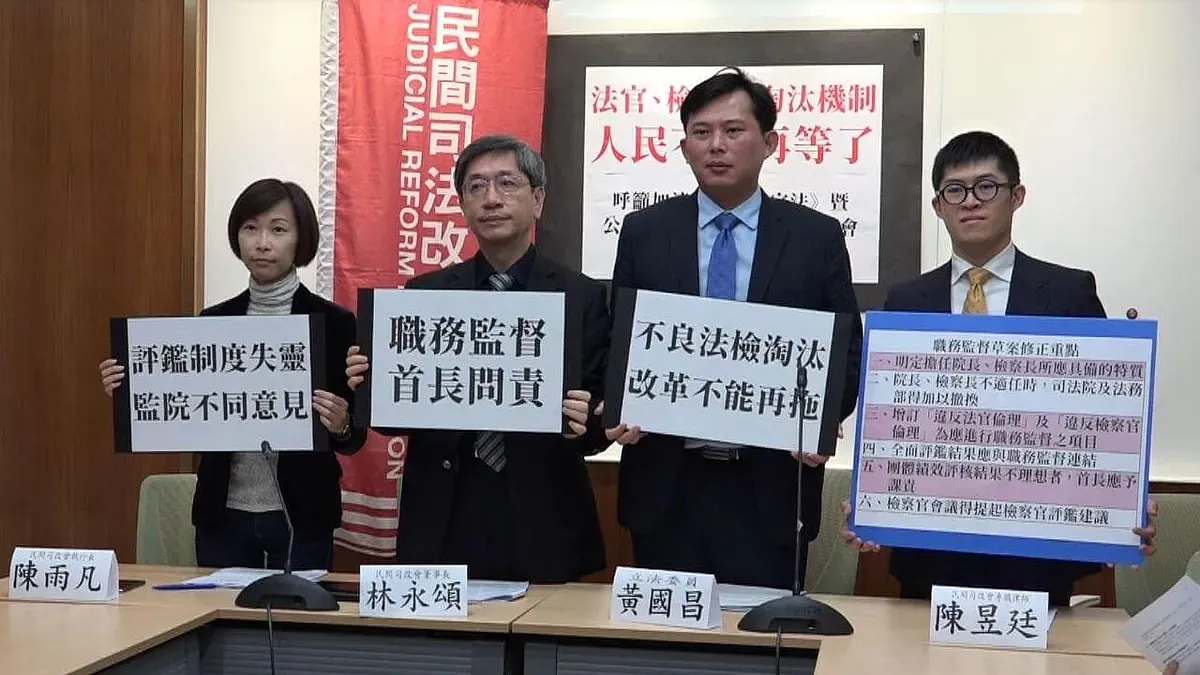
The Public Can No Longer Wait for the Mechanisms to Remove Unfit Judges and Prosecutors: Press Conference Calling for the Accelerated Deliberation of the Judges Act and the Release of the Draft Provisions on Official Supervision
Last edited: 2026-07-27
Since the National Consultative Conference on Judicial Reform was convened, three outcome reports have been issued, yet public trust in the judiciary has failed to improve. One of the reasons for this continued decline in judicial trust is the overly sluggish pace of reform concerning the mechanisms for removing unfit judges and prosecutors, as the evaluation system has failed to produce results. Today (March 12), the Judicial Reform Foundation (JRF) held a press conference demanding that the legislature promptly review the draft amendments to the Judges Act while releasing its draft provisions on official supervision, in the hope that the judiciary will strengthen its internal self-discipline mechanisms alongside external evaluation mechanisms.
The Malfunctioning Evaluation System and Ineffective Evaluation Committees
Recently, the Control Yuan released several investigation reports highlighting deficiencies in the determinations made by the evaluation committees (see appendix for details). In one sexual assault case involving a foreign migrant worker, a prosecutor concluded that the victim had consensual sexual intercourse with the perpetrator on the grounds that the victim did not "bite the perpetrator's penis" when forced to perform oral sex. Furthermore, the Prosecutor Evaluation Committee decided not to proceed with an evaluation, reasoning that the defendant "had a considerable sense of trust in the victim and therefore felt comfortable placing their genitalia in the victim's mouth without fear of being injured by sharp teeth." Regarding the aforementioned case, the Control Yuan stated that there is room to study the possibility of reopening the investigation, pointing out that the prosecutor lacked gender awareness and that official supervision should be exercised.
In another evaluation case where a prosecutor prohibited defense counsel from taking notes and confiscated their notes during an interrogation without presenting reasonable evidence that defense counsel had colluded on testimonies or violated the principle of non-disclosure of investigations, the Prosecutor Evaluation Committee similarly decided not to proceed with an evaluation. However, in an unprecedented move, the case featured the first-ever dissenting opinion issued within an evaluation committee. The Control Yuan likewise issued an investigation report stating that the prosecutor's disposition was inappropriate and that attention should be called to it.
In yet another evaluation case concerning the sexual assault of a child, the prosecutor violated relevant provisions of the Sexual Assault Crime Prevention Act by commencing the interrogation of the victim without notifying social workers to be present, as required by regulations—a serious violation of legal procedure. Although the Evaluation Committee acknowledged that the violation was quite obvious, it deemed the circumstances not to be serious and ruled the request unfounded. Regarding this decision, the Control Yuan expressed regret, holding that the Prosecutor Evaluation Committee failed to impose an appropriate sanction.
Aside from the debatable content of their decisions, the effectiveness of the evaluation committees continues to hit rock bottom. Over the past year, the Judges Evaluation Committee made only one decision, while the Prosecutor Evaluation Committee made two. Among these, although evaluations were established, both committees each decided that there was no need for disciplinary action and referred the matters to the Personnel Review Committee; another case before the Prosecutor Evaluation Committee resulted in a decision not to proceed with an evaluation. The two committees have yet to make any decisions this year, rendering them completely incapable of fulfilling their function of weeding out unfit judges and prosecutors.
Reform Proposals Must Respond to Public Expectations
Over the past year, judicial disciplinary scandals have emerged one after another, triggering a wave of calls for reform from civil society. Although the Judicial Yuan has also proposed draft amendments to the Judges Act, it has repeatedly delayed submitting them to the Legislative Yuan for deliberation. Moreover, many parts of the content do not quite align with the spirit of the resolutions adopted at the National Consultative Conference on Judicial Reform (a comparison between the JRF and Judicial Yuan drafts can be found in the appendix). Taking the composition of the Judges and Prosecutors Evaluation Committees as an example, while the Judicial Yuan's draft increases the number of external members by two (to a total of six), their number remains smaller than that of the other members composed of "legal professionals" (totaling seven). Therefore, it remains questionable whether this can achieve the heterogeneity and diversification required by the resolutions of the National Consultative Conference on Judicial Reform.
| Judicial Yuan Draft (Legal professionals form the majority) |
JRF Draft (External members and non-legal professionals form the majority) |
||
|---|---|---|---|
| Judges, Prosecutors, Attorneys | External Members | Judges, Prosecutors, Attorneys | External Members |
| 7 persons | No qualification restrictions; the 6 external members may also be "legal professionals" | 5 persons | 6 members who are "non-legal professionals" |
Furthermore, the JRF also suggests amending regulations concerning comprehensive appraisals. In the past, comprehensive appraisals of judges and prosecutors were controlled by the Judicial Yuan and the Ministry of Justice—which could be described as insiders evaluating insiders. Moreover, the results of both comprehensive appraisals did not lead to any judges or prosecutors being referred for individual evaluations. Additionally, because the appraisal results were not made public, the public was entirely unable to monitor unfit judges and prosecutors through the comprehensive appraisal mechanism, rendering the system practically void. Therefore, the JRF advocates renaming comprehensive appraisals to comprehensive evaluations, to be administered by the evaluation committees rather than insiders evaluating insiders, while also making evaluation results public for external scrutiny.
Regarding the organizational restructuring of the evaluation committees, to resolve their current low effectiveness, the JRF proposes adding five full-time members to the evaluation committees and explicitly stipulating that the convener shall be chosen from among these full-time members. In addition, depending on the volume and complexity of affairs, full-time personnel may be hired to handle the administrative affairs of the evaluation committees. It is hoped that by committing more manpower, the quantity and quality of decisions made by the evaluation committees can be enhanced. However, the Judicial Yuan's version of the provisions merely stipulates that the Judicial Yuan may hire appropriate personnel to assist, without increasing the number of full-time members, nor is there any apparent increase in administrative staffing. Thus, it is difficult to see how this approach could effectively improve the efficiency of the evaluation committees.
Taking the simplification of the evaluation process as another example, under the current system, individuals determined by the evaluation committees to be subject to disciplinary action still need to undergo review by the Control Yuan before proceedings can advance to the Judicial Tribunal for adjudication. Because this procedure is overly protracted, the National Consultative Conference on Judicial Reform resolved that those subject to disciplinary action should be directly referred to the Judicial Tribunal without passing through the Control Yuan. Yet, the Judicial Yuan's draft completely fails to adopt this resolution. Furthermore, the Judicial Yuan plans to reform the Judicial Tribunal into a two-tier, two-instance system in the future; such a protracted procedure is likely still inadequate to meet public demands for removing unfit judges and prosecutors.
Reforming the Evaluation System Externally, Refining Official Supervision Internally
In addition to reforming the evaluation system through external supervision, the JRF has also proposed relevant provisions concerning official supervision (see appendix for key points of the legal amendments). As demonstrated by the aforementioned cases, apart from the failure of external oversight mechanisms, the internal self-discipline mechanisms for judges and prosecutors have likewise failed to activate. The JRF hopes to reinforce the supervisory responsibilities of chief judges and chief prosecutors over the judges and prosecutors under their jurisdiction, requiring them to proactively discover whether judges and prosecutors under their jurisdiction exhibit any circumstances rendering them unfit. If so, they should proactively exercise supervision. If they neglect their supervision and external oversight mechanisms discover through individual or comprehensive evaluations that they themselves are unfit to serve as chief judges or chief prosecutors, the Judicial Yuan or the Ministry of Justice may relieve them of their concurrent duties as chief judge or exempt them from their positions as chief prosecutor.
The monitoring and removal of unfit judges and prosecutors have always been core priorities of judicial reform in the public eye. Under circumstances where the current monitoring and removal mechanisms are malfunctioning, only by rebuilding this system can public trust in the judiciary be won back. We hereby sincerely call upon the Legislative Yuan to swiftly commence deliberations and avoid letting a small minority of unfit judges and prosecutors continue to erode public confidence in the judiciary, thereby sparing diligent judges and prosecutors from unjustly bearing the stigma of being labeled "dinosaur" officials.
Appendices
- Comparison of Individual Cases Between Evaluation Results and Control Yuan Reports
- Comparison Table Between the Civil Society Draft and the Judicial Yuan Draft
- General Explanatory Note and Comparison Table of Provisions for the Civil Society Draft Amendments on Official Supervision
Attendees
Huang Kuo-ch'ang (黃國昌) / Legislator
Lin Yung-sung (林永頌) / Chairperson, Judicial Reform Foundation
Ch'en Yü-fan (陳雨凡) / CEO, Judicial Reform Foundation
Ch'en Yü-t'ing (陳昱廷) / Staff Attorney, Judicial Reform Foundation
Press Contact
Attorney Ch'en Yü-fan, CEO, Judicial Reform Foundation (02)2523-1178
This article is an AI-generated translation of the original Chinese text. In the event of any discrepancy, the Chinese version shall prevail.