
The Civic Responsibility of Judicial Reform
Last edited: 2026-07-27
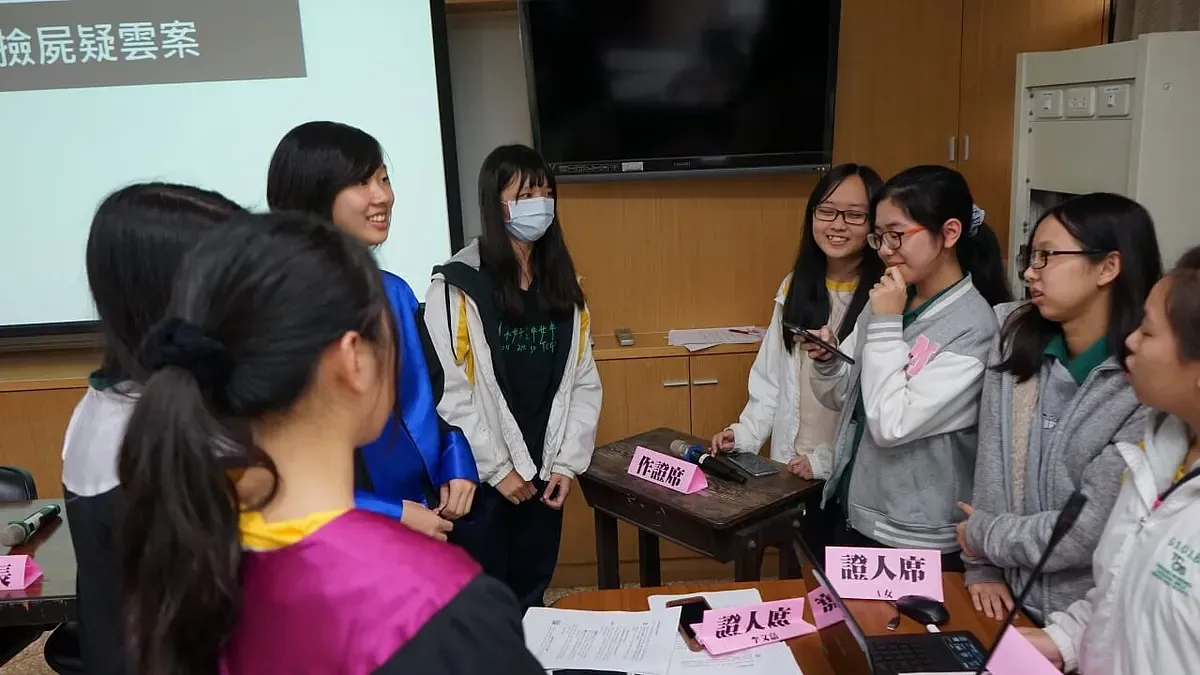
Photo / JRF Campus Mock Jury Trial @ Taichung Girls' Senior High School
In March alone, the Judicial Yuan held 36 mock trial events across 14 courts nationwide, conducting a large-scale rehearsal for the draft "Citizen Judges Act" currently under review by the Legislative Yuan. The JRF also held regional briefings nationwide on campus civic practical courses, committing to promoting mock jury trials in every classroom. Similar mock trials have been held hundreds of times over the past few years, and both official and grassroots experiences show that to resolve Taiwanese society's longstanding distrust of the judiciary, citizens must share and participate in the heavy responsibility of judicial trials.
United States civics curriculum standard SS.7.C.2.2 stipulates that middle school students must recognize that the responsibilities of U.S. citizens include obeying the law, paying taxes, defending the country, and serving as a juror. The curriculum emphasizes that the power of democracy comes from civic participation, and citizens must undertake these four responsibilities for the United States to become a safer and more livable home. The true meaning of a democratic system lies in enabling citizens to be responsible for their own decisions.
Divisions in the Legal Community Over Lay Participation Systems
The distrust between Taiwanese society and the government stems from long-term martial law rule. After the lifting of martial law, through elections of administrative heads and people's representatives at all levels, citizens were allowed to share the responsibility of organizing the government, which gradually dissolved society's distrust of the executive and legislative powers. However, because the judicial power has consistently failed to undergo democratization, society's trust in the judicial power has remained difficult to elevate. Fortunately, thousands of citizens who have participated in mock trials have stated that citizen participation in trials helps improve judicial credibility and is a democratic mechanism that judicial reform should promote.
A social consensus on legislating citizen participation in trials has already formed, and President Tsai Ing-wen has also declared this to be a core judicial reform issue that must be addressed this year. However, regarding the choice of system—whether to adopt the "lay assessor system" where citizens and judges judge together, or the "jury system" which leaves fact-finding to citizens—serious divergences of opinion have occurred within the legal community. Officials support the lay assessor system, while the private sector supports the jury system. The main reason for this divergence is also based on the experiences of the two different mock trials.
The private sector began promoting mock trials in 2012. Initially, the lay assessor system and the jury system were given equal weight, but the lay assessor system requires the participation of sitting judges to be more precise. Due to conditional limitations, subsequent private simulations focused mainly on the jury system, supplemented by the lay assessor system. Grassroots operational experience shows that the jury system is better able to correct the ills of the people's distrust of professional judges' trials.
In 2015, the official sector abandoned the "observer system" where the people "could only watch but not judge" and began holding mock trials for both the lay assessor system and the jury system. The official experience believes that Taiwan's judicial system follows the civil law tradition, and the lay assessor system used in Germany and Japan is closer to the current legal system, which can reduce the retraining costs of professional legal personnel.
Leaving the Power of Choice to the Citizens
Citizens in about 80 countries worldwide have the right to participate in judicial trials. Although jury systems outnumber lay assessor systems in classification, in reality, each country's system has its own characteristics. This phenomenon illustrates that there is no good or bad choice of system; the key lies in whether it can be tailored to national conditions. The "official version of the lay assessor system" and the "grassroots version of the jury system" drafts currently being negotiated in the Legislative Yuan are both small-scale pioneer bills designed based on mock trial experiences. Legislators can well uphold democratic principles, integrate the two systems for a joint pilot test, gather public opinion to accumulate experience, and revise them to derive the trial system best suited for Taiwanese society.
Former U.S. Supreme Court Chief Justice William Rehnquist pointed out: "The Founding Fathers believed that the right of trial by jury was an important bulwark against tyranny and corruption." This reminds U.S. citizens to have the courage to serve as jurors and defend their rights. The citizens of Taiwan have both the capability and the confidence to shoulder the responsibility of upholding judicial justice. The legal community should face this with humility and leave the power to choose between the lay assessor system and the jury system to the citizens.
※ This article was published in the Apple Daily on 2019/03/15
This article is an AI-generated translation of the original Chinese text. In the event of any discrepancy, the Chinese version shall prevail.