
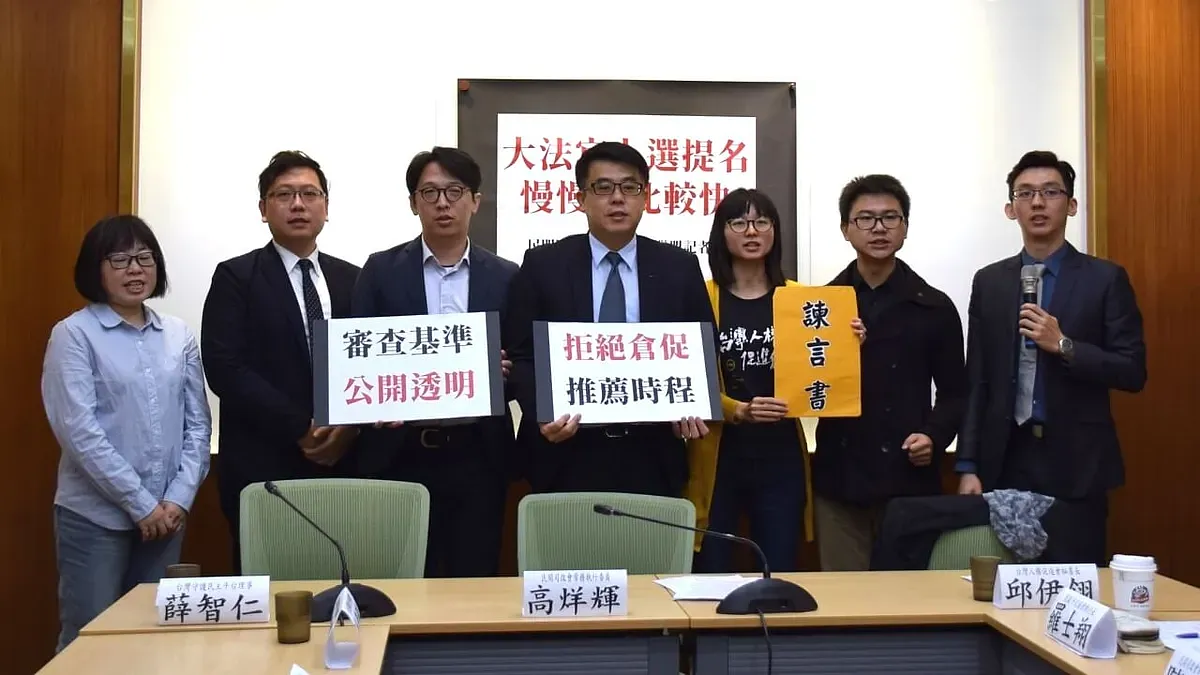
Grand Justice Nominations: Slow and Steady Wins the Race — Press Conference by the Alliance for Judicial Yuan Grand Justice Candidates Monitoring
Last edited: 2026-07-27
Grand Justices are the highest symbol of judicial power in our country and hold a revered status. Their interpretations of the Constitution and laws guide Taiwan's constitutional development, and their rulings on numerous controversial social issues repeatedly play pivotal roles. Through statistical analysis, the "Alliance for Judicial Yuan Grand Justice Candidates Monitoring" found that the annual average number of Grand Justice interpretations has increased significantly in recent years, which is worthy of external recognition.
Four Grand Justices will complete their terms and step down this year. However, the meeting of the "2019 Judicial Yuan Grand Justice Nomination Recommendation Review Committee" held at the Office of the President on March 13 only resolved to provide the public with a mere "16 days" to recommend Grand Justice candidates to the review committee, which is far too hasty and perfunctory.
The "Alliance for Judicial Yuan Grand Justice Candidates Monitoring" held a press conference today (the 26th) at the Zhongxing Building of the Legislative Yuan to solemnly protest that this recommendation process "has been reduced to a mere formality, merely serving as window dressing with external participants." It publicly called on the review committee to ensure that the nomination and review process is timely, public, and transparent. A slow, steady, and solid review process can make the subsequent review process for Grand Justice nominations more rigorous and robust, and subject nominees to public scrutiny. Following the press conference, the Alliance mailed its "Alliance Advisory Statement" to all six members of the review committee.
-
Commending the "increase in Grand Justice interpretations in recent years, and expecting the continued improvement in both the quality and quantity of future interpretations"
According to the Alliance's statistics, since President Hsu Tsung-li took office in November 2016, the annual average number of interpretations and reasoning opinions has increased significantly, rising from approximately 9.8 interpretations per year during former President Rai Hau-min's term to an annual average of as many as 15 interpretations. The "Alliance for Judicial Yuan Grand Justice Candidates Monitoring" commends the Grand Justices for their contributions to the judiciary and constitutionalism, and hopes that the new Grand Justice nominees proposed by the review committee will similarly be optimal candidates capable of continuously improving the quality and quantity of interpretations and promoting constitutional development.
-
Protesting that "the review committee's timeframe for public nominations is only about two weeks, reducing the process to a mere formality that uses various sectors as window dressing"
The 2019 review committee was approved by President Tsai Ing-wen on March 6, but following its first meeting on March 13, it immediately announced the schedule for recommending Grand Justice nominees, allowing only 16 days for external recommendations. This timeframe is far too short and hasty, reducing the good-intentioned policy of allowing public recommendations to a mere formality. Some eligible organizations did not even receive the official document in time, or upon receiving it, had less than 10 days left to respond with candidates! The "Alliance for Judicial Yuan Grand Justice Candidates Monitoring" questions how all sectors are supposed to find suitable candidates within such a hurried timeframe, not to mention that they also need to obtain the candidate's consent and prepare the required recommendation materials within the deadline!
Such schedule planning demonstrates a "lack of sincerity" on the part of the review committee in inviting external recommendations. The Alliance questions whether the review committee already has a "pre-selected list," and whether the so-called invitation for external recommendations is merely a formality designed to drag well-meaning recommending organizations along as window dressing to go through the motions.
-
Calling for "nominees to be subject to public scrutiny, and for the Office of the President's review procedure to be timely, public, and transparent"
Compared to the composition of review committees in the past, which was overly homogenous, the "Judicial Yuan Grand Justice Nomination Review Committee" established this year has added representatives from the academic community, which raises expectations that the review committee will be more pioneering and pluralistic.
However, given past nomination experiences, once the review committee announces the list of Grand Justice nominees, the public has no way of knowing the final reasons why each recommended person was "nominated" or "not nominated." The Alliance calls on the review committee to explain to the public how it determines the "review criteria" for nominees. More importantly, after the President announces the nominations, the resumes of the nominees (including educational and professional background, property, tax status, etc.) should be published online for public review.
Appendix
- Advisory Statement to the Judicial Yuan Grand Justice Nomination Review Committee
-
Table 1: Statistics on the Number of Interpretations During the Terms of the Past Two Judicial Yuan Presidents
President Term Start Term End Cutoff Date Years in Office Number of Interpretations Annual Average of Interpretations Rai Hau-min 2010/10/13 2016/10/31 2019/3/1 6.1 59 9.8 Hsu Tsung-li 2016/11/1 - 2019/3/1 2.3 35 15.0 ※ Note: Years in office calculated up to 2019/03/01, rounded to the first decimal place -
Table 2: Statistics on the Number of Interpretations from 2010 to March 2019
Year 2010 2011 2012 2013 2014 2015 2016 2017 2018 2019.3 Interpretations 14 12 12 9 10 8 9 16 14 2
Attending Representatives
Lo Shih-hsiang / Executive Director, Taiwan Association for Innocence
Hsueh Chih-jen / Board Director, Taiwan Forever Democracy Project
Chiu Ee-ling / Secretary General, Taiwan Association for Human Rights
Kao Yang-hui / Standing Executive Committee Member, Judicial Reform Foundation
Tseng Chao-yuan / Senior Researcher, Awakening Foundation
Chen Yen-gen / Staff Attorney, Judicial Reform Foundation
Alliance Members
Citizen's Congress Watch
Taipei Bar Association
Taiwan Association for Human Rights
Citizen's Congress Watch (Note: repeat in original)
Taiwan Association for Innocence
Taiwan Forever Democracy Project
Awakening Foundation
Judicial Reform Foundation
(Note: Sheh-she / Society of Wilderness or similar scholarly community - translating '澄社' as Cheng-She / Society of Social Scientists or keeping as Cheng She)
Cheng She
Press Contact
Attorney Chen Yen-gen, Judicial Reform Foundation (02)2523-1178
This article is an AI-generated translation of the original Chinese text. In the event of any discrepancy, the Chinese version shall prevail.