
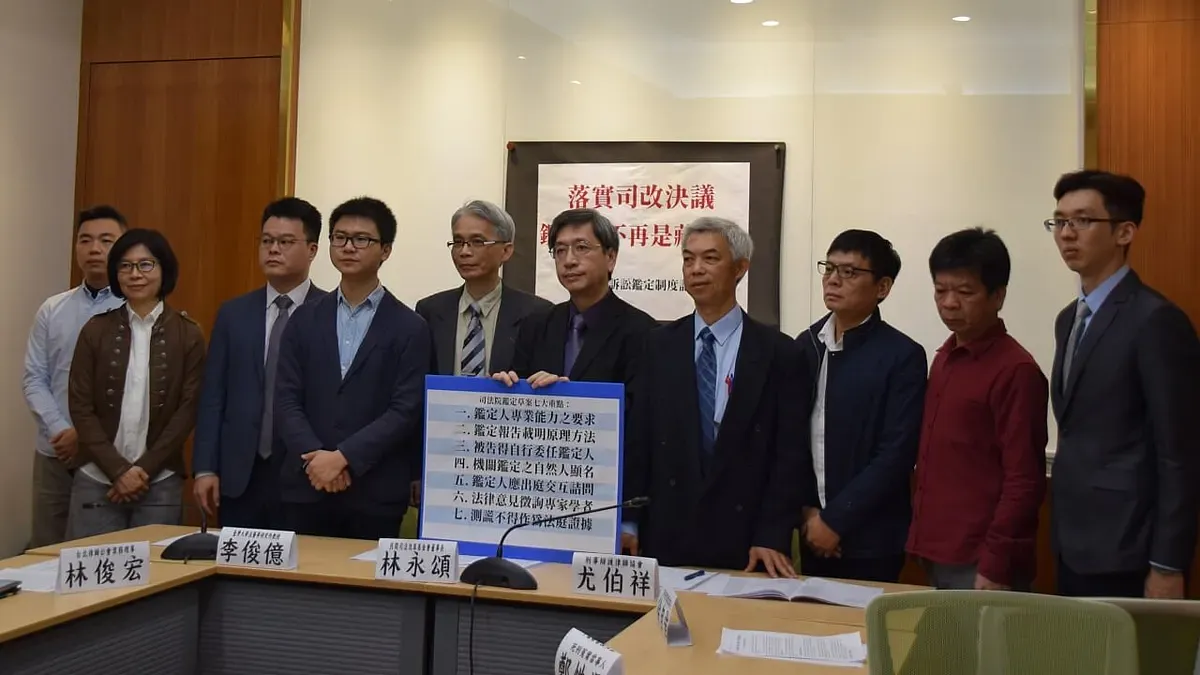
Joint Statement Regarding the Judicial Yuan's Public Hearing on Expert Testimony Held on February 20
Last edited: 2026-07-27
Regarding the public hearing held by the Judicial Yuan on February 20 regarding the "Draft Amendment to Certain Provisions of the Code of Criminal Procedure Concerning Expert Testimony (hereinafter referred to as the Draft)," as this system involves major reforms to the expert testimony chapters of the Code of Criminal Procedure and bears upon the success or failure of judicial reform, the Judicial Reform Foundation (hereinafter referred to as the JRF), the Taipei Bar Association, the Criminal Defense Lawyers Association, the Taiwan Association for Innocence, Professor Li Chün-i of the Graduate Institute of Forensic Medicine at National Taiwan University, and Professor Hsiao Hsü-feng of the Department of Entomology at National Taiwan University jointly state as follows:
-
The Draft incorporates new requirements for the quality of expert testimony, which helps discover the truth and prevent wrongful convictions
In the course of conducting wrongful conviction rescue work, the JRF has found that many miscarriage of justice cases occurred due to erroneous expert reports. For example, in the Chiang Kuo-ch'ing case, the forensic report's determination of the murder weapon and DNA did not match the facts. To prevent erroneous expert reports from producing wrongful convictions, the Draft references Rule 702 of the Federal Rules of Evidence in the United States. In addition to requiring expert witnesses to possess a certain level of professional competence, it also stipulates that expert reports must set forth matters sufficient to ensure the quality and procedures of the testimony, such as the principles and methods applied. Furthermore, the Draft requires that individuals performing expert testimony must be named and that, as a rule, they must appear in court to undergo cross-examination, thereby subjecting the expert witness's opinions to scrutiny by both parties. Finally, the Draft also grants both parties the right to independently appoint expert witnesses, thereby realizing the principle of equality of arms.
-
The Draft expressly excludes the admissibility of polygraph evidence, which is worthy of affirmation
Polygraphs use instruments to measure physiological changes such as blood pressure, pulse, respiration, and galvanic skin response when a test subject answers questions, and the examiner interprets the data as the basis for whether the subject is lying. However, everyone's physiological reactions when lying vary, and the data is interpreted by the examiner. When the same person is tested under different circumstances, identical conclusions cannot be obtained; thus, it lacks the possibility of repeated testing and is devoid of "replicability." Moreover, polygraph results can also be erroneous when the test subject's memory is faulty. This is a severe inherent defect of polygraphs and cannot be mentioned in the same breath as DNA or other forms of expert testimony.
Polygraphs have furthermore led to multiple major wrongful convictions. For instance, investigations by the Control Yuan concluded that supervisory and operational oversights in polygraph testing were discovered in cases such as the "Chiang Kuo-ch'ing case accused of sexual assault and murder of a young girl," the "Lü Chieh-min case accused of murder," and the "theft case at the ammunition depot of the Air Force Taoyuan Base," and an investigation report was submitted in July 2018. In addition, scholar Wang Chao-pêng has argued that polygraphs possess testimonial characteristics and should be subject to the privilege against self-incrimination. Therefore, the Draft's exclusion of the admissibility of polygraph evidence avoids confusing the submission of evidence in trials and is worthy of affirmation.
-
Hopes for smooth passage and recommendations for future amendments
Conclusion Item 13 of the Judicial Reform National Consultative Conference resolutions recommended that the Judicial Yuan study and enact a specialized Evidence Act, review the current expert testimony system, prudently consider the evidentiary admissibility of polygraphs, and establish evidence custody and chattel safekeeping systems. This Draft proposes amendments addressing both the current expert testimony system and polygraph evidence, which is highly commendable. The JRF looks forward to the smooth passage of the Draft and hopes that the Judicial Yuan will also make progressive amendments regarding other parts in the future, thereby establishing a more comprehensive expert testimony mechanism to discover the truth and protect human rights.
Joint Signatories
Judicial Reform Foundation
Taipei Bar Association
Criminal Defense Lawyers Association
Taiwan Association for Innocence
Professor Li Chün-i, Graduate Institute of Forensic Medicine, National Taiwan University
Professor Hsiao Hsü-feng, Department of Entomology, National Taiwan University
This article is an AI-generated translation of the original Chinese text. In the event of any discrepancy, the Chinese version shall prevail.