
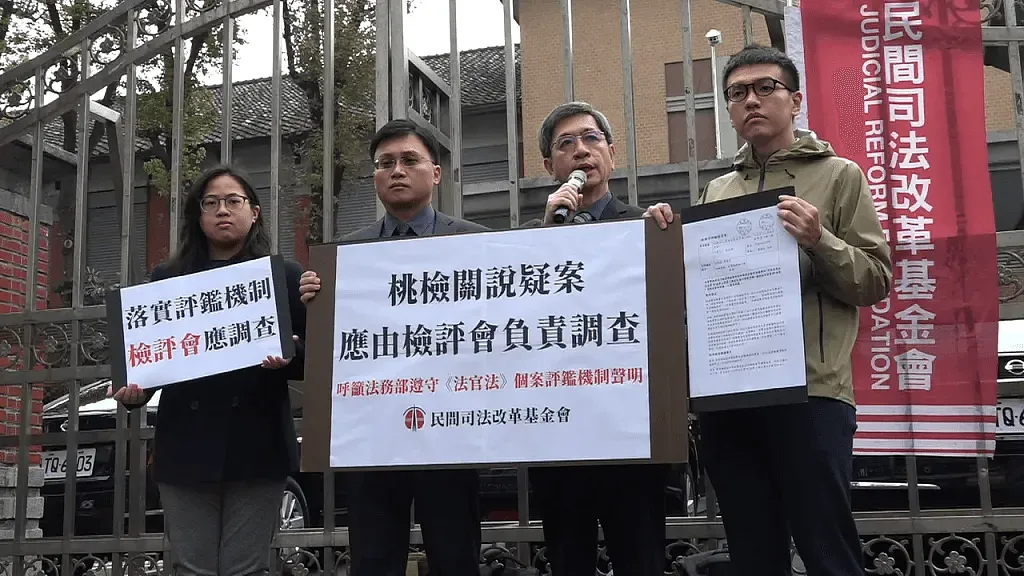
The Alleged Lobbying Case Involving the Taoyuan District Prosecutors Office Should Be Investigated by the Prosecutor Evaluation Commission—Calling on the Ministry of Justice to Comply with the Individual Case Evaluation Mechanism under the Judges Act
Last edited: 2026-07-27
Regarding the alleged lobbying case involving Chief Prosecutor P'eng K'un-yeh of the Taoyuan District Prosecutors Office, our Foundation filed a petition with the Prosecutor Evaluation Commission yesterday requesting an individual case evaluation. We hereby issue three statements as follows:
-
This Case Falls Within the Scope That the Evaluation Commission Should Open for Investigation
Article 89, Paragraph 4, Subparagraph 5 of the Judges Act stipulates: "Serious violation of case-handling procedural regulations such as non-disclosure of investigations or occupational regulations, resulting in serious circumstances." If a prosecutor meets the grounds of this subparagraph, an individual case evaluation shall be instituted. Furthermore, when the factual circumstances of a case are unclear but involve judicial integrity and serious circumstances, the Evaluation Commission should likewise conduct an investigation. In the 2013 lobbying case involving Chief Prosecutor Ch'en Shou-huang of the Taiwan High Prosecutors Office, the Prosecutor Evaluation Commission investigated pursuant to this provision and ultimately recommended the disciplinary measure of a warning (102-Nien-Chien-P'ing-Tzu Decision No. 16). Since this case similarly involves a chief prosecutor suspected of lobbying, the Prosecutor Evaluation Commission should naturally investigate whether there were any deficiencies in the performance of official duties.
-
This Case Should Be Investigated by the Prosecutor Evaluation Commission
At present, this case is being internally investigated by a special task force established by the High Prosecutors Office; however, Chief Prosecutor P'eng K'un-yeh was also reassigned to the High Prosecutors Office following this incident. Such an investigative procedure is likely to invite doubts of officials protecting one another. The suspected lobbying by the Taoyuan District Prosecutors Office chief prosecutor touches upon the gravest matters of judicial fairness. We call upon the Ministry of Justice to abide by the individual case evaluation mechanism under the Judges Act when confronting similar cases, leaving the investigation to the Prosecutor Evaluation Commission—which is predominantly composed of external members—so that the outcome may command the public's trust. To this end, our Foundation has proactively requested an individual case evaluation and also calls upon the Ministry of Justice to transfer its internal investigation materials to the Evaluation Commission and cooperate with the evaluation and investigation in accordance with the law.
-
The Portion Involving Political Appointees Should Be Proactively Investigated by the Control Yuan
Yesterday, media outlets revealed that former Minister of Justice and current Chief Advisor to the National Security Council of the Office of the President, Ch'iu T'ai-san, was the source of the petition in this case, and indicated that it was only after the Ministry of Justice investigation team uncovered this fact on the 24th that incumbent Minister of Justice Ts'ai Ch'ing-hsiang decided to transfer P'eng K'un-yeh back to the Taiwan High Prosecutors Office. At present, the public prosecutors, Chief Prosecutor P'eng K'un-yeh, and Advisor Ch'iu T'ai-san have given conflicting public statements, leaving the truth unclear. Because Ch'iu T'ai-san is a high-ranking political appointee, he is not a subject of individual case evaluations under the Judges Act. Our Foundation calls upon the Control Yuan to proactively intervene and investigate, to neither wrong the innocent nor shield the guilty, and to clarify the truth of the incident.
Press Contacts
Lin Yung-sung, Attorney-at-Law, Chairperson, Judicial Reform Foundation
Hsiao Yi-min, Office Director, Judicial Reform Foundation
This article is an AI-generated translation of the original Chinese text. In the event of any discrepancy, the Chinese version shall prevail.