
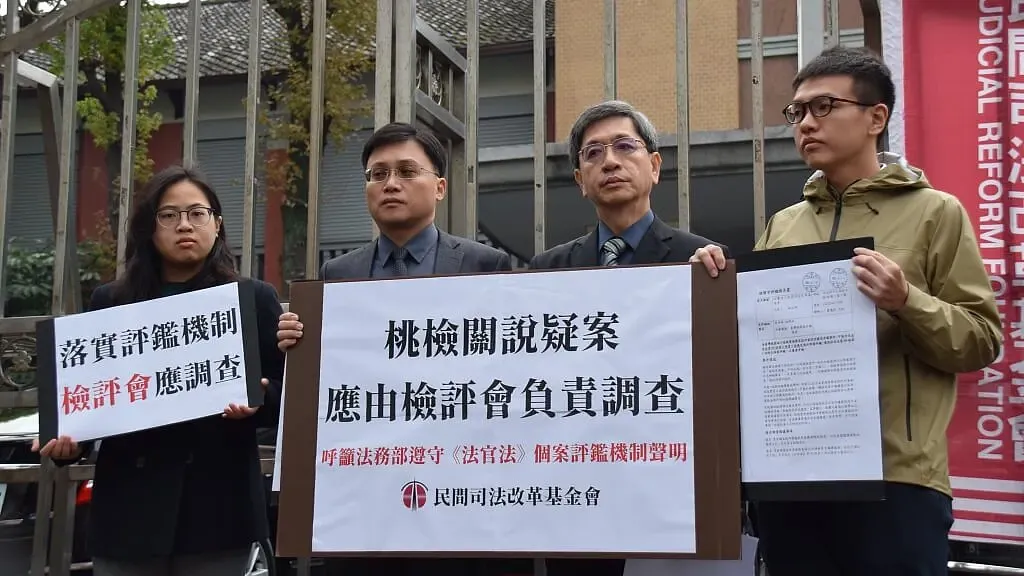
The Disappearing Civil Society Oversight Mechanism in the Judges Act
Last edited: 2026-07-27
The long-delayed draft amendment to the Judges Act proposed by the Judicial Yuan was finally sent to the Legislative Yuan last week, and a public hearing was scheduled today to solicit public opinion. This draft claims to be designed in accordance with the resolutions of the National Judicial Reform Conference, but from the perspective of civil society, it is a countercurrent that opposes reform under the banner of reform. Not only does it fail to address the current difficulties in implementing the Judges Act, but it will also make it even harder to weed out incompetent judges and prosecutors.
The ineffective weeding-out function of the Judges Act is primarily due to the fact that the Evaluation Committees for Judges and Prosecutors can only handle "case-specific evaluations" referred by institutional bodies, and cannot conduct "comprehensive evaluations" of all judges and prosecutors. This causes the evaluation committees to miss the forest for the trees, rendering them unable to grasp the overall picture to screen out incompetent personnel. Moreover, due to limited authority, it is difficult to hire full-time evaluation committee members and caseworkers, resulting in poor case-investigation quality. Coupled with the fact that current part-time members are mostly legal experts lacking non-legal perspectives, the effect of external oversight cannot be truly realized. The National Judicial Reform Conference had resolved to improve all of these aforementioned flaws, yet the Judicial Yuan's draft completely fails to address them.
Civil Society Groups May Struggle to Request Evaluations
According to an investigation report released by the Control Yuan this January, over the six years since the implementation of the Judges Act, case-specific evaluations filed by the Judicial Reform Foundation accounted for 65% of the total cases received by the Judges Evaluation Committee, and an even higher 88% of those received by the Prosecutors Evaluation Committee. These statistics prove that the "civil society oversight mechanism" is the key to the smooth operation of case-specific evaluations under the Judges Act! However, the Judicial Yuan's draft deletes the civil society oversight mechanism stipulated in Article 35, Paragraph 1, Subparagraph 4 of the Judges Act—meaning that people's organizations headed by the Judicial Reform Foundation will lose their eligibility to request case-specific evaluations of judges and prosecutors after the amendment.
The background for incorporating the civil society oversight mechanism into the Judges Act was the succession of judicial and prosecutorial corruption scandals in 2010. To weed out incompetent judges and prosecutors, civil society advocated for the establishment of an independent "Evaluation Foundation" outside the Judicial Yuan and the Ministry of Justice to directly accept public complaints. However, at the time, the Judicial Yuan and the Ministry of Justice opposed allowing citizens to directly file complaints against judges and prosecutors, and were only willing to establish internal "Evaluation Committees" to strengthen self-discipline. Ultimately, through cross-party legislative negotiations, it became "Evaluation Committees" under the jurisdiction of the Judicial Yuan and the Ministry of Justice with a majority of external members, where citizens could only lodge complaints with courts, prosecutors' offices, bar associations, and civil society organizations, indirectly petitioning official bodies for case-specific evaluations.
The prohibition against citizens directly requesting evaluations of judges and prosecutors caused public grievance, leading to the National Judicial Reform Conference's resolution that the law should be amended to improve this. Now, the Judicial Yuan's draft has finally been changed to allow "parties and crime victims" to directly request evaluations, but uses this as a pretext to strip civil society organizations of their qualification to make requests. Originally, the institutions and organizations permitted to accept public complaints under the Judges Act included courts, prosecutors' offices, bar associations, and civil society organizations, but this time the Judicial Yuan's amendment deliberately deleted only the eligibility of civil society organizations to request evaluations. This results in the best-performing entities being disqualified, raising suspicions that the authorities are intentionally weakening oversight power.
Secondly, vulnerable and helpless parties as well as crime victims who are unwilling to be exposed cannot possibly request case-specific evaluations without the assistance of civil society organizations, let alone participate in complex and professional evaluation procedures. Taking the evaluation case of Judge Ch'en Ch'iu-yueh as an example, after she began handling debt-readjustment cases in September 2015, the number of debt-rehabilitation rulings issued by the Taichung District Court plummeted sharply. After civil society organizations discovered the problem, they struggled to find a party willing to file a complaint, the reason being that debtors trapped in credit card debt were economically vulnerable and dared not come forward to offend a judge. Fortunately, the Judicial Reform Foundation was qualified to independently initiate case-specific evaluations, allowing it to represent debt-trapped individuals in accusing the judiciary of injustice. Ultimately, Judge Ch'en Ch'iu-yueh was transferred away from the debt-readjustment division, and in 2018 the number of debt-rehabilitation rulings by the Taichung District Court immediately rebounded, demonstrating the importance of the civil society oversight mechanism.
Weeding Out Incompetent Judicial Officers
Finally, in major cases of judicial lobbying and corruption, the parties involved are either unidentified or are the ones who bribed the judges and prosecutors in the first place, and thus would never come forward to request a case-specific evaluation. Recently, in the physician tax-evasion lobbying case exposed at the Taichung District Court and Prosecutors Office, the media revealed that a judge and a chief prosecutor were suspected of accepting lobbying from an attorney, and further exposed that the mastermind behind the scenes was suspected to be former Minister of Justice Ch'iu Tai-san. Under such a complex power structure, the involved parties obviously would not request a case-specific evaluation. Only by relying on civil society organizations to step forward and exercise oversight can the truth avoid being buried in unpublicized and opaque internal official investigations.
Reviewing the various problems in the Judicial Yuan's draft, we call upon legislators to increase and strengthen the authority of the Evaluation Committees, preserve the existing civil society oversight mechanism, and fulfill the public's most anticipated judicial reform: weeding out incompetent judges and prosecutors.
※ This article was published in the Apple Daily on 2019/04/03
This article is an AI-generated translation of the original Chinese text. In the event of any discrepancy, the Chinese version shall prevail.