
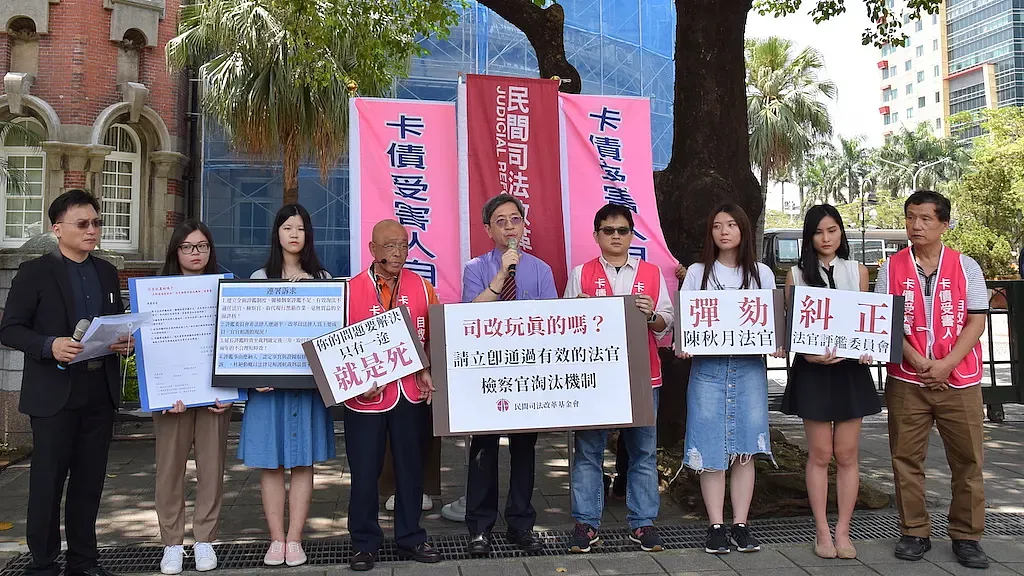
Is Judicial Reform for Real? Please Immediately Pass an Effective Elimination Mechanism for Judges and Prosecutors: Press Conference on Reporting Judge Ch'en Ch'iu-yueh and the Judges Evaluation Commission
Last edited: 2026-07-27
Yesterday (the 24th), after conducting only an interpellation of the Judicial Yuan and the Ministry of Justice, the Judiciary and Organic Laws and Statutes Committee of the Legislative Yuan suspended the review of the Judges Act. Civil society is concerned that, under the obstruction of judicial bureaucrats, the judicial reform policy most valued by the public will be aborted in infancy. Today, taking the opportunity of the Debtors' Self-Help Association coming to the Control Yuan to report Judge Ch'en Ch'iu-yueh of the Taichung District Court and the members of the Judges Evaluation Commission for illegal dereliction of duty, we cite this concrete instance to illustrate the serious flaws in the current elimination mechanism for judges and prosecutors, which lacks efficacy and is difficult to operate:
-
Lacking a comprehensive evaluation system, individual case evaluations fail to effectively eliminate unfit judges
On April 24, 2017, the Debtors' Self-Help Association and our Foundation held a press conference requesting an individual case evaluation from the Judges Evaluation Commission regarding Judge Ch'en Ch'iu-yueh's illegal and abusive dismissal of cases under the Statute for Consumer Debt Clearance. Deeming the situation serious, the Taichung District Court transferred Judge Ch'en away from the specialized debt clearance division at the end of 2017, and cases under the Statute for Consumer Debt Clearance immediately rebounded in 2018 (see Appendix 1). However, after an investigation lasting one year and six months, the Judges Evaluation Commission unexpectedly resolved that the individual case evaluation against Judge Ch'en Ch'iu-yueh was unfounded (Resolution No. 106-P'ing-Tzu-3). The reasoning was that, in the absence of courtroom recordings, decisions could not be made solely on the statements of the individual lawyer and the debtor to prove that Judge Ch'en coerced parties into withdrawing their cases. The problem is, the withdrawal rate for debt clearance cases handled by Judge Ch'en is approximately 70% to 80%, far exceeding the national average. If a comprehensive evaluation had been initiated, the overall situation would have demonstrated that Judge Ch'en clearly had a problem of coercing withdrawals. The lesson of this case illustrates that individual case evaluation suffers from the severe flaw of missing the forest for the trees; the Judges Act should grant the Evaluation Commission the power to conduct comprehensive evaluations in order to effectively eliminate unfit judges.
-
The Evaluation Commission is dominated by legal professionals, leading to severe mutual protection among officials
The Statute for Consumer Debt Clearance is a social welfare mechanism designed to help economically disadvantaged individuals rebuild their lives and stabilize economic development. Judges evaluation commissioners, predominantly legal professionals, lack expertise in economics and social welfare and are unable to understand the social plight of debtors. Consequently, when handling Judge Ch'en Ch'iu-yueh's abusive conduct—threatening debtors who already met the "conditions for exemption from liability" to borrow extra money from friends and family to excessively repay banks—they unexpectedly deemed it "not yet exceeding the scope of reason and necessity," which is completely divorced from reality and ignorant of the hardships faced by ordinary people (see resolution, page 56). The lesson of this case illustrates that the Evaluation Commission should incorporate scholars and experts from non-legal specialties such as economics, social welfare, or other fields to prevent evaluation reasoning that asks "why don't they eat cake" from recurring.
-
One-sidedly summoning bank personnel to shield the judge; requesters of evaluations lack the right to procedural participation
In this case, a total of three Taichung lawyers submitted written statements or testified in person to expose Judge Ch'en Ch'iu-yueh's abhorrent conduct during court hearings. Among them, a lawyer explicitly pointed out that during the court session at 09:30 on April 17, 2016, Judge Ch'en Ch'iu-yueh told a debtor:
"There is only one way to solve your problem, and that is to die." (See resolution, pages 20-27)
However, the Judges Evaluation Commission independently summoned representatives from CTBC Bank, Land Bank of Taiwan, and SinoPac Bank. Without notifying the evaluation requester, the Judicial Reform Foundation, and the lawyer-witnesses so they could be present, the Commission had the three bank representatives give testimony stating they had no recollection of hearing Judge Ch'en say "that is to die," and subsequently used this testimony to conclude that the lawyers' statements were difficult to credit, thereby shielding Judge Ch'en Ch'iu-yueh from disciplinary action. The lesson of this case illustrates that the procedural participation rights of evaluation requesters should be strengthened to supervise the Evaluation Commission from abusing procedures to shield judges.
-
Abusing the umbrella of legal interpretation to conceal the malpractices of illegal and abusive power
Article 141 of the Statute for Consumer Debt Clearance explicitly stipulates that once a debtor has settled the amount under Article 133, the judge shall issue a ruling exempting them from liability, granting the judge no discretionary space. Nor does the Statute for Consumer Debt Clearance authorize judges to convene mediation proceedings when reviewing exemption conditions. The judge evaluation resolution deemed that Judge Ch'en Ch'iu-yueh conducting mediation within exemption proceedings fell within the scope of a judge's official authority. The Commission's determination completely violates the explicit provisions of the Statute for Consumer Debt Clearance. The lesson of this case illustrates that the scope of "legal interpretations are not subject to evaluation" stipulated in the Judges Act must be reasonably narrowed; otherwise, it will become an umbrella concealing illegal and abusive acts by judges.
Launch a Petition to Urge the Immediate Passage of an Effective "Elimination Mechanism for Judges and Prosecutors"
The term of the current Legislative Yuan is drawing to a close, yet the judicial reform promise most cared about by the national populace—"eliminating unfit judges and prosecutors"—made by President Tsai Ing-wen has still not been fulfilled! At present, the draft Judges Act proposed by the Judicial Yuan and the Executive Yuan not only fails to resolve the existing malpractices of "internal disciplinary failure and weak external supervision," but also fails to strengthen the efficacy of eliminating unfit judges and prosecutors. For this reason, civil society organizations will launch a nationwide petition, calling on President Tsai Ing-wen to demonstrate her determination for reform and immediately pass an effective "elimination mechanism for judges and prosecutors" to win public support through the outcomes of judicial reform.
Petition Demands
- Establish a comprehensive evaluation system to make up for the deficiencies of individual case evaluations and effectively eliminate unfit judges and prosecutors, replacing the current black-box operation of comprehensive reviews that yields no practical benefit!
- Non-legal professionals should constitute a majority on the Evaluation Commission, reforming the current status where legal professionals are the primary members and officials protect one another!
- Extend the evaluation statute of limitations to three years after a judgment becomes final, replacing the current unreasonably short statute of limitations of two years after the conclusion of case handling!
- Evaluation grounds should incorporate "severe errors occurring in the determination of facts and the selection of evidence," putting an end to the malpractice of routinely using legal interpretations to shield poor adjudication quality!
Press Contacts
Judicial Reform Foundation: Chairman Ch'en Yung-shung, Director Hsiao I-min
This article is an AI-generated translation of the original Chinese text. In the event of any discrepancy, the Chinese version shall prevail.