
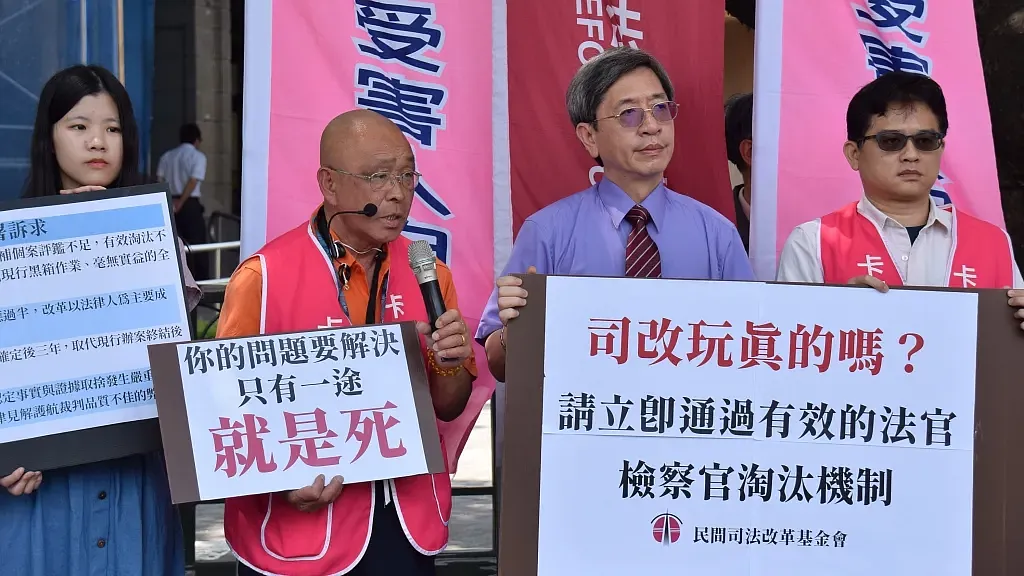
Is Judicial Reform Serious? Petition for the Immediate Passage of an Effective "Mechanism to Weed Out Unfit Judges and Prosecutors"
Last edited: 2026-07-27
As the term of the current Legislative Yuan draws to a close, President Tsai Ing-wen's judicial reform promise that the public cares about the most—"weeding out unfit judges and prosecutors"—remains unfulfilled! The Judges Act draft currently proposed by the Judicial Yuan and the Executive Yuan not only fails to resolve the existing flaws of "internal self-regulation failure and external oversight impotence," but also fails to strengthen the effectiveness of weeding out unfit judges and prosecutors. In response, the Judicial Reform Foundation has drafted the NGO Version of the Draft Amendment to the Evaluation Chapters of the Judges Act and entrusted legislators such as Yu Mei-yu (Yü Mei-nü) to jointly propose the bill. Civil society organizations believe that the following key points of the NGO version are crucial to the success or failure of the reform of the mechanism for weeding out unfit judges and prosecutors:
-
Establish a comprehensive evaluation system to make up for the inadequacy of individual-case evaluations and effectively weed out unfit judges and prosecutors. Replace the current black-box operations and completely useless comprehensive reviews!
The current Judges Act stipulates that "comprehensive reviews" of judges and prosecutors shall be handled by the "Judicial Yuan and the Ministry of Justice," with the results kept confidential. If problematic individuals are found, they should be referred for individual-case evaluations. However, among the two comprehensive reviews conducted so far, "not a single" judge or prosecutor has been transferred for individual-case evaluation and investigation. Moreover, because the results are not made public, outsiders cannot review them, rendering comprehensive reviews completely indistinguishable and in need of abolition. Civil society organizations advocate establishing a comprehensive evaluation mechanism handled by an "Evaluation Commission," with public results. Those found to be problematic shall be directly subjected to individual-case evaluation by the Evaluation Commission. The Evaluation Commission may also proactively initiate individual-case evaluations to genuinely fulfill the function of supervising judges and prosecutors.
-
Non-legal professionals should constitute a majority on the Evaluation Commission, reforming the current status quo where legal professionals are the primary members and protect one another!
Currently, the Evaluation Commission is dominated by legal professionals, and the phenomenon of "protecting one's own" has long been questioned. Civil society organizations advocate that socially impartial individuals without legal professional backgrounds should constitute a majority on the Evaluation Commission, with a gender ratio established such that neither gender shall account for less than one-third of the members, thereby avoiding legal solipsism and diversifying perspectives. Full-time evaluation commissioners and dedicated personnel should also be appointed to handle evaluation affairs, coupled with a screening mechanism to prevent frivolous requests.
-
Extend the evaluation statute of limitations to three years after a judgment becomes final, replacing the current unreasonable and short statute of limitations of two years after the conclusion of a case!
The current Judges Act stipulates that the statute of limitations for requesting an evaluation of judges and prosecutors is only two years. However, people are already exhausted by investigations and trials during litigation and simply have no time to report unfit judges and prosecutors. By the time the trial procedure concludes, the statute of limitations for evaluation has often already expired, making it impossible to request an evaluation. Civil society organizations advocate extending the evaluation statute of limitations to three years from the date a judgment becomes final, and strengthening the parties' right to participate in the evaluation procedure, granting them the right to express opinions and review materials during the procedure, so that the Evaluation Commission can more comprehensively listen to the public's grievances regarding the judiciary.
-
Grounds for evaluation should include "gross errors in fact-finding and the weighing of evidence," putting an end to the malpractice of shielding poor judgment quality under the guise of legal interpretation!
Under the current provisions of the Judges Act, legal interpretations may not serve as grounds for evaluation. However, many evaluation cases do not involve disputes over legal interpretations, yet the Evaluation Commission uses "legal interpretations cannot be evaluated" as an excuse to shield unfit judges and prosecutors, turning a blind eye to poor judgment quality. Civil society organizations advocate explicitly stipulating in the statutory provisions that situations involving "gross errors in fact-finding and the weighing of evidence" do not fall within the scope of legal interpretation, thereby eliminating the aforementioned malpractice.
The Judiciary and Organic Laws and Statutes Committee of the Legislative Yuan has currently suspended the review of the Judges Act after conducting only interpellations of the Judicial Yuan and the Ministry of Justice. Civil society organizations concerned with weeding out unfit judges and prosecutors are deeply worried that, under the obstruction of judicial bureaucrats, the judicial reform policy most valued by the entire populace will be stillborn. For this reason, civil society organizations jointly call on President Tsai Ing-wen to demonstrate the resolve to carry out reforms and immediately pass an effective "mechanism to weed out unfit judges and prosecutors" to win the public's support through judicial reform achievements.
Petition Demands
- Establish a comprehensive evaluation system to make up for the inadequacy of individual-case evaluations and effectively weed out unfit judges and prosecutors. Replace the current black-box operations and completely useless comprehensive reviews!
- Non-legal professionals should constitute a majority on the Evaluation Commission, reforming the current status quo where legal professionals are the primary members and protect one another!
- Extend the evaluation statute of limitations to three years after a judgment becomes final, replacing the current unreasonable and short statute of limitations of two years after the conclusion of a case!
- Grounds for evaluation should include "gross errors in fact-finding and the weighing of evidence," putting an end to the malpractice of shielding poor judgment quality under the guise of legal interpretation!
Cordially invited by Lin Yung-sung (Lin Yung-sung), Chairperson, Judicial Reform Foundation
Petitioning Organizations
Environmental Jurists Association
Keelung Bar Association
Taiwan Forever
Their Stories
Association for Self-Help of Debtors of Cash Cards and Credit Cards
Taiwan Social Welfare General Alliance
Taiwan Environmental Protection Union
Taiwan Association of University Professors
Presbyterian Church in Taiwan Indigenous Mission Committee
Taiwan Labour Front
Taiwan Association for Labor and Social Policy Research
Eco-Taiwan Association
Troposphere: Enabling Interactive Dialogue Between Homophilous and Heterophilous Groups
Vietnam Migrant Workers and Immigrants Office
Student Parliament of Shih Hsin University
Student Association of Fu Jen Catholic University
Garden of Hope Foundation
Department of Social Work Student Association, National Taiwan University
(Invitations for joining are ongoing)
This article is an AI-generated translation of the original Chinese text. In the event of any discrepancy, the Chinese version shall prevail.
