

The Red Lines for Overseeing Judicial Independence and Judgment Quality
Last edited: 2026-07-27
"Abuse of discretionary power" has a long history and is the most common reason for Taiwanese citizens to file complaints against judges and prosecutors. In 2001, a Taipei District Court judge turned a blind eye to the defendant's prior criminal record in the case files, failed to aggravate the sentence in accordance with the law, and even cited non-existent information while granting probation. This case drew the attention of the Control Yuan, which impeached the judge for the first time on the grounds of "abuse of discretionary power." At the same time, it published a "Special Investigation and Research Report on Cases of Judges and Prosecutors Abusing Discretionary Power in Handling Cases" to explain that overseeing the quality of judgments in finalized judicial cases does not pose a problem of interfering with judicial independence.
The Commission on the Disciplinary Measures of Public Functionaries supported the Control Yuan's view, pointing out that: "Where a judge's judgment is manifestly unlawful or manifestly violates the rules of evidence or rules of experience, and such unlawful dereliction of duty has nothing to do with the issue of judicial independence, the Control Yuan is not precluded from impeaching them and transferring the case to this Commission for disciplinary action" (No. 10095, Chien-Tzu, 2003).
Following the implementation of the Judges Act, the Judge Evaluation Commission made multiple resolutions concerning complaints about poor judgment quality, and pointed out in Resolution No. 2, Ping-Tzu, 2015: "Where the determination of facts or the subsumption, interpretation, and judgment of legal elements is such that it is already unimaginable to any person of general rationality, conscience, and rich experience that any reasonable basis exists to support such decision, and may thus be evaluated as arbitrary or manifestly unlawful..." drawing the red line of "arbitrary or manifestly unlawful" for overseeing judicial independence and judgment quality.
Because the views of the Commission on the Disciplinary Measures of Public Functionaries and the Judge Evaluation Commission only possess binding force over individual cases, in order to strengthen the oversight of judgment quality, the draft amendments to the Judges Act proposed respectively by the JRF version and by legislators such as Chou Chun-mi both referred to practical interpretations. They added a proviso to the existing text of Article 30, Paragraph 3—which states that "The interpretation of the application of law shall not serve as the basis for individual judge evaluations"—to read: "Provided, however, that this shall not apply to (manifest) errors in the subsumption between facts and law." Unexpectedly, the draft triggered strong backlash from judge and prosecutor associations as well as bar associations, who questioned that the amendment would seriously damage judicial independence.
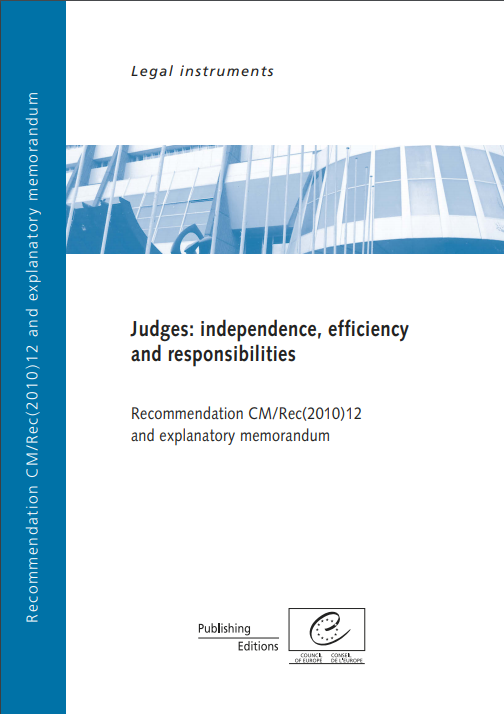 Image / Recommendation CM/Rec (2010) 12
These legal associations argue that problems with judgment quality should be resolved through hierarchical remedies and appeals, and should not serve as the basis for disciplining judges and prosecutors. The intention of the commentators to safeguard judicial independence is commendable. However, judicial independence is not merely a privilege for judges; it is also a judge's responsibility, with the purpose of protecting the people's right to a fair trial. The Committee of Ministers of the Council of Europe promulgated Recommendation CM/Rec (2010) 12 (Recommendation CM/Rec (2010) 12) in 2010, regulating the oversight red lines for the "civil, criminal, and disciplinary liabilities" of judges belonging to member states of the European Convention on Human Rights.
Recommendation CM/Rec (2010) 12 is a legal document formulated in accordance with a treaty, serving as a common code of judicial conduct for the 47 member states of the European Convention on Human Rights. Among them, the civil and disciplinary liability of judges is stipulated in Paragraph 66: "Judges should not be subject to personal liability, whether civil or disciplinary, for their interpretation of the law, assessment of facts or weighing of evidence in a given case, except in cases of malice or gross negligence." It further stipulates in Paragraph 68 that judges shall bear criminal liability in cases of "malice." While the principle respects judges' application of law and determination of facts in individual cases, exceptions are made for "malice or gross negligence" under which judgment quality may be overseen.
The European standard that proper oversight of judgment quality does not impair judicial independence was incorporated into Article 7-1, Paragraph 3 of the Universal Charter of the Judge by the International Association of Judges in 2017. Although the Charter is a soft law without treaty binding force, Taiwan, as a member of the association, ought to actively comply with the Charter's norms to win the respect of the international community.
Judicial reform touching upon judgment quality—the core of adjudication—inevitably triggers backlash and skepticism, which is understandable. Facing controversy, we should engage in positive communication to find solutions that avoid harming judicial independence while properly overseeing judgment quality. For example, instead of amending the original text of "legal interpretation" in Article 30, Paragraph 3 of the Judges Act, we could instead amend Article 30, Paragraph 2, Subparagraph 1 of the Judges Act to read: "Where there are facts sufficient to recognize that, due to intentional intent or gross negligence, the adjudication of a case contains obvious and significant errors, resulting in severe infringement upon people's rights. Where the determination of facts seriously violates the rules of evidence, it shall be deemed gross negligence." This may draw an appropriate oversight red line between judicial independence and judgment quality.
Reforming "abuse of discretionary power" is the sincere expectation of the people. Resorting to conspiracy theories or political smearing does not help solve the problem. Aligning with international norms and seeking win-win solutions is the only right and sound path to enhancing judicial trust.
※ This article was published in the Apple Daily on May 30, 2019
This article is an AI-generated translation of the original Chinese text. In the event of any discrepancy, the Chinese version shall prevail.