
Judicial Trust: How Far is This Step?
Last edited: 2026-07-27
Most people dislike going to court, and those who have no choice but to do so naturally expect a fair trial. However, many citizens who pass through courts or prosecutors' offices experience bad attitudes, bias, poor and sloppy quality, as well as lengthy and delayed procedures.
Every survey on public trust in the judiciary yields pathetically low results, and incompetent judges and prosecutors bear the primary responsibility. Yet, we cannot help but ask: why do these incompetent judicial personnel continue to exist within the judicial system, undermining judicial trust without being weeded out?
Chief judges and chief prosecutors, who bear the duty of supervision, are well aware of which judges and prosecutors have terrible attitudes or are sloppy and perfunctory. However, constrained by personal ties, they protect and cover for each other. Unless exposed by the media or the outside world, they rarely take the initiative to handle such matters, rendering administrative supervision ineffective.
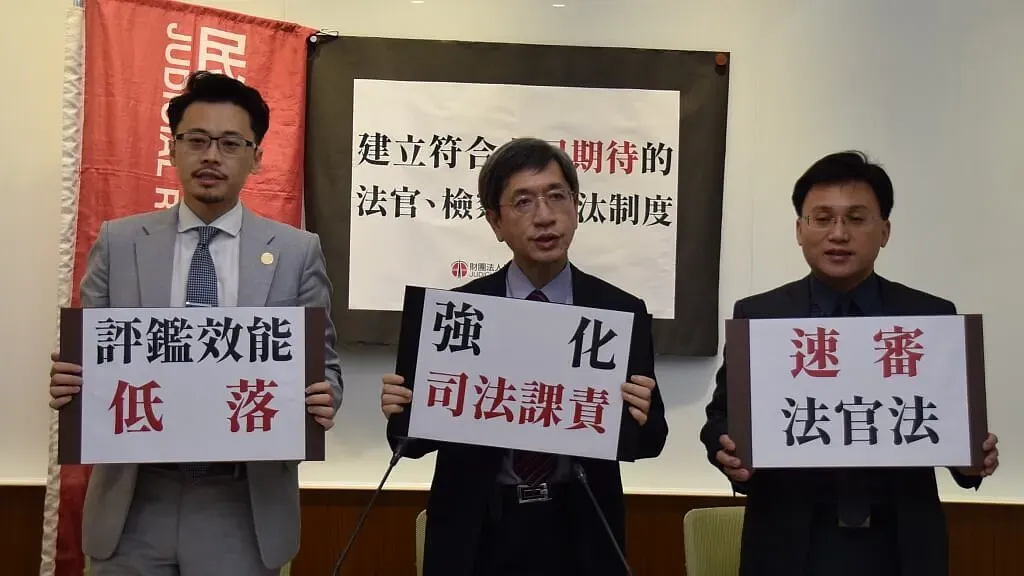
In 2012, the judge and prosecutor evaluation mechanisms stipulated in the Judges Act began implementation, hoping that evaluation committees with external members would fulfill the function of weeding out incompetent judges and prosecutors. After more than seven years, however, it has become apparent that the system has increasingly devolved into mutual protection among officials, showing poor performance and failing to achieve its expected goals. Why is this the case? The main reasons are as follows:
-
Excessively Short Time Limits
According to current regulations, requests for the evaluation of judges and prosecutors must be submitted within two years of their judgment or indictment. At this stage, the case is usually not yet final, and parties often dare not submit an evaluation request for fear of adverse consequences to their case. By the time the case becomes final, the deadline for requesting an evaluation has already passed. Over the past seven years or so, 16 prosecutor evaluation cases encountered procedural issues, 12 of which exceeded the two-year time limit. If citizens petition the Control Yuan directly, no such restriction applies. Is the judge and prosecutor evaluation system ultimately a weeding-out mechanism, or a mechanism to protect incompetent judges and prosecutors? The amendment draft to the Judges Act proposed by the Judicial Yuan merely changes the aforementioned two-year period after judgment or indictment to three years, which fails to solve the problem. The NGO version of the amendment draft changes this to three years after the judgment becomes final, which can truly resolve the issue.
-
Lack of Procedural Safeguards
Under the former Judges Act, entities eligible to request evaluations included courts, prosecutors' offices, bar associations, and more than ten civic organizations approved by the Ministry of Justice. Over the past seven years or so, more than half of the evaluation cases were brought by the Judicial Reform Foundation on behalf of the public. However, as evaluation requesters, they had no right to appear and make statements, request the investigation of evidence, or review case files. After the JRF requested an evaluation, it had no way of knowing how the evaluated judge or prosecutor presented their defense, nor how the Evaluation Committee conducted its investigation, and thus could not provide further clarification on behalf of the public. Over the past seven years, evaluation resolution documents have revealed that the Evaluation Committee frequently gave credence to the absurd defenses of the evaluated judges and prosecutors, or misconstrued relevant laws and evidence. Surprisingly, the amendment draft to the Judges Act proposed by the Judicial Yuan stipulates that evaluated judges and prosecutors may review case files, whereas the citizens requesting the evaluation may not, and the Evaluation Committee may also refuse to provide the written opinions submitted by the evaluated judges and prosecutors. With such an unfair evaluation procedure, how can a weeding-out mechanism function? The NGO version of the draft explicitly stipulates that the requester has the right to appear and make statements, apply for the investigation of evidence, and review case files.
-
Conservatism and Protectionism Among Legal Professionals
Current provisions of the Judges Act dictate that the Evaluation Committee is composed of judges, prosecutors, attorneys, and experts and scholars. While the first and second terms still included non-legal scholars, all four experts and scholars from the third term onward have been legal scholars. An Evaluation Committee consisting entirely of legal professionals exhibits conservatism and protectionism, as seen in the following examples:
- A judge used pretrial detention to coerce a defendant into confessing and implicating accomplices. Although the Evaluation Committee also sampled other cases and found improper circumstances, the evaluation resolution astonishingly concluded that because the judge had no disciplinary record, possessed a good performance evaluation history over the years, and there was no need for disciplinary action, the matter should merely be referred to the Personnel Review Committee of the Judicial Yuan for administrative supervision, without needing to be referred to the Control Yuan for investigation. A judge extracting confessions through detention is a serious violation of the law and may even constitute criminal liability under Article 125 of the Criminal Code. Yet, the Evaluation Committee deemed that an evaluation was unnecessary. If this is not shielding wrongdoing, what is?
- A judge handling card debt cases saw 80% of the cases withdrawn—vastly higher than the average withdrawal rate of 10%. Attorneys and debtors came forward to explain how the judge coerced withdrawals, yet the Evaluation Committee deemed the evaluation unfounded based on statements from bank representatives claiming they could not remember, among other things. For low-income households applying for liquidation, the judge groundlessly demanded that the debtors borrow another one million NT dollars to repay the bank before they could be exempted from liability. Despite such blatant violations of legal provisions, the Evaluation Committee's resolution upheld that this fell within the judge's discretionary authority of legal interpretation and application, thereby dismissing the evaluation. Composed entirely of legal professionals, the Evaluation Committee went so far as to distort the law and disregard the suffering of vulnerable individuals in order to shield and cover for the judge.
- A summary court judge scheduled court sessions for only one half-day per month, hearing over 50 cases—allowing less than five minutes per case. The judge refused to let parties make statements and repeatedly demanded settlements, making numerous inappropriate and sarcastic remarks such as: "Are your hands clean?" "Two people cheating the country out of money yet asking the country's judge to uphold justice!" "You are the one stirring up trouble," "Your sincerity makes my heart very cold," and "Isn't this just like North Korea?" For such a derelict and sloppy judge to refuse parties the opportunity to speak during proceedings, demand settlements, and make sarcastic remarks—if we were the parties to the case, would we consider such a judge competent? Astonishingly, the Evaluation Committee deemed the circumstances not serious and merely asked the court in question to issue a reminder, holding that an evaluation was unnecessary.
As seen from these three cases, the Evaluation Committee requires the inclusion of non-legal professionals. On one hand, this avoids overlapping personal relationships; on the other hand, it introduces diverse perspectives. The Judicial Yuan's amendment version makes no mention of the number of non-legal evaluation members, whereas the NGO version clearly stipulates that non-legal members must constitute a majority. It is our hope that the Legislative Yuan will perceive public sentiment and actual conditions and adopt the NGO version.
-
Insufficient Manpower
The Judges Evaluation Committee has only four staff members, and the Prosecutors Evaluation Committee has only one. It is evidently difficult for them to shoulder the massive workload of evaluation cases. In contrast, the Control Yuan has dozens of investigators, some of whom possess attorney qualifications. If the Evaluation Committees are to receive direct evaluation requests from the public in the future, they must be provided with adequate staffing possessing specific qualifications.
-
Public Unable to Directly Apply for Evaluations
Under the current Judges Act, the public can only request evaluations through institutions or civic organizations. Both the Judicial Yuan version and the NGO version amend this to allow the public to request evaluations directly. However, while the court version eliminates civic organizations as eligible evaluation requesters, some vulnerable populations—such as card-debt holders and migrant workers—may not dare or be capable of requesting evaluations directly. Furthermore, some cases requiring evaluation have no individual parties involved. Therefore, in addition to allowing direct public requests, the NGO version also retains civic organizations as eligible evaluation requesters.
-
Evaluations Do Not Extend to Judicial Quality
Currently, the Evaluation Committees largely focus their reviews on attitudes and procedural compliance, frequently rejecting evaluations of judges' and prosecutors' trial or investigative quality under the pretext that legal interpretations are not subject to evaluation. However, public dissatisfaction with the judiciary extends beyond attitude and procedural compliance; the public also cares deeply about quality. The NGO version's position is that fact-finding, evidence weighing, and legal application by judges and prosecutors should generally not be subject to evaluation, except in cases of intentional misconduct or gross negligence. European countries adopt this very view.
※ This article was published in ETtoday News Cloud on June 5, 2019
This article is an AI-generated translation of the original Chinese text. In the event of any discrepancy, the Chinese version shall prevail.