
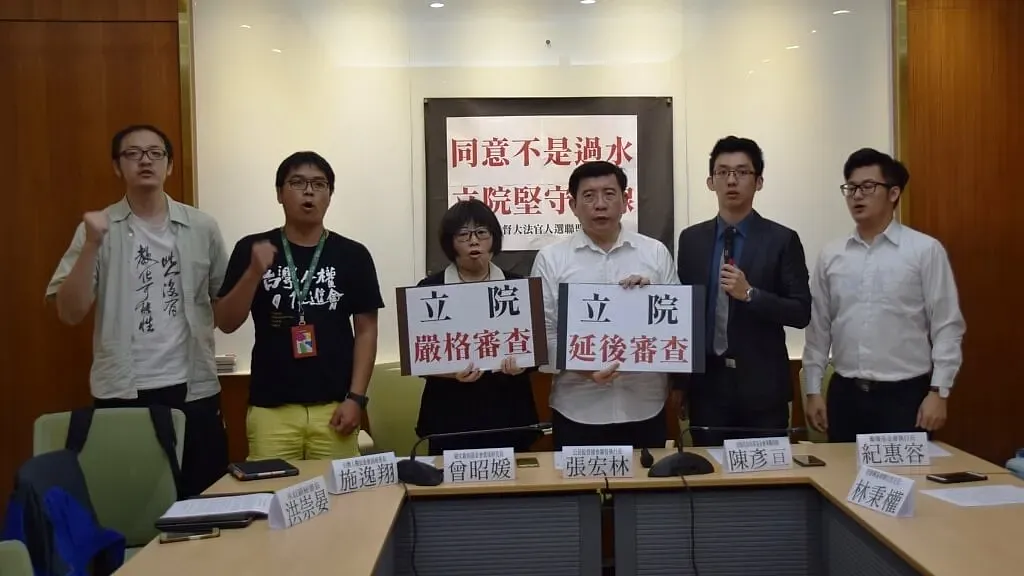
Consent Is Not a Mere Formalicley, Legislative Yuan Must Hold the Line—Alliance for Citizen Monitoring of Grand Justice Nominees Press Conference
Last edited: 2026-07-27
The Alliance for Citizen Monitoring of Grand Justice Nominees (referred to as the Alliance), composed of 13 civil society organizations, held a press conference today (the 13th) at Room 101, Chung-Hsing Building, Legislative Yuan, to strongly protest the Legislative Yuan's rush to hastily complete the consent confirmation for Grand Justice nominees during an extraordinary session without giving the general public at least one month to express their opinions on the presidential nominees. The Alliance solemnly calls upon the Legislative Yuan to postpone the review of the Grand Justice personnel consent and establish a comprehensive review procedure. Party caucuses and legislators should also proactively gather opinions from the Grand Justice nominees and civil society organizations to concretely examine whether the nominees are qualified. In addition, the Alliance has proposed 17 questions to the Grand Justice nominees, calling upon them to provide detailed and truthful responses.
On May 27, the President nominated four individuals as Grand Justices and submitted a formal request to the Legislative Yuan for consent: Yang Hui-chin (楊惠欽), Judge and President of the Kaohsiung High Administrative Court; Tsai Tsung-chen (蔡宗珍), Minister of Civil Service; Hsieh Ming-yang (謝銘洋), Professor at the National Taiwan University College of Law; and Lü Ta-tar (呂太郎), Secretary-General of the Judicial Yuan, in order to succeed the Grand Justices whose terms expire on September 30. According to news reports, the Legislative Yuan will prioritize the Grand Justice personnel consent during the extraordinary session of the 7th session starting on June 17. As the Legislative Yuan is the final line of defense in determining whether Grand Justices are qualified, the Alliance issues the following statement:
-
Calling on the Legislative Yuan to Postpone the Review of the Grand Justice Personnel Consent Case to Concretely Examine Qualifications
Looking back at the last review of Grand Justice personnel consent by the Legislative Yuan in 2016, within a limited time frame, some legislators seemed to misunderstand the powers, duties, and importance of Grand Justices, demanding that the nominees recite statutory provisions, sing the national anthem, or recite English. The review content was hollow, raising questions as to whether the legislators were adequately prepared or simply treating the Grand Justice personnel consent as child's play?
Following the President's nomination of four Grand Justice candidates on May 27, the Alliance held a press conference on May 30, calling upon the Legislative Yuan to afford the general public a period of over one month to voice their opinions on the nominees, enabling legislators to gather sufficient information and deliberate appropriately. Unexpectedly, the Legislative Yuan is scheduled to prioritize the review of the Grand Justice personnel consent during the extraordinary session of the 7th session starting on June 17—merely three weeks after the presidential nomination. The general public has not had sufficient time to scrutinize the Grand Justice nominees, nor have any party caucuses or individual legislators posed questions to the nominees. Such a sloppy and hasty process neither allows the Grand Justice nominees to explain themselves clearly nor enables the Legislative Yuan and the general public to "concretely" examine their substantive qualifications.
The term of office for the current batch of Grand Justice nominees begins on October 1. It would not be too late if the Legislative Yuan postponed the Grand Justice personnel consent review to the 8th session starting in September. Taking 2016 as an example, for the Grand Justices who took office on November 1, 2016, the Legislative Yuan held public hearings in early October and conducted the review on October 13. However, this year the review has been surprisingly advanced to June for Grand Justice nominees who will not take office until more than three months later. By significantly advancing the deliberation dates this year, the Legislative Yuan inevitably raises public doubts as to whether appropriate deliberation can be carried out.
The Alliance calls upon the Legislative Yuan to postpone the Grand Justice personnel consent case until September for review. Party caucuses and legislators should also proactively pose questions to the Grand Justice nominees and gather opinions from the general public before concretely examining whether the Grand Justice nominees are qualified.
-
Calling on the Legislative Yuan to Hold Hearings and Produce a Review Report Before Submitting to the Plenary Session for a Vote
Prior to deliberating on the Grand Justice nominees in 2016, the Legislative Yuan held two public hearings, but almost no legislators participated throughout the entire process, rendering the opinions of scholars and experts useless for legislative review and reducing the public hearings to mere formalities. Furthermore, after the conclusion of the review, the Legislative Yuan failed to produce a concrete review report to be referenced by the public and legislators who did not participate in the review prior to holding a vote. Consequently, commissioners who did not attend the public hearings or participate in the review lacked sufficient information to judge whether the nominees were qualified, and the flaws in the review procedure were self-evident.
After the President announced the Grand Justice nominees this year, many legislators expressed that they would conduct a rigorous review; however, the Legislative Yuan has yet to announce the review schedule, casting doubt on whether the Legislative Yuan still intends to follow past precedent and conduct reviews and votes after holding public hearings that are mere formalities. As the final line of defense in determining whether Grand Justices are qualified, the Alliance believes that there should be a more rigorous review schedule and procedure.
Therefore, the Alliance calls upon the Legislative Yuan to transform public hearings into formal hearings, requiring nominees to attend and respond to questions from scholars and experts, thereby enhancing the quality and effectiveness of the review. The report produced after the hearing can serve as the basis for voting in the Plenary Committee. In addition, the Alliance suggests that to enable all legislators to understand the qualifications of the nominees prior to voting as a basis for approval or opposition, the congress should—after the completion of the hearing—have the participating commissioners first review the qualifications, produce a review report, and submit it to the plenary session for a vote.
Finally, Grand Justice nominees are the guardians of our constitutional system and are tied to the future well-being of the people of our nation. The nomination process for Grand Justices must be public, transparent, and cautious; furthermore, the legal interpretations and values of the nominees should be understood by the general public through strict and prudent review. The Alliance sincerely hopes that before conducting the review, the Legislative Yuan will complete the amendment to the Law Governing the Legislative Power in accordance with the direction suggested by the Alliance, making the rigorous Grand Justice review process a routine to fulfill the public's expectations of Grand Justices upholding constitutional human rights.
-
The Alliance Proposes 17 Questions to Grand Justice Nominees, Urging Active Responses
When holding a press conference on May 30, the Alliance announced the formation of an evaluation committee to question and evaluate the four nominees, and has recently mailed the 17 questions and personal background questionnaires to the four nominees. These 17 questions encompass constitutional issues such as gender, freedom of speech and the press, transitional justice, victim protection, judicial reform, and environmental and housing justice. In addition, the Grand Justice nominees were asked to self-evaluate their past performance, point out deficiencies in past Grand Justice interpretations, and express opinions on the future operation of the Constitutional Court. It is hoped that through the nominees' responses to these 17 questions with constitutional standing, they will demonstrate their scholarship, professional competence, and perspectives on constitutional human rights, allowing the general public to understand them and accept civic oversight.
The Alliance calls upon the four Grand Justice nominees to respond thoroughly and accurately to facilitate the evaluation committee's assessment. Should the nominees fail to respond, the evaluation committee will nevertheless gather relevant materials independently to conduct the evaluation. Furthermore, the Alliance will make public the 17 questions and the Grand Justice nominees' responses to facilitate legislative deliberation and external oversight.
Appendix
Attending Representatives
Chi Hui-jung (紀惠容) / Executive Director, Garden of Hope Foundation
Lin Ping-ch'üan (林秉權) / Office Director, Judicial Jury Association
Hung Chung-yen (洪崇晏) / Deputy Secretary-General, Taiwan Forever Association
Chang Hung-lin (張宏林) / Executive Director, Citizen Congress Watch
Tseng Chao-yüan (曾昭媛) / Senior Researcher, Awakening Foundation
Ch'en Yen-huan (陳彥亘) / Staff Attorney, Judicial Reform Foundation
Alliance Members
Hsueh-She
Taipei Bar Association
Taiwan Association for Human Rights
Citizen Congress Watch
Taiwan Association for Innocence
Taiwan Association for Democracy Protection
Awakening Foundation
Judicial Reform Foundation
Taiwan Criminal Defense Lawyers Association
Taiwan Forever Association
Judicial Jury Association
Environmental Jurists Association
Garden of Hope Foundation
This article is an AI-generated translation of the original Chinese text. In the event of any discrepancy, the Chinese version shall prevail.