
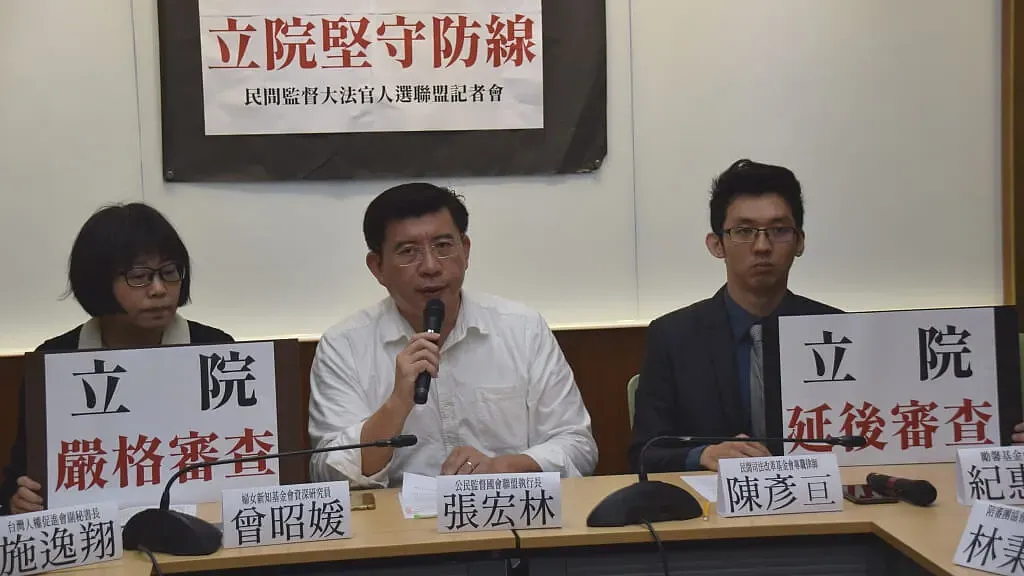
2019 Questionnaire by the Alliance for Citizens' Watch on Grand Justices Nominees
Last edited: 2026-07-27
-
The Constitution, Additional Articles of the Constitution, Local Government Act, CEDAW, and other laws all mention the quota system for women's safeguards. What are your views on the constitutionality of this type of affirmative action established by law?
-
Article 15 of the Constitution guarantees the people's rights to subsistence, work, and property, alongside emerging rights such as the right to a healthy environment, the right to health care, and cultural rights, which are generally referred to as social rights. These are also fundamental human rights protected under Article 9 of the International Covenant on Economic, Social and Cultural Rights. In the face of laws related to the annuity system, long-term care system, and childcare policies failing to provide adequate protection for socially vulnerable groups—where the coverage rate of public-interest services for long-term care and early childhood care is less than forty percent; and when the National Pension Insurance was launched, it claimed to safeguard the old-age economic security of vulnerable groups, yet it required vulnerable groups to pay high monthly premiums, causing the payment rate to drop to forty percent, with forty percent of those who have not paid (estimated at approximately 400,000 people) facing financial difficulties and being dunned by the government for premiums, with the highest arrears approaching NT$100,000, making it difficult for them to have old-age security in the future, and other issues inconsistent with the original intent of the annuity policy—how should legislative omissions or deficiencies related to social security be viewed constitutionally? How do you, as a nominee, believe constitutional requirements should be used to control and address the legislature's discretionary power in this regard?
-
In your opinion, what is the boundary for the criminal law system to intervene in intimate relationships? Under the social reality of gender inequality, women are convicted at a higher proportion than men in current judicial practice regarding the criminal punishment of the crime of adultery. Does the punishment of the crime of adultery violate the constitutional protection of gender equality?
-
How can the concept of militant democracy be interpreted through current constitutional interpretation? In particular, how should the balance be struck among national security, freedom of the press, freedom of speech, and even the right to privacy?
-
How might media property owners infringe upon freedom of the press or the public's right to receive information? How should this be prevented constitutionally?
-
In your opinion, how can transitional justice be realized through constitutional interpretation?
-
Do you support the abolition of the death penalty? Is the death penalty unconstitutional? If the death penalty is to be abolished, what accompanying complementary measures do you think should be in place?
-
Do you think the current direction of criminal justice amendments in our country places too much emphasis on the protection of defendants' human rights while neglecting the protection of victims' rights and interests?
-
Do you think that citizen participation in trials can further protect people's constitutional rights? If the answer is affirmative, what system do you think should be adopted—lay assessor system (canzhen), jury system, or another system? What are the reasons? Regardless of which of the aforementioned options is adopted, what special arrangements should be noted in the institutional design? If the answer is negative, what are the reasons?
-
To ensure the right of the people to a full, effective, and fair trial, when relevant organs consider that judges' or prosecutors' factual determinations, legal subsumption, or legal interpretations in individual cases are erroneous, and thereby exercise the powers conferred by the Constitution or laws—such as the Control Yuan impeaching judges and prosecutors, the Control Yuan issuing investigation reports and requesting relevant organs to deliberate on applying for a retrial or extraordinary appeal, the Judges and Prosecutors Evaluation Commissions conducting individual case evaluations, the adjudication by the Disciplinary Court, and the comprehensive evaluations of judges and prosecutors conducted by the Judicial Yuan and the Ministry of Justice—what are the boundaries with the constitutional protection of judicial independence? Furthermore, what is the scope of the legislature's discretionary power to form laws? What are the reasons?
-
Are there still deficiencies in the remedies for urban planning derived from Judicial Yuan Interpretation No. 742 when people initiate lawsuits targeting land use? Additionally, regarding the district land expropriation system, especially prior district expropriation occurring before urban planning, do you think there are unconstitutionality controversies?
-
Article 15 of the Mining Act stipulates the documentary materials required for applying to mine. Furthermore, Article 27 of the same Act stipulates that "Applications for establishing mining rights in the following areas shall not be approved: 1. Within strategic points, fortresses, naval ports, security zones, and locations previously cordoned off and restricted in connection with military facilities, without the consent of the competent authority. 2. Within one kilometer from the boundary of commercial ports and markets, without the consent of the competent authority. 3. Within security forest lands, reservoir catchments, scenic specific areas, and national park areas, without the consent of the competent authority. 4. Within 150 meters from the boundaries of public buildings, national burial grounds, railways, national highways, provincial highways, important factory sites, and immovable famous historic sites, without the consent of the competent authority or the land owner and land occupant. 5. In other areas where laws stipulate that prospecting and mining are prohibited without the approval of the competent authority, without the approval of the competent authority. 6. In other areas where prospecting and mining are prohibited by law." This legislation results in almost all applications being approved in practice, evidently sparking controversy over the trade-off between environmental protection and economic development. Taking the Taroko Asian Cement case and the Hsinchu Kuanhsi case as examples, if mining permits involve indigenous peoples' lands, how should the conflict between the Mining Act and Paragraph 12 of Article 10 of the Additional Articles of the Constitution be handled?
-
The Constitutional Court is about to commence operations. How can public trust in the Constitutional Court be increased? How can political interference be avoided?
-
Regarding previously issued Grand Justices' Interpretations, which one would you most want to write a dissenting opinion for?
-
In past constitutional interpretations and judicial reviews, has the adoption of methods such as the application of comparative legal systems, the invocation of international covenants, and historical and social reflection been inadequate? What are the reasons?
-
What views on social, economic, political, or other issues have your writings or judgments demonstrated? Please use this to explain your reasons for being qualified as a Grand Justice.
-
Please share the setbacks, regrets, and struggles you have encountered in the process of practicing law. What kind of public persona have you established in the past, and why are you qualified to undertake the work of a Grand Justice?
This article is an AI-generated translation of the original Chinese text. In the event of any discrepancy, the Chinese version shall prevail.