
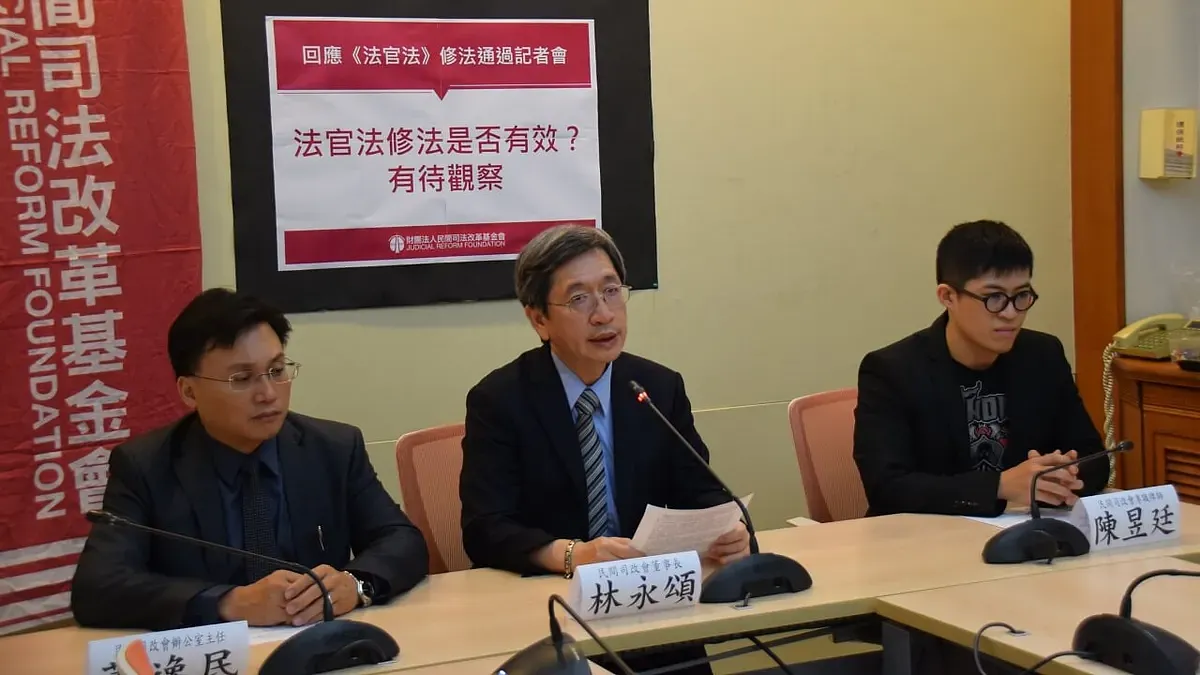
Will the Amendments to the Judges Act Be Effective? Remaining to Be Seen—Response to the Press Conference on the Passage of the Judges Act Amendments
Last edited: 2026-07-27
Public satisfaction with the judicial system remains extremely low. In response to public expectations for judicial reform, President Tsai Ing-wen convened the National Conference on Judicial Reform. Among its many resolutions, how to weed out incompetent judges and prosecutors has become one of the issues most acutely felt by the public. Certain judges and prosecutors exhibit biased and poor attitudes, fail to follow statutory procedures, and produce subpar work. The evaluation and disciplinary systems for judges and prosecutors prescribed by the 2012 Judges Act were intended to weed out incompetent judges and prosecutors through evaluation and disciplinary actions. However, after eight years of implementation, the results have been lackluster, and public dissatisfaction with the judiciary has not diminished.
The amendments to the Judges Act passed today (June 28) introduce certain changes to the evaluation mechanism and the Disciplinary Court, marking clear progress. However, several important recommendations provided by civil society organizations were not adopted. Whether the new law can effectively weed out incompetent judges and prosecutors and win public trust in the judiciary after its implementation remains to be seen. Laws rely on faithful enforcement; whether relevant agencies conscientiously implement them and abandon the mindset of officials shielding one another are also critical factors that warrant continued public oversight.
Progressive Provisions in This Amendment
-
Citizens Can Directly Request Evaluation
Prior to the amendments, citizens could only request evaluations through civil society organizations. Under the new law, parties to a case and crime victims can directly request evaluations (Article 35).
-
Reasonable Extension of the Time Limit for Requesting Evaluations
Prior to the amendments, requests for evaluating a prosecutor or judge had to be filed within two years starting from the conclusion of the investigation or the conclusion of the trial at that instance; otherwise, the statutory time limit would expire. Litigants often dared not offend judicial authorities before their lawsuits were finalized. By the time their lawsuits were concluded, the time limit to request an evaluation had already expired. The new law amends this to allow evaluation requests to be filed within three years after the conclusion of the litigation (Article 36).
-
Shortening Lengthy Relevant Procedures
Prior to the amendments, if the Evaluation Commission deemed disciplinary action necessary, it had to first refer the case to the Control Yuan, which would then submit an impeachment for the Disciplinary Court to try—a lengthy and repetitive process. The new law has been changed so that the Evaluation Commission can refer cases directly to the Disciplinary Court for trial (Article 39).
-
Procedural Protections for Evaluation Requesters
Prior to the amendments, there were no explicit provisions regarding the rights of an evaluation requester during the evaluation procedure. The new law explicitly stipulates that evaluation requesters may appear before the commission to state their opinions, apply for the investigation of evidence, and review case files (Article 41-1).
-
Adoption of the Lay Participation System in the Disciplinary Court
Prior to the amendments, the Disciplinary Court was composed of five professional judges, and retrial cases involving officials shielding one another had occurred. The new law adopts a lay participation system for the Disciplinary Court, consisting of three professional judges and two lay participants (Article 48).
Key Points Omitted from This Amendment
-
Overly Narrow Scope of Evaluation Requesters
Under the new law, the scope of individuals permitted to request evaluations is limited to parties to a case and crime victims. However, witnesses, expert witnesses, defense counsels, agents, and assistants who also interact with judges in the courtroom are excluded. Compared with the Control Yuan, where anyone may file a petition, the scope of evaluation requesters is unduly narrow. Furthermore, some vulnerable litigants—such as migrant workers and debt-laden individuals—dare not or are incapable of requesting evaluations. There are also cases where no party will request an evaluation, such as Prosecutor-General Huang Shih-ming's violation of the principle of non-disclosure of investigations. In all these situations, there is a need for civil society organizations to act as evaluation requesters. Yet, the new law excludes civil society organizations, which have submitted over half of all evaluation requests over the past eight years. This is truly regrettable. How the evaluation mechanism will change as a result remains to be observed (Article 35).
-
Failure to Explicitly Include Laypersons as Evaluation Commissioners
Before the amendments, among the 11 evaluation commissioners, four were scholars and individuals of social impartiality. In practice, however, almost all positions were held by legal professionals, frequently resulting in legal professionals shielding one another and letting judges and prosecutors who should have been referred for discipline off the hook. The new law increases the number of scholars and socially impartial individuals from four to six, but it fails to regulate the quota for non-legal professionals. Since these six members are nominated by the legal-professional Ministry of Justice and bar associations, and selected by the President of the Judicial Yuan, the majority will likely be legal professionals. Whether the toxic culture of legal professionals shielding one another can be improved remains deeply concerning. It is also contradictory that while the backend Disciplinary Court adopts a lay participation system with two non-legal professionals, the frontend Evaluation Commission fails to regulate the number of non-legal professionals (Article 33).
-
Ineffective Comprehensive Reviews Abolished Rather Than Improved
When the Judges Act was enacted in 2011, comprehensive evaluations were replaced by comprehensive reviews conducted by the Judicial Yuan and the Ministry of Justice. These reviews were held once every three years but were not made public. The Judicial Yuan and the Ministry of Justice conducted two rounds of comprehensive reviews and failed to discover a single incompetent judge or prosecutor—a stark gap from public perception. Such an ineffective comprehensive review system should have been improved or transformed into comprehensive evaluations. Instead, the new law completely abolishes comprehensive reviews on the grounds that judicial supervision, self-regulation mechanisms, and individual case evaluations already exist. If court presidents and chief prosecutors faithfully fulfilled their duties of judicial supervision, and if self-regulation mechanisms among judges and prosecutors functioned properly, how could there be such massive public grievances against the judiciary? Although the new law stipulates that parties can directly request individual case evaluations, a large proportion of the public faces an authoritarian judiciary and dares not challenge it to request individual case evaluations. Conversely, comprehensive reviews actively and proactively discover judges and prosecutors who need improvement, nipping problems in the bud; thus, their nature and function differ from individual case evaluations (Article 31).
-
Unresolved Issue of Judicial Quality Being Unevaluatable
Public dissatisfaction with the judiciary stems not only from the attitudes of judges and prosecutors but primarily from poor trial and adjudication quality. The Evaluation Commission often dismisses requests on the grounds of Article 30, Paragraph 3 of the Judges Act, which states that legal interpretations cannot be the subject of individual case evaluations. In principle, a judge's legal interpretation cannot serve as grounds for evaluation to safeguard judicial independence. However, in cases of intentional misconduct or gross negligence, it should exceptionally serve as grounds for evaluation and discipline. Recommendation No. R(2010)12 issued by the Committee of Ministers of the Council of Europe adopts this view. Due to opposition rooted in judicial and prosecutorial self-interest, the Legislative Yuan did not amend the law. How the evaluation commissioners will handle quality issues in the future remains to be observed (Article 30).
-
Unclear Normative Regulations on Staffing the Evaluation Organization
Members of the Evaluation Commission all serve on a part-time basis. The Judges Evaluation Commission has only 4 full-time staff members, and the Prosecutors Evaluation Commission has only 1. Under the new law, evaluation commissioners remain part-time, and there are no clear regulations regarding the qualifications and number of full-time staff. Compared with the Control Yuan, whose members are full-time and supported by dozens of investigative officers with relevant expertise and experience, whether the Evaluation Commission can function effectively—faced with direct requests for evaluation from parties and crime victims—depends on the Judicial Yuan and the Ministry of Justice adequately staffing the evaluation commissions (Article 41-2).
Our Foundation Will Continue to Intensify Oversight
Over the past eight years, our Foundation has done its utmost to help the public request evaluations, filtering cases through a three-tiered mechanism with thorough deliberation. The number of requests we filed exceeded half of all evaluations conducted. Such a heavy and thankless task has earned us no small share of misunderstandings and smears. Astonishingly, the Legislative Yuan has even removed civil society organizations as eligible evaluation requesters. Yet, evaluating and weeding out incompetent judges and prosecutors remains the absolute core of judicial reform. Faced with citizens suffering from biased and indolent judicial practices, their pain and tears compel our non-governmental Foundation to fulfill its advocacy and oversight duties to the utmost. We will continue to discuss and contemplate how to assist the public in filing evaluation requests and how to effectively weed out incompetent judges and prosecutors, until judicial supervision is fully implemented, judicial and prosecutorial self-regulation genuinely functions, and the trust of the people is won.
Attendees
Lin Yung-sung / Chairperson, Judicial Reform Foundation
Hsiao I-min / Office Director, Judicial Reform Foundation
Ch'en Yü-t'ing / Staff Attorney, Judicial Reform Foundation
Press Contacts
Lin Yung-sung, Chairperson, Judicial Reform Foundation
Hsiao I-min, Office Director, Judicial Reform Foundation
This article is an AI-generated translation of the original Chinese text. In the event of any discrepancy, the Chinese version shall prevail.