
State Violence Without Accountability? Huang Sheng-yung Acquitted in March 24 Private Prosecution, the Judiciary Perpetuates the Banality of Evil ~ Volunteer Lawyers Group for Opposing the Black-Box CSSTA
Last edited: 2026-07-27
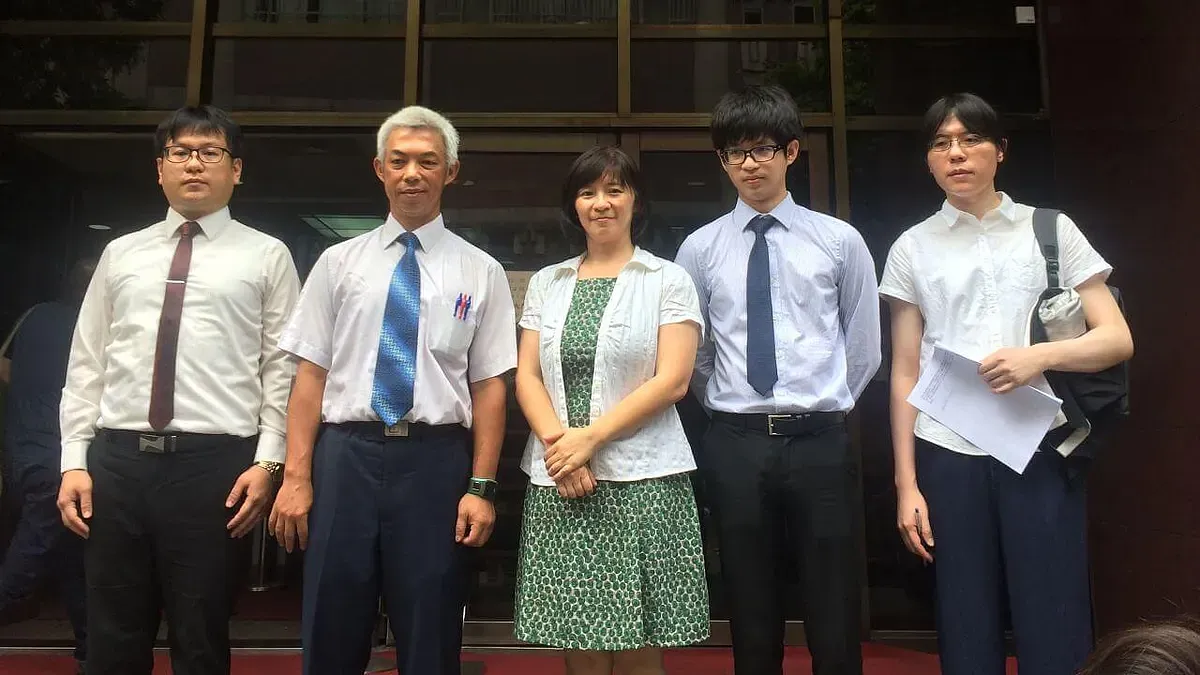
Photo / On July 18, 2019, the Volunteer Lawyers Group for Opposing the Black-Box CSSTA and former Legislator Ms. Chou Ni-an accept interviews outside the courtroom today.
Today, the Criminal Division of the Taipei District Court rendered its first-instance verdict in the private prosecution brought by former Legislator Ms. Chou Ni-an against then Taipei City Police Department Commissioner Huang Sheng-yung for attempted murder, aggravated assault, and assault during the "March 24 Executive Yuan Eviction Incident." The court acquitted Huang Sheng-yung, and the Volunteer Lawyers Group expresses its deep regret over this outcome.
More than five years have passed since the "March 24 Executive Yuan Eviction Incident," and the public's path to holding state violence accountable has been fraught with difficulties. Over 40 victims previously filed private prosecutions, but most were dismissed by courts on procedural grounds using technicalities. After years of victims wandering at the gates of justice with no way in, a judge finally agreed to conduct a substantive investigation. However, apart from private prosecutor Ms. Chou Ni-an in this case, the remaining 29 private prosecutors were unexpectedly not permitted to join as parties and could only participate as victims to state their opinions at the very end of the court hearings, leaving procedural participation severely inadequate.
On March 24, Huang Sheng-yung served as the on-site commander, allowing police officers equipped with police equipment or shields to forcibly beat peacefully sitting protesters with batons, strike them with shields, and even direct high-pressure water cannons straight at them to accomplish the forced eviction mission, injuring countless citizens that day. During the court proceedings, through the court's review of police evidence collection footage, scenes were restored showing numerous police officers wearing helmets, dressed in unidentifiable black uniforms, wearing combat boots, and holding shields and batons, ruthlessly and massively unleashing violence against peacefully sitting protesters. This was clearly not the isolated out-of-control behavior of individual officers, but rather an organizational crime committed by the state.
Yet, the final verdict in this case ultimately acquitted Huang Sheng-yung—meaning that Huang Sheng-yung, who commanded the clearance operation on-site, bears no responsibility for the state violence that night, and the court even characterized the fact of large-scale state violence merely as the result of "a small number" of officers losing emotional control. The Volunteer Lawyers Group expresses deep regret over this and believes that the court's judgment has let down the private prosecutors, the victims, Taiwanese society, and citizens at home and abroad who seek freedom and democracy, failing their expectations of Taiwan's judiciary.
As a country that long suffered under authoritarian rule, Taiwan has countless recorded experiences of its people—who pursue democracy and freedom—being subjected to state violence during protest movements. In the history of authoritarian rule, the wounds of victims are often invisible to the outside world and must be borne in silence. Aside from the fact that individuals struggling against state violence in unequal power dynamics often find it difficult to identify individual perpetrators, more importantly, the old-style judicial system was frequently part of the perpetrator apparatus, making the possibility of accountability virtually negligible.
More than 30 years have passed since Taiwan transitioned from authoritarianism to democracy. Following its democratic transition, Taiwan's judiciary—which prides itself on maintaining a spirit of democratic rule of law distinct from China and Hong Kong—still chose in this case to use acts performed in accordance with the law as an excuse for individual exoneration. This clearly ignores how the banality of evil breeds precisely through the meticulous division of labor and tedious procedures within bureaucratic systems, which dilutes personal responsibility for independent judgment and enables a group of utterly ordinary people to accomplish colossal evils like state violence. To this day, Taiwan's judiciary still chooses to let those in power within the police command chain hide behind bureaucracy to shift blame and shirk responsibility. How can we expect state power to be restrained and to stop acting as an enemy to the people?
In the process of pursuing transitional justice, unclarified truths often serve as obstacles to reconciliation. After discussing with our client, the Volunteer Lawyers Group will proceed with an appeal and will not abandon the pursuit of historical truth and justice. We still hope that in a free and democratic Taiwan, the system of checks and balances in the separation of state powers can function, and that Taiwan's judiciary can ensure that the tragic history of state violence during the authoritarian era—characterized by having "victims, but no perpetrators"—is not repeated.
This article is an AI-generated translation of the original Chinese text. In the event of any discrepancy, the Chinese version shall prevail.
