
The Ends Justify the Means, Creating Greater Evil—Closing Argument by Attorney Yu Po-hsiang in the March 24 Private Prosecution Case Against State Violence
Last edited: 2026-07-27
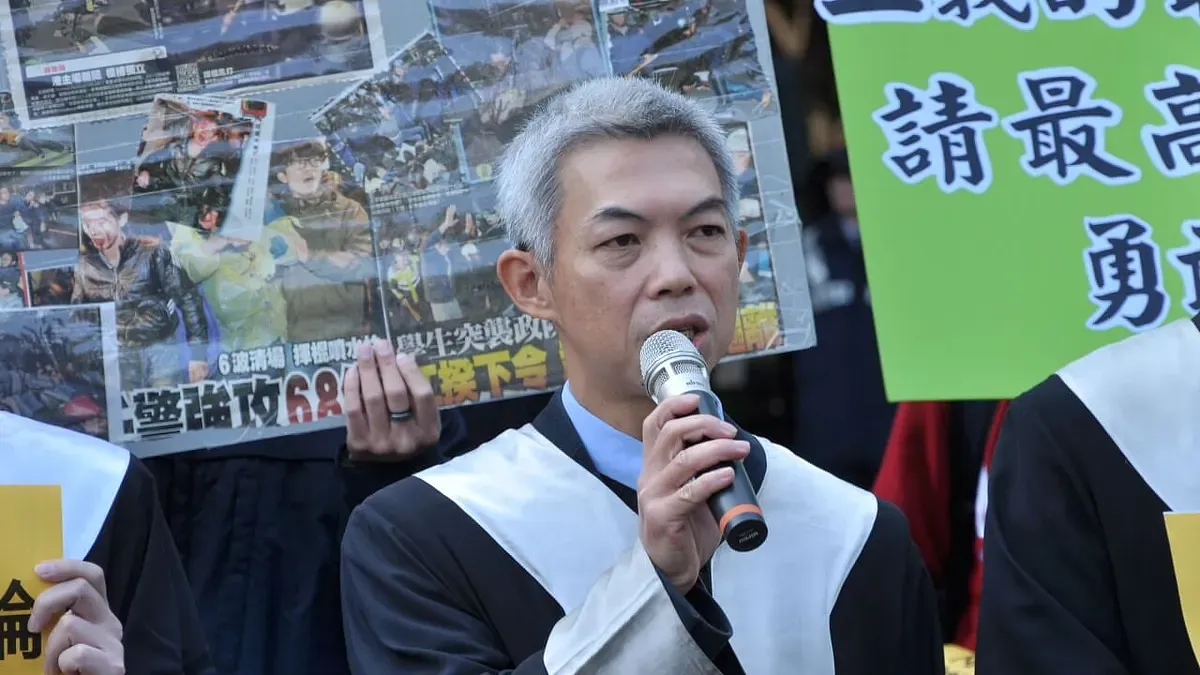
Archival photo / On December 30, 2014, Attorney Yu Po-hsiang attended the press conference titled "Denied Private Prosecution: How Can the Court Shield State Violence?"
The two police commanders, the two precinct chiefs, sitting across from me—I imagine that within the police force and out in society at large, they are regarded as respectable individuals. To say that the actions they took on the scene were entirely well-intentioned is something the general public would likely believe. Counsel for the private prosecutors has never doubted that the two gentlemen sitting across from us—one being Yang Hung-cheng[1]—harbored the utmost good intentions when carrying out the clearance mission assigned that day by Chief Huang Sheng-yung. Perhaps Mr. Yang Hung-cheng believed that completing the clearance and vacating the Executive Yuan compound was a necessary action to protect the nation's administrative hub as well as various classified documents within the yuan, and that this concerned the public interest. Therefore, to accomplish this mission, he was committed to fulfilling his duty through thick and thin, stopping at nothing.
The renowned 20th-century liberal theorist Friedrich August von Hayek famously observed: The road to hell is paved with good intentions. The violations of freedom and physical integrity suffered by private prosecutors Lin O-chieh, Lin O-tzu, Wang O-ching, and other victims of the March 24 state violence who lacked the opportunity to seek justice for themselves in this courtroom stemmed precisely from the good intentions of Mr. Yang Hung-cheng and other police officers of varying ranks who shared those same good intentions. Such good intentions not only drove Mr. Yang Hung-cheng and the officers under his command and supervision to use any means necessary to achieve their mission, but they also created greater evil, even bringing about a living hell. The crimes committed by Mr. Yang Hung-cheng against the private prosecutors and other victims during the execution of the clearance mission cannot be absolved by his good intentions, nor can he take refuge under the scope of performing official duties pursuant to law under Article 21 of the Criminal Code. Counsel for the private prosecutors says this because it is precisely when public servants engage in such self-righteous, unthinking obedience and unconditional fulfillment of missions that the modern government, composed of many ordinary individuals, can manufacture immense evil. To maintain external and internal security, peace, and order, the state is equipped with legitimate violence in the form of the military and police; if these powers are abused, they pose the greatest danger to the people's freedom and security.
Reigning in the Sea Monster "Leviathan"
As early as the 17th century, the renowned English philosopher Thomas Hobbes used the biblical sea monster of immense power, "Leviathan," to give concrete form to the formidable nature of state power—a concept well-known in constitutional and political science. Today, aided by various technologies, the power of the modern state far exceeds anything imaginable in Hobbes's era. The reach of state power penetrates deep into the most secluded corners of society, capable of thoroughly tracking every individual. If state power cannot be tamed by the constitutional order of freedom and democracy, it will inevitably use modern technology to forge a giant prison that confines everyone, evolving itself into a totalitarian state.
To view the Constitution merely as a written document with which we hope to tame "Leviathan" is nothing more than wishful thinking. If the Constitution is to have normative force and genuinely tame "Leviathan," it must rely, on the one hand, on the mutual checks and balances of the separation of powers; on the other hand, and more importantly, it must rely on the public's loyalty to the Constitution and their determination to uphold the constitutional order of freedom and democracy. Regarding the latter, aside from citizens being willing to step forward—through civil disobedience or even the exercise of the right of resistance—to defend the Constitution when democracy fails, perhaps even more crucially, public servants exercising public authority within government organizations must steadfastly uphold the rule of law in their daily work.
The Banality of Evil
The power of the modern state is exercised through a rigorous organizational hierarchy. Through the complex division of labor and strict administrative discipline of this bureaucratic structure, the government can efficiently integrate national human and material resources to govern. However, precisely because of the complex division of labor within the bureaucratic structure, government actions are often the result of protracted administrative processes and the collaboration of multiple departments. Before the final decision is made, public servants participating in the process can certainly claim they lacked final decision-making power and bear no responsibility for the outcome; meanwhile, the person who ultimately gives final approval can offer plausible excuses, deflecting blame by claiming they merely stamped documents based on subordinates' recommendations or were deceived.
While an assembly-line administrative process features precise division of labor, it simultaneously diffuses responsibility. Thus, we witness the so-called layered accountability, which often results in no one being held responsible. This situation mirrors the famous observation from the book *The Judge's Victims: A Record of German Miscarriages of Justice*: "In an avalanche, no single snowflake feels responsible." Public servants embedded in a rigid bureaucracy are like components of a massive machine, required by organizational discipline to simply follow protocol and suppress independent judgment. Through long-term conditioning, public servants easily lose their faith in the rule of law, recognizing only superior circulars and directives rather than the Constitution, and knowing only how to obey orders and fulfill missions without realizing they ultimately remain accountable to the people and their own conscience.
Under such circumstances, the government truly resembles a dehumanized colossal machine operated at the whim of its controllers. Even decisions or directives devoid of human kindness can be executed with absolute precision. In this scenario, monstrous villains are unnecessary; a government composed of numerous ordinary individuals can still manufacture immense evil. It is precisely the unthinking obedience and unconditional mission-fulfillment of public servants that enable unbridled state violence to successfully suppress the people's efforts to defend freedom, democracy, and constitutional order. This has forged the cruel tyrannies and shocking crimes seen in totalitarian states of both the left and the right over the past century, and it similarly enabled our nation's prolonged authoritarian rule, stripping countless people of their freedom, happiness, and even lives while severely tearing society apart, damaging interpersonal trust, and leaving scars that persist to this day.
The devil has failed to forge purgatory on earth, but totalitarian rule can truly use the power of the government bureaucracy to transform the entire country into a living hell. Humanity has learned from the painful experiences of the authoritarian era that, to avoid repeating past mistakes, the grip of government bureaucratic organizations over public servants must be appropriately relaxed. We should neither expect public servants to accomplish missions at all costs nor permit them to abuse power without restraint based on their self-righteous good intentions. Conversely, we should expect public servants' loyalty to the constitutional order of freedom and democracy to supersede their loyalty to government organizations—not only refraining from using human rights-violating or unconstitutional methods to achieve goals, but also attempting to refuse illegal directives or missions, at the very least, by drawing upon their conscience and moral courage.
Holding the Command Chain of State Violence Accountable
The higher the rank within a bureaucratic structure, the greater the control over the organization, and the more likely one is to use that organizational control to prevent the execution of unlawful orders. Therefore, expectations that public servants avoid executing unlawful tasks naturally escalate with their rank: the higher the rank, the higher the expectation of fidelity to the rule of law. When investigating government crimes, holding commanders with command and supervisory responsibilities along the chain of command accountable is actually more important than pursuing frontline grassroots personnel who physically carried out the acts, as grassroots personnel are often merely tools used by commanders to accomplish missions. In terms of culpability, a commander's culpability is far greater than that of a grassroots operative; in terms of preventing the government from repeating past mistakes, holding commanders accountable ensures that successors know hiding deep within the bureaucracy does not guarantee peace of mind.
The foregoing is not merely an appeal of political philosophy or legal jurisprudence; it is a consensus shared by the civilized world—which has embraced constitutionalist values since the Second World War—that has long been translated into concrete legal language. Legal professionals in our country often feel that such cases are not worth prosecuting or discussing, reasoning that commanders along the command chain did not commit the constituent elements of the offense and therefore no crime is established. They also frequently assume these actions constitute official duties pursuant to law, thereby excluding unlawfulness, leaving nothing further to discuss. Wrong. The legal systems of the modern civilized world and contemporary civilized society no longer permit commanders along the command chain to evade their responsibilities so easily.
This is precisely why the concept of the "perpetrator behind the perpetrator" (Täter hinter dem Täter) has been applied in Germany to prosecute commanders for state violence and other government crimes. When the March 24 incident first occurred, over a hundred criminal law professors in Taiwan also issued a statement citing the concept of the perpetrator behind the perpetrator to call for accountability for the commanders—a statement Your Honor just referenced as well. I believe the reason lies precisely in this consensus of the civilized world. When will Taiwan align with such civilized global consensus?
The Action and Inaction of Commanders
Mr. Yang Hung-cheng was the on-site commander of the Executive Yuan's main building lobby on March 24, so our expectation that he uphold the rule of law is naturally higher than that of officers who directly inflicted physical force or used police equipment against citizens on the scene. This is a given. Even if one assumes he lawfully ordered a clearance—issuing lawful orders much like Mr. Huang Sheng-yung—does responsibility simply vanish once the order is given? Mr. Huang Sheng-yung may argue that he was in the command post, did not witness the scene firsthand, and remained unaware of the on-site violence. However, Mr. Yang Hung-cheng was present throughout the entire day. He possessed the power to command and supervise the officers on the scene and owed a duty of protection to the targets of that power—the citizens on site—to ensure they were not subjected to the abuse of power by police officers. Had he been willing to exercise this power and fulfill his duties, he could have prevented the on-site tragedy by correcting and halting the officers' abuses, thereby shielding the private prosecutors and other citizens from unlawful violent harm by the police.
He occupied a position of dominance over the violent crimes committed by the police officers on the scene; this is beyond dispute. If not him, who else could protect citizens on the site from unlawful police violence? Yet he failed the private prosecutors and other victims, causing expectations rooted in the rule of law to fall through. His omission—condoning the police's abuse of power and their infliction of unlawful violence upon the victims—served precisely as his means of utilizing the unlawful violent crimes of on-site police to accomplish the clearance mission assigned to him by his superiors. Can such dereliction of duty, even if motivated by good intentions to uphold the public interest, be deemed an act performed pursuant to law that excludes unlawfulness? With Mr. Yang Hung-cheng present throughout the unlawful state violence inside the lobby, must only those violent officers whose names the police somehow cannot identify bear responsibility for all these actions, while Mr. Yang Hung-cheng, who was present the entire time as a police commander, bears no responsibility whatsoever? I believe no one can accept this conclusion.
The Invisible Perpetrators
I believe what Taiwanese citizens hate most—when discussing transitional justice to this day—is that there are forever only victims, but never perpetrators. Today in this courtroom, we are posing this very question: Must this case continue to feature only victims and no perpetrators?
During the authoritarian era, the judiciary functioned as part of the perpetrating apparatus. In the face of state violent crimes—whether torture to extract confessions or military suppression of citizens rallying and demonstrating on the streets for freedom—the judiciary always remained tight-lipped and even actively shielded the authorities. Following democratic transition, the judiciary no longer shoulders the tasks of perpetration and suppression. Yet, toward the abuse of power and unlawful violence by public servants, the judiciary never hesitates to exercise the utmost charitable understanding. Nearly all state violence is deemed to have a reason, and the majority of unlawful violence is viewed as well-intentioned. In these individual cases, justifications and good intentions are overwhelmingly transformed within judicial rulings into acts performed pursuant to law or superior orders. Consequently, among police officers who inflicted unlawful violence upon citizens during the clearance of assemblies and demonstrations, I have scarcely heard of anyone being convicted, and even fewer held administratively accountable.
The judiciary's consistent handling model seems to be that settling matters through state compensation suffices, as if paralyzed by the fear that holding individual public servants accountable would impair the future efficacy of clearing street assemblies and demonstrations. It is precisely this handling model that transmits the following message to police officers: "When you reach the scene, go ahead and do whatever it takes; you won't have to shoulder any of the responsibility!" Receiving this message, the feedback the police system gives us is that such clearance missions never see the scale of unlawful violence diminish. This trend of escalating unlawful violence finally culminated on March 24 in nearly 200 people being injured that night and rushed to hospitals by ambulance. According to the testimony of on-site medical personnel, many more citizens harmed by unlawful police violence simply departed after receiving emergency bandaging at on-site medical stations, meaning the actual number of injured citizens far exceeds this figure. To call it "large-scale" is certainly no exaggeration.
Yesterday's verdict[2] deemed this the fault of only a small minority of officers; I find this completely unacceptable. The police's own evidentiary footage was carefully filmed to avoid capturing their own personnel beating people; yet, even after reviewing it, we were able to unearth this much footage. Medical personnel also testified that numerous citizens left on their own after being injured. The scale of the violent means employed by the police that day far exceeds anything imaginable within this courtroom. Mr. Yang Hung-cheng might argue that most citizens simply stood up and walked away—an argument similarly made by Mr. Fang Yang-ning or Mr. Huang Sheng-yung. But I must say: when so many citizens are sitting on the ground, and after you beat several of them amid cries of agony, won't some people walk away out of fear? Yes, if it were me, I would have walked away myself. But does driving people away through fear of being beaten not constitute the very purpose of the beatings? When facing such a large-scale count of injured citizens, what is the point of attributing responsibility to commanders by claiming it was the action of a few or a minority of out-of-control officers? What matters more is that the defendant was present, that he clearly knew, yet failed to lift a finger to stop it. That is the core point we are here to hold him accountable for.
Safeguarding the Right to Peaceful Assembly
If we believe today that the right to peaceful assembly should be protected, and if we hope citizens will step forward to take to the streets—demonstrating through assemblies and processions their collective will to defend the Constitution and safeguard freedom when the constitutional order of freedom and democracy faces threats from either domestic or foreign sources—then the law must not force citizens taking to the streets to treat the likelihood of being subjected to unlawful police violence as the cost of exercising their freedom of assembly and procession. However, judicial practice's ongoing sympathy and understanding toward unlawful police violence—readily dismissing unlawful violence born of good intentions as acts performed pursuant to law that exclude unlawfulness—has left police officers virtually free from the fear of paying a price when deploying unlawful violence. Conversely, that cost is shifted onto citizens exercising their right to assembly and procession on the streets.
Taiwan's democracy and freedom face exceptionally dangerous threats, both explicit and covert, from across our borders, making their collective defense by the people all the more imperative. Future generations may yield more objective and accurate assessments of the merits and demerits of the Sunflower Student Movement than we have today, but there is no doubt that this was a mass movement spontaneously joined by numerous citizens to defend Taiwan's democracy, which subsequently inspired Hong Kong's Anti-Extradition Law Amendment Bill Movement. If the courts continue to signal to the police that they may proceed with clearances without fearing individual accountability, and if citizens taking to the streets must still worry about falling victim to state violence, then the next time Taiwan needs its people to take to the streets to defend the constitutional order of freedom and democracy, will another Sunflower Movement even be possible?
State Violence is Also a "Crime"
Holding Mr. Yang Hung-cheng accountable in his capacity as the on-site commander for his criminal liability is done not only because he is truly guilty—counsel for the private prosecutors can confidently tell Your Honor that we have taken on this case pro bono because we firmly believe they are guilty—nor is it solely to remedy the injured rights of the private prosecutors through criminal sanctions; more importantly, it holds milestone significance for the rule of law.
Securing a conviction against the defendant means that within the courtroom, it is finally no longer exclusively the case that only individuals harming individuals, or individuals harming the legal interests of the state and society, constitute crimes. By securing a conviction against the defendant in this case, the infringement upon people using state power will finally also constitute a crime—and a crime far more culpable than the former. This is the gravest of crimes because, as St. Augustine tells us in his book *The City of God*, this type of crime causes the democratic state to regress, stripping it of any justice or legitimacy. It is the most severe crime. Only when we reach this point can the rule of law be considered truly without gaps, can the courts truly be regarded as guardians of the rule of law and human rights, and can they genuinely earn the trust of the people.
Footnotes
- Yang Hung-cheng served as the Chief of the Nangang Precinct at the time and was responsible for the clearance operation within the Executive Yuan compound.
- Criminal Judgment 103-Zi-61 of the Taiwan Taipei District Court
This article is an AI-generated translation of the original Chinese text. In the event of any discrepancy, the Chinese version shall prevail.