
[Statement] The Difficult Road to Prosecuting Taiwan's "Bad Cops" for Abuse of Power: On-Site Commanders Acquitted in First Instance for March 24 Executive Yuan Violent Eviction
Last edited: 2026-07-27
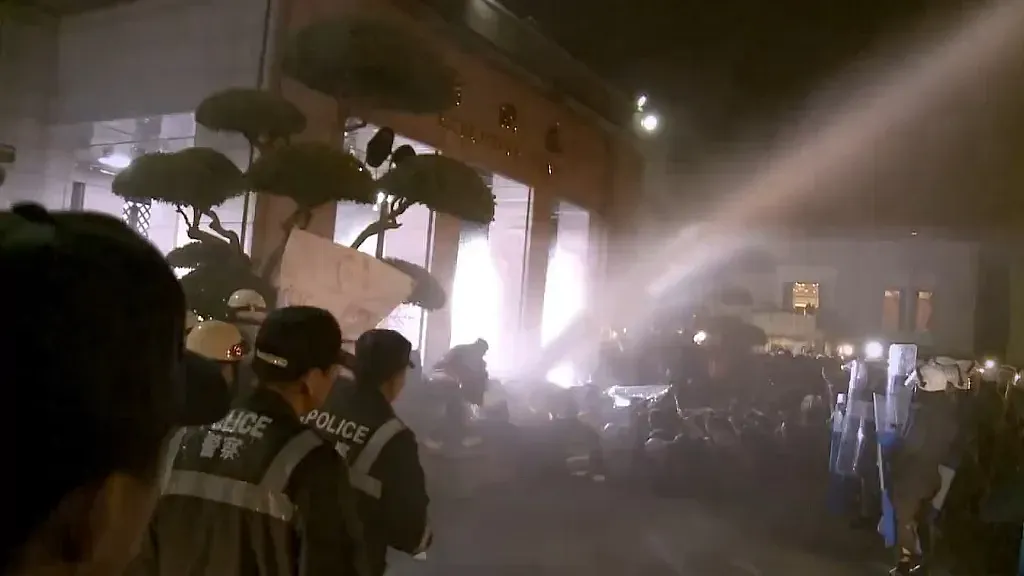
The Taipei District Court rendered its first-instance verdict today in the private prosecution brought against the commanders who directed on-site police officers to use violent eviction during the "March 24 Executive Yuan Eviction Incident," facing charges of attempted grave bodily injury, bodily injury, and coercion. The court found former Taipei City Police Department Da'an Precinct Chief Hsueh Wen-jung and Nangang Precinct Chief Yang Hung-cheng not guilty. The volunteer legal team expressed regret over the decision.
More than five years have passed since the violent eviction incident at the Executive Yuan in March 2014. Last month marked the first-instance verdict in the private prosecution brought by former Legislator Ms. Chou Ni-an against then-Taipei City Police Department Commissioner Huang Sheng-yung for attempted murder, grave bodily injury, and bodily injury[1]. Regrettably, while the court acknowledged that on-site police officers indiscriminately subjected citizens to violence, it still concluded that former Taipei City Police Department Commissioner Huang Sheng-yung—who served as the overall commander of the eviction operation that night—"knew nothing," allowing superiors with the authority to issue orders to easily evade responsibility under the umbrella of a bureaucratic hierarchy.
If Huang Sheng-yung had the excuse of not being at the scene to shirk responsibility, the same cannot be said for Nangang Precinct Chief Yang Hung-cheng and Da'an Precinct Chief Hsueh Wen-jung in this case. Both were frontline commanders overseeing the eviction scene who took no action whatsoever while on-site police officers assaulted peacefully sitting citizens everywhere with batons, riot shields, sucker punches, and kicks, and even allowed high-pressure water cannons to be aimed directly at the heads and bodies of the public, causing numerous injuries.
Relevant witnesses testified during the trial that when the March 18 Movement first broke out, police officers at the Legislative Yuan actually played a role in protecting the public. However, on the night of March 23, 2014, at the Executive Yuan, the attitude of the police officers changed overnight, turning into unsparing violence against the public. The wounds from that night remain vivid to this day, and trust in the police was shattered overnight. Throughout the proceedings of this case, the legal team repeatedly emphasized: if frontline police officers—who have always upheld the principle of administering the law in accordance with the law—did not receive orders and indulgence from their superiors, would frontline officers dare to inflict violence on unarmed citizens sitting in peaceful protest? The commanders occupied a position of dominance over the on-site police officers' violent crimes; apart from them, who else could better protect the citizens at the scene from being harmed by unlawful police violence?
These on-site commanders resorted to unscrupulous means to fulfill their superiors' order for a time-limited eviction, stopping at nothing to achieve the objective of eviction through illegal violence. This was precisely the reason why people bled and were injured that night, and it was the primary culprit in tearing apart the trust between the police and the public.
Yet, the court of first instance in this case acquitted Hsueh Wen-jung and Yang Hung-cheng, meaning it endorsed the notion that Hsueh Wen-jung and Yang Hung-cheng—who commanded the on-site eviction operation—could feign total ignorance of the on-site police brutality and bear no responsibility whatsoever. The volunteer legal team expressed profound regret over this, believing that the judiciary has failed to fulfill its duty to hold state violence accountable and has let down society's expectations for freedom and democracy.
In a democratic country, public power is meant to exist for the protection of the people, not as a tool for the government to suppress dissent. However, history both past and present shows that public power frequently degenerates into a tool for the state to carry out violence and consolidate its position. In fact, the antagonism between the police and the people is by no means caused by the malice of hardworking frontline officers, nor can it be created by a mere handful of police officers; rather, it inevitably stems from the instigation and manipulation of power-holders behind the scenes. Therefore, when prosecuting state crimes, holding the commanders in the chain of command accountable is always far more important than holding accountable the frontline officers who actually carried out the violence.
Coming to the present day, those of us in Taiwan watch day and night as the "bad cops" in Hong Kong use disproportionate methods to attack the public and disperse crowds. How can we fail to look back and reflect on how Taiwan—which prides itself on freedom and democracy—allowed those "Taiwan-version bad cops" on the night of March 23, five years ago, to hide behind black clothing, black helmets, and shields? How can we condone these police commanders in continuing to shirk responsibility? And how can we not feel disappointed that Taiwan's judicial personnel lack the courage to exercise the checks and balances of the separation of state powers following administrative abuses of power?
The legal team will study and discuss the matter of appeal with our clients. We still sincerely hope that the dawn of justice can shine behind masked police helmets, and that Taiwan's judiciary will ensure the tragic history of state violence during the authoritarian rule period—characterized by having "victims, but no perpetrators"—is never repeated.
Footnote
- Taiwan Taipei District Court 103-年度-自-字第61號 Criminal Judgment
This article is an AI-generated translation of the original Chinese text. In the event of any discrepancy, the Chinese version shall prevail.
