
Quieting the "Heroes' Civil War": The Bar Association Must Reform
Last edited: 2026-11-03
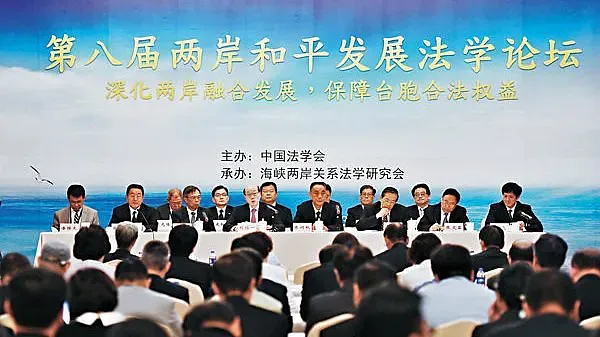
Photo/Opening of the 8th Cross-Strait Peaceful Development Law Forum (Source: Xinhua News Agency)
High-ranking officials of the Taiwan National Bar Association (hereinafter the National Bar Association) attended the "Cross-Strait Peaceful Development Law Forum" in China from August 21 to 23. Wang Ch'en, Vice Chairperson of the Standing Committee of the National People's Congress of China, and Liu Chieh-i, Director of the Taiwan Affairs Office, successively took the stage to call on Taiwan's legal community to contribute to peaceful reunification! On August 24, the Taipei Bar Association (hereinafter the Taipei Bar) issued a statement objecting to the National Bar Association cooperating with China's united front work and being reduced to a tool that degrades our nation's sovereign dignity. Previously, the Taipei Bar withdrew from the National Bar Association in 2017 in what has been termed the "Heroes' Civil War," and the conflict continues to rage unabated to this day!
As Lawyers' Day approaches, and considering that lawyers bear the mission of safeguarding human rights, realizing social justice, and promoting democracy and the rule of law, the humble student would like to pose a few questions to the high-ranking officials of the National Bar Association:
Given that the "Cross-Strait Peaceful Development Law Forum" was themed "Deepening Cross-Strait Integrated Development and Safeguarding the Legitimate Rights and Interests of Taiwan Compatriots," and claimed that human rights can serve as the value foundation for both sides of the Taiwan Strait, I wonder if the high-ranking officials ever pointed out the Chinese Communist Party's promotion of AI facial recognition, the establishment of social credit scoring systems, the prohibition and restriction of religious activities, and the establishment of concentration camps? When the so-called "governance according to law" resembles a dark joke parodying the "rule of law," how can cross-strait integration be achieved? Did they ever use this occasion to demand the rescue of Taiwanese citizen Li Ming-che or express concern regarding his treatment in prison?
The Chinese side claimed at the forum that Taiwan's drafting of the "Chinese Communist Agent Act" hinders cross-strait exchanges. I wonder if the high-ranking officials ever questioned on the spot China's 2017 implementation of the "Law on the Administration of Activities of Overseas Nongovernmental Organizations Within the Territory of China," which tightly controls NGOs from engaging in public welfare and rights defense, thereby stifling grassroots democracy and civil society?
The Chinese side further claimed that the suspension of individual travel for mainland residents was a punishment against the Taiwanese authorities for supporting Hong Kong's "anti-extradition bill movement." I wonder if the high-ranking officials ever pointed out that the Chinese Communist Party is even more afraid of Chinese citizens with free-travel capabilities directly contacting Taiwan's democratic elections and Hong Kong's anti-authoritarian movement? Did they ever ask why China refuses to honor the commitments of "one country, two systems," "Hong Kong people governing Hong Kong," and a "degree of autonomy unchanged for 50 years" as set forth in the "Sino-British Joint Declaration"?
The Chinese side also claimed that because the Taiwanese authorities are suppressing cross-strait exchanges, China is willing to conduct "democratic consultations" directly with public opinion in Taiwan that hopes for peaceful development. I wonder if the high-ranking officials ever retorted: with Hsi Chin-p'ing's lifelong dictatorship, how can there be any talk of "democracy"? With the "Anti-Secession Law" pre-setting the conclusion of "reunification" and the conditions for the use of force against Taiwan, what room is left for any "consultation"?
Furthermore, the Chinese side claimed that "cross-strait peaceful development" is a phased "instrumental value," whereas national reunification is the "target-oriented value," and instrumental values must serve target values. If reunification occurs in the future, it would be difficult to allow Taiwan to retain its military, and the central government would have the power to plan and supervise Taiwan's education and culture to promote ideological transformation and national identity. I wonder if the high-ranking officials ever made a solemn declaration that such a proclamation of "unconditional surrender" cannot be accepted under the "free and democratic constitutional order"?
Of course, we should not make unreasonable demands of people to avoid the high-ranking officials ending up like Li Ming-che and being unable to return. However, since they knew it was a "forum" where our side could not speak the truth and could only listen to the other side's grandiose talk, why did they still go? The political judgment of the high-ranking officials of the National Bar Association evidently runs counter to the general will of the lawyer community. The chronic and critical illness of Taiwan's lawyer self-governance system can thus be diagnosed through these symptoms.
The origins of the Taipei Bar can be traced back to the "Taipei Litigation Agent Association" established in 1898 and the "Taipei Barristers Association" established in 1900. Island-wide lawyer organizations during the Japanese colonial period successively included the "Taiwan Barristers Association" established in 1931 and the "Federation of Taiwan Barristers Associations" established in 1942. After the war, the Nationalist Government took over Taiwan, and the Taipei Barristers Association was liquidated and reorganized into the Taipei Bar. Meanwhile, the National Bar Association was established in Nanjing on September 9, 1948 (subsequently designated as Lawyers' Day) under the instructions of the Nationalist Government. Subsequently, the executive directors and supervisors who followed the Nationalist Government to Taiwan willingly endorsed the party-state authoritarian rule, becoming "eternal executive directors and supervisors" who did not need to be re-elected until they were fully re-elected in 1990. This should also be a target for review under "transitional justice"!
There is no direct textual link in the regulatory wording of Article 11 of the Attorney Regulation Act between the National Bar Association and practicing lawyers. A lawyer practicing in a given locality "shall" join the local bar association, and local bar associations "may" organize the National Bar Association, electing representatives level by level to manage association affairs: local bar associations select and dispatch member representatives to first elect 35 directors and 11 supervisors, who then mutually elect 11 standing directors, and from the standing directors elect 1 chairperson and 2 vice chairpersons. As for lawyer representatives taking up positions in government departments, they have always been bound to the seniority of local bar associations and the National Bar Association, operating "vote-pooling" within a "small circle" to secure promotions. Such a cumbersome and overlapping structure is actually a remnant of the legal system of the Republic of China from the mainland period.
From the wording of the Attorney Regulation Act, local bar associations are not strictly obligated to join the National Bar Association. Moreover, the Taipei Bar advocates for "single membership, nationwide practice," which has long made it difficult to integrate opinions with other local bar associations. While the Taipei Bar has the largest membership and pays the highest dues, its representative seats are limited, and its proposals to amend the articles of incorporation were shelved. Thus, the Taipei Bar's withdrawal from the National Bar Association had seeds planted long ago, is well-founded, and was by no means a rash act.
The reform of the bar association system is naturally an important link in judicial reform. According to the results of the legal amendment opinion survey conducted by the Judicial Reform Foundation and vTaiwan in 2016, it is evident that the industry generally supports "single membership, nationwide practice." The 2016 National Congress on Judicial Reform also resolved that "lawyers who join a local bar association shall be ex officio members of the National Bar Association." This year (2019), the Executive Yuan submitted the amendment draft of the Attorney Regulation Act to the Legislative Yuan for deliberation: transforming the current National Bar Association into the "National Federation of Bar Associations"; adopting a single-membership system for lawyers joining local bar associations, while simultaneously becoming individual members of the National Federation of Bar Associations, allowing them to practice nationwide or across districts in accordance with the latter's articles of incorporation; and having the chairperson, executive directors, supervisors, and member representatives directly elected by individual members. Does such an amendment to the law align with public opinion? Can it meet the demands of modern society? Can the Legislative Yuan deliberate on it in a timely and appropriate manner? The amendment of the Attorney Regulation Act has been delayed for many years and urgently awaits the concern of legal peers and the public.
※ This article was published in the Apple Daily on August 27, 2019
This article is an AI-generated translation of the original Chinese text. In the event of any discrepancy, the Chinese version shall prevail.