
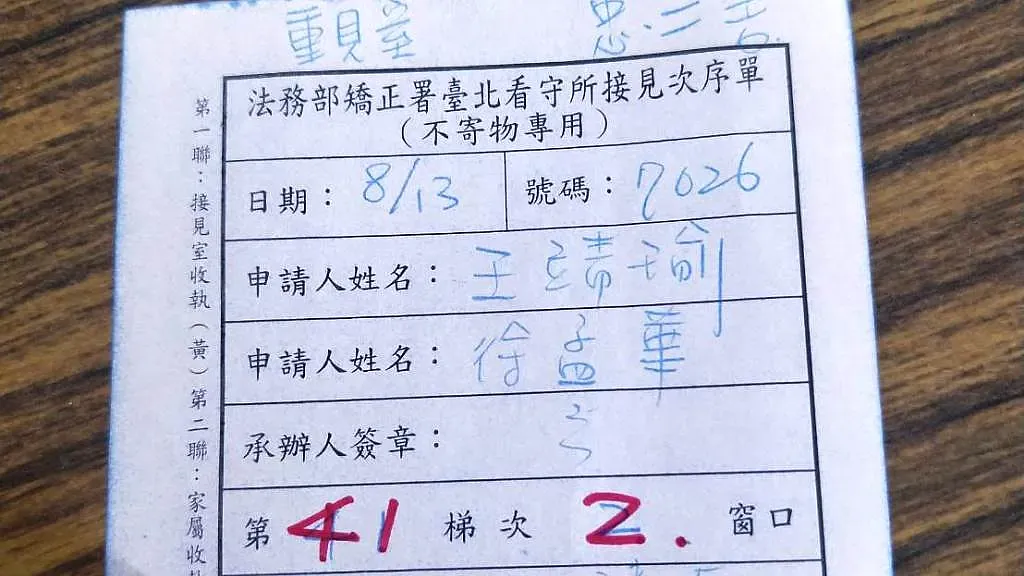
First Visit to the Detention Center: Chiou Ho-shun, No. 7026
Last edited: 2026-07-27
With a mix of nervousness and anticipation, after walking out of the wrong exit under the scorching sun and getting off at the wrong bus stop, we finally arrived, only to wait from number 155 to 165 for our turn. Then followed another series of waits while we reviewed his background and thought about what questions to ask. After about half an hour, a guard led us in to go through the full-body scanner and have our temperature taken. We couldn't bring anything inside. Passing through door after door, we finally reached the visiting room. As my nervousness mounted, I kept imagining what he would look like when the door between the visiting room and the detention center opened, and what he would say.
After waiting inside for about 10 minutes, the door suddenly opened. A smiling man walked out, waved vigorously at us, and gestured for us to sit down. I had wondered if the glass and wall in between would really block all sound. Once he came out, I realized that "you really couldn't hear any sound at all!" He was all smiles and extremely amiable, not looking at all like someone who had been imprisoned for 31 years. He asked which school and department we were from, then shared some of his thoughts on Taiwan, talked about the trivial matters of his daily life, mentioned how he had lost 8 kilograms, and spoke of his dream to reform the judicial system, because this complex system has caused miscarriages of justice for far too many people.
Then he began to sing his own self-composed song, "Hearts Linked, Together We Create Well-being." It was really catchy, though he mentioned that singing is technically not allowed in prison! Yet he sang so well that we were completely enthralled. He then gave us a pair of numbers, "327," telling us that we were the 326th and 327th visitors, and saying this was very meaningful because he keeps a record of them.
Since the visiting time was only 20 minutes, as soon as he finished singing, he hurriedly told us to ask our questions. I asked him if there was anything he wanted to do but hadn't yet done, and how he could remain so optimistic after being locked up for so long. He replied that he wanted to reform the judicial society and the entire Taiwanese system. He said that without heart, active thought, and ideas, he probably would have gone crazy in there long ago; therefore, it is essential to hold onto a dream and hope. That was when I realized that for 31 years, he had neither given up on himself nor abandoned hope, still holding onto hope for justice in trials. But what about our judicial justice?
The two of us had actually prepared many questions, but seeing him in person made many of them naturally melt away. Yet he was much more thoughtful and connected to the outside world than I had imagined. Perhaps this was because he frequently contemplates issues, writes memoirs, and corresponds with the outside world! He seemed so accustomed to these procedures that he even timed our farewell down to the exact second. In the end, he kept telling us to keep it up and have dreams—it was truly uplifting! I hope our judicial system can soon realize true justice!
This article is an AI-generated translation of the original Chinese text. In the event of any discrepancy, the Chinese version shall prevail.