
Review of the Controversy Between the Taipei Bar Association and the Taiwan Bar Association
Last edited: 2026-07-27
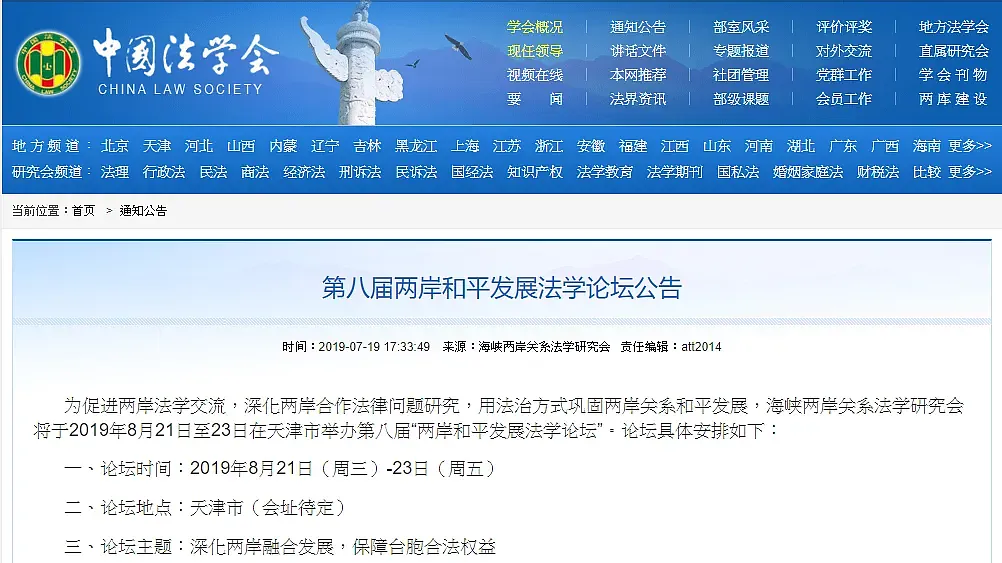
Photo / Announcement of the 8th Cross-Strait Peaceful Development Law Forum on July 19, 2019 (taken from the China Law Society website)
The participation of the Taiwan Bar Association in the "Cross-Strait Peaceful Development Law Forum" sparked a controversy with the Taipei Bar Association (hereinafter referred to as the Taipei Bar). In a previous article, the author used "Civil War" as a satire, which also metaphorically implied the ultimate villain "Thanos" lurking in the background.
The "Xi Five Points" initiative calls on cross-strait "political parties" and "sectors" to put forward "representative figures" to carry out "democratic consultations" and reach institutional arrangements for promoting the peaceful development of cross-strait relations. The so-called "sectors," with reference to the composition of the Chinese People's Political Consultative Conference, are basic units established by allocating member quotas, organizing groups, and conducting activities according to different categories such as various social sectors; Hong Kong's Legislative Council also has "functional constituencies," including the "legal sector"; the text of our Constitution also stipulates that certain National Assembly delegates and legislators are elected from "occupational organizations." The Taiwan Bar Association is a nationwide lawyers' "occupational organization," represented externally by its chairperson, which matches the literal meaning of the aforementioned "sectors" and "representative figures."
This forum was announced on July 19 with the theme "Deepening Cross-Strait Integrated Development and Protecting the Legitimate Rights and Interests of Taiwan Compatriots." The topics included: the institutionalized construction of the peaceful development of cross-strait relations, legal guarantees for cross-strait integrated development, policies and measures benefiting Taiwan, and the improvement of Taiwan-related legislation—such "institutional arrangements" for "promoting the peaceful development of cross-strait relations," which is tantamount to a preparatory meeting before launching "democratic consultations." However, upon receiving the invitation letter, the Taiwan Bar Association handled it according to routine. At its standing board meeting on July 20, the chairperson merely proposed to retroactively approve the allocation of funds to pay for airfare for an increased number of official delegation representatives (food and lodging were hosted by the other side), seemingly without substantive discussion of cross-strait political changes and forum topics, and directly put it to a vote for passage.
During the forum, Taiwan Affairs Office Director Liu Chieh-yi and scholars Yin Pao-hu, Li Hsiao-ping, Tien Fei-lung, Chu Chieh, Tuan Lei, and others made provocative remarks: "Cross-Strait peaceful development" belongs to a phased instrumental value, which must serve the target value of "national unification"; the Democratic Progressive Party government's sabotage of cross-strait relations is to be enemies with compatriots on both sides; "democratic consultations" is an alternative path to Taiwan's institutional suppression of cross-strait exchanges; the suspension of individual tourist visits is a justified counterattack against the Tsai Ing-wen administration playing the "Hong Kong card"; after unification, it will be difficult to allow Taiwan to keep its military, and concept transformation and national identity education will be planned and supervised by the central government. High-ranking officials of the Taiwan Bar Association attending such international diplomatic occasions bore the obligation to uphold national dignity and maintain the professional dignity of lawyers. Could they only exercise "international etiquette" without even the courage to shout an objection ("Igiari")?
The author does not agree with the Taipei Bar's accusation that the Taiwan Bar Association cooperated with the united front, but merely believes that the Taiwan Bar Association was constantly "out of the loop" and should have refused the invitation from the very beginning. Therefore, the leaders must be held accountable for whether they fell short of their duty of loyalty and diligence. It is respectfully suggested that the Taiwan Bar Association conduct an internal investigation to clarify the factual background and attribution of responsibility, and formulate guidelines and procedures for handling affairs related to China to guard against the threat of the united front.
※ This article was published in the Liberty Times on Sep. 2, 2019
This article is an AI-generated translation of the original Chinese text. In the event of any discrepancy, the Chinese version shall prevail.