
Those Bad Cops We Couldn't Find All These Years
Last edited: 2026-07-27
Photography / nondavidmirage
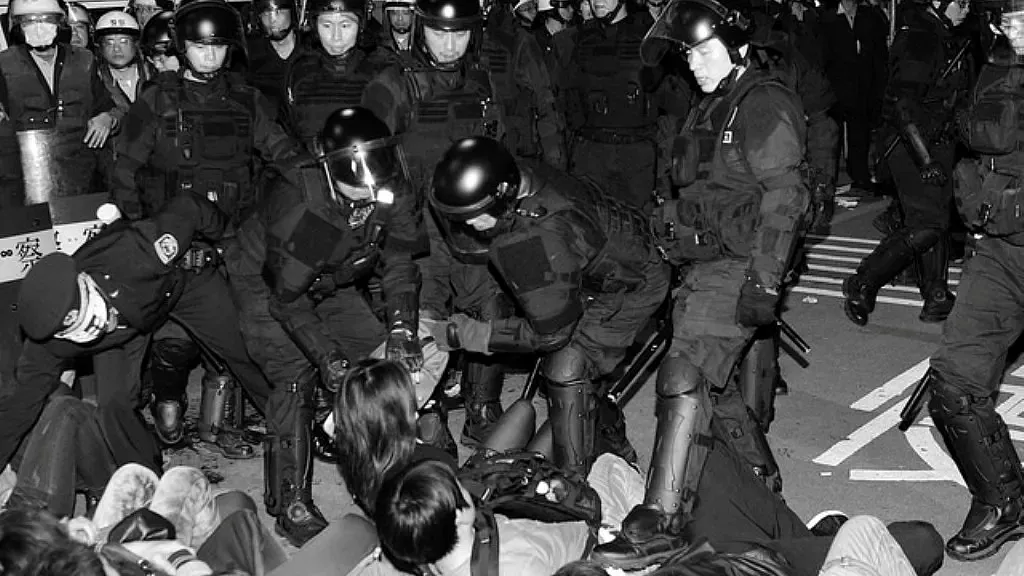
Criminal Judgment No. 61 (Year 103 of the Republic) of the Taipei District Court has already established that during the Executive Yuan eviction incident on March 24, 2014, certain police officers—either due to poor emotional control or residual authoritarian-era thinking that treated the people as enemies—used violence in violation of the principle of proportionality, striking protesting citizens with their bodies or police equipment... constituting inhuman treatment or punishment, in breach of the ICCPR, the Police Powers and Duties Act, and the Enforcement Act for Police Use of Weapons, among other regulations. The court explicitly noted that the state must not only conduct an effective investigation, but also identify the violent police officers who bear criminal responsibility and compensate the victims. Yet, five and a half years have passed—has the state shouldered the responsibility of identification and prosecution?
Unidentified Police Officers Not Found, and No Superiors Held Accountable
When the March 24 incident occurred, it caused a nationwide uproar and was known to all, but the prosecutorial system at the time initiated no criminal prosecution against the violent police officers. Having no other choice, forty-eight citizens filed private prosecutions with the Taipei District Court, stepping up with civil society strength to assume the state's role of prosecuting and gathering evidence of crimes. They brought charges of attempted murder and assault against administrative and police superiors, frontline commanders, and unidentified violent police officers. However, all private prosecutions against unidentified officers were dismissed as inadmissible and finalized. The private prosecutions against Ma Ying-jeou, Chiang Yi-huah, Wang Cho-chun, and Fang Yang-ning (then President, Premier, National Police Agency Director-General, and Zhongzheng First Precinct Chief, respectively) were dismissed twice by the district court, and the High Court subsequently remanded them to the district court for further proceedings.
Most cases were dismissed without ever entering substantive adjudication. After victims wandered before the doors of justice with no way in, five and a half years later, in the middle of this year, the victims finally awaited the first-instance verdicts in two of the cases. What they got, however, was an acquittal for Huang Sheng-yung (then Taipei City Police Department Commissioner), and acquittals for frontline commanders Hsueh Wen-jung and Yang Hung-cheng as well.
In fact, the confrontation between police and the people cannot be attributed solely to the malice of grass-roots officers, nor could it be created by a mere handful of police; it necessarily stems from the instigation and manipulation of those holding power behind the scenes. Therefore, when prosecuting state crimes, holding the administrative and police superiors and commanders in the chain of command accountable is even more critical than holding accountable the frontline officers who actually carried out the violence. Tragically, in the case of the March 24 incident, accountability for both has yielded no results to date.
※ This article was published in the Liberty Times on Sep. 23, 2019
This article is an AI-generated translation of the original Chinese text. In the event of any discrepancy, the Chinese version shall prevail.