
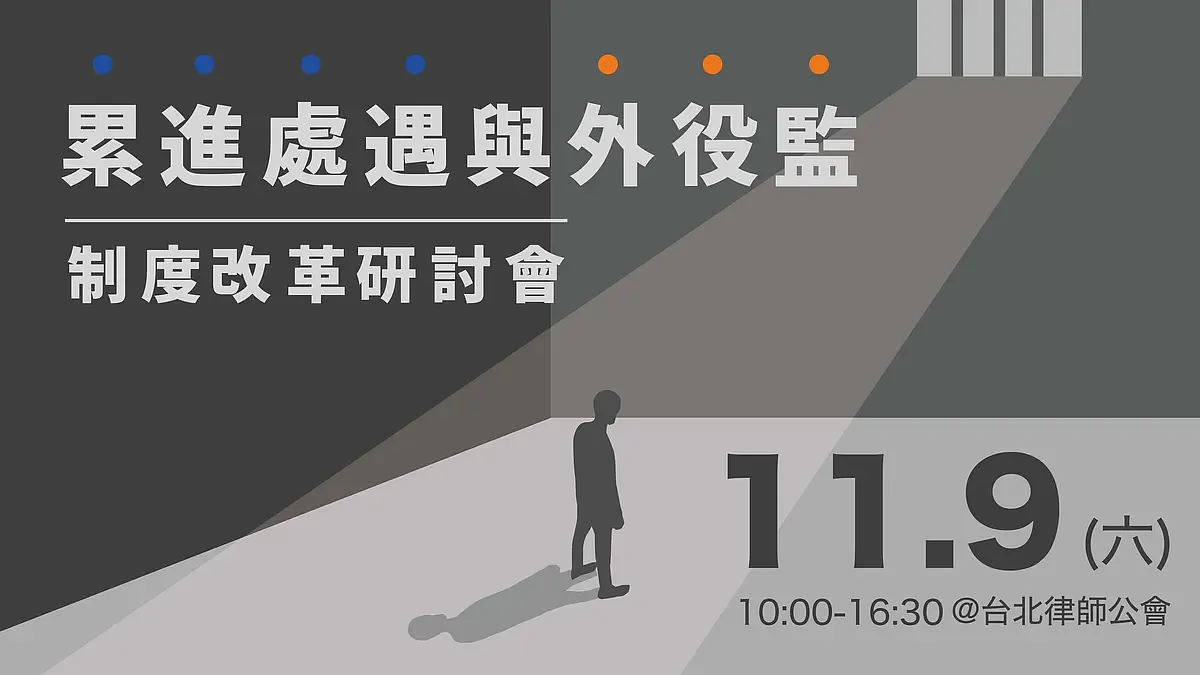
Seminar | Seminar on Progressive Execution and Reform of the Outlying Prison System
Last edited: 2026-07-27
Constrained by existing prison hardware and facilities, correctional institutions in Taiwan have long faced the dilemma of overcrowding, and the protection of prisoners' human rights has also faced severe criticism and challenges under these practical considerations. Marking the second anniversary of the National Congress on Judicial Reform, prison reform practices and directions are matters of great concern and participation for both the private sector and the government.
Among these issues, reforms targeting the progressive execution system have been one of the most widely discussed topics. During the discussions of Group 5 at the National Congress on Judicial Reform, although civil society proposed that most countries gradually adopt good-time systems based on risk assessment without depriving inmates of the minimum requirements needed to maintain dignity, the Agency of Corrections argued that the ratio of reform personnel to inmates in our prisons is disproportionate, leaving no conditions for implementing risk assessments. Following the National Congress on Judicial Reform, the Agency of Corrections currently only uses seminars or progressive execution task force meetings to discuss short-term plans that do not involve statutory amendments, such as measures to simplify progressive execution scoring. However, the progressive execution system involves the rights and interests of more than 50,000 inmates, prison hardware facilities, and custodial management personnel. The abolition, revision, and establishment of alternative plans for the system still require empirical research and multifaceted discussions.
On the other hand, facing the current situation of overcrowding, the Agency of Corrections also announced via a press release during the National Congress on Judicial Reform that it would strengthen the reformative functions of prisons—for example, engaging in outside-prison work under low-custody conditions prior to release, gradually helping inmates adapt to social life and reducing recidivism. Among these measures, the outlying prison system is regarded as the transitional treatment measure with the strongest rehabilitative color under the current system, yet it is frequently questioned by various parties due to opaque selection standards. Issues such as how the outlying prison system can fulfill its rehabilitative function while maintaining fairness in prison treatment also require discussion and supervision from all parties.
Following Judicial Yuan Interpretations No. 755 and No. 756, regarding prison disciplinary actions and other management measures, if inmates believe that these exceed administrative purposes and infringe upon their rights, they may pursue internal grievances and subsequently file administrative litigation externally. This seminar will help members of the Taipei Bar Association understand the effects of prison treatment and benefit members in handling related cases. The Taipei Bar Association and the Judicial Reform Foundation have long cared for prison human rights and hope that this seminar will serve as a modest stimulus to encourage multi-party exchanges among academia, civil society, and government workers, gathering diverse opinions to facilitate subsequent discussions and promotion of prison reform.
Time
November 9, 2019 (Sat) 10:00-16:30
Location
Taipei Bar Association Main Conference Room (9F, No. 7, Sec. 1, Roosevelt Rd., Zhongzheng Dist., Taipei City)
Speakers
Presenters
Li Li-chüan / Ph.D. student, Department of Law, National Chung Cheng University, and Board Director, Taiwan Association for Prisoners' Rights
Lin Cheng-yu / Assistant Professor, Department of Law, Fu Jen Catholic University
Huang Tsung-min / Assistant Professor, Department of Law, Chinese Culture University
Panelists
Ch'en Hui-min / Chairperson, Taiwan Association for Prisoners' Rights
Lai Yung-lien / Associate Professor, Department of Criminology, Central Police University
Liu Pei-yuan / Member of the National Congress on Judicial Reform, and New Life Fellowship Volunteer
Lu Ying-chieh / Professor, Department of Law, National Chung Cheng University
Cheng I-lung / Counselor, Shilin Probation Association
Li Mao-sheng / Professor, Department of Law, National Taiwan University
Moderators
Huang Hung-hsi / Senior Inspector, Agency of Corrections, and Ph.D., Department of Criminology, Central Police University
Lin Chun-hung / Executive Director, Taipei Bar Association
Kao Yung-ch'eng / Control Yuan Member
Agenda
| Time | Activity | Moderator / Presenter / Panelist |
| 0945-1000 | Registration | |
| 1000-1010 | Opening | Ch'en Yü-fan / Executive Director, Taipei Bar Association |
| [Session I] Review of the Outlying Prison System | ||
| 1010-1040 | Presentation |
Moderator Huang Hung-hsi / Senior Inspector, Agency of Corrections, and Ph.D., Department of Criminology, Central Police University |
|
"An Examination of the Outlying Prison System" Presenter Lin Cheng-yu / Assistant Professor, Department of Law, Fu Jen Catholic University |
||
| 1040-1130 | Discussion |
Panelists Ch'en Hui-min / Chairperson, Taiwan Association for Prisoners' Rights Lai Yung-lien / Associate Professor, Department of Criminology, Central Police University |
| 1130-1330 | Lunch | |
| [Session II] Treatment and Social Reintegration in Ordinary Prisons and Outlying Prisons | ||
| 1330-1400 | Presentation |
Moderator Lin Chun-hung / Executive Director, Taipei Bar Association |
|
"Introduction to Japan's Inmate Treatment Grading System and Open Facility Legislation" Presenter Huang Tsung-min / Associate Professor, Department of Law, Chinese Culture University |
||
| 1400-1450 | Discussion |
Panelists Liu Pei-yuan / Member of the National Congress on Judicial Reform, and New Life Fellowship Volunteer Cheng I-lung / Counselor, Shilin Probation Association |
| 1450-1510 | Mid-session Tea Break | |
| [Session III] Reform of the Progressive Execution Regulations | ||
| 1510-1540 | Presentation |
Moderator Kao Yung-ch'eng / Control Yuan Member |
|
"What the Grand Justices Left Unsaid: The Path of Reform for Taiwan's Progressive Execution System" Presenter Li Li-chüan / Ph.D. student, Department of Law, National Chung Cheng University, and Board Director, Taiwan Association for Prisoners' Rights |
||
| 1540-1630 | Discussion |
Panelists Lu Ying-chieh / Professor, Department of Law, National Chung Cheng University Li Mao-sheng / Professor, Department of Law, National Taiwan University |
Organizers
Taipei Bar Association
Judicial Reform Foundation
This article is an AI-generated translation of the original Chinese text. In the event of any discrepancy, the Chinese version shall prevail.