
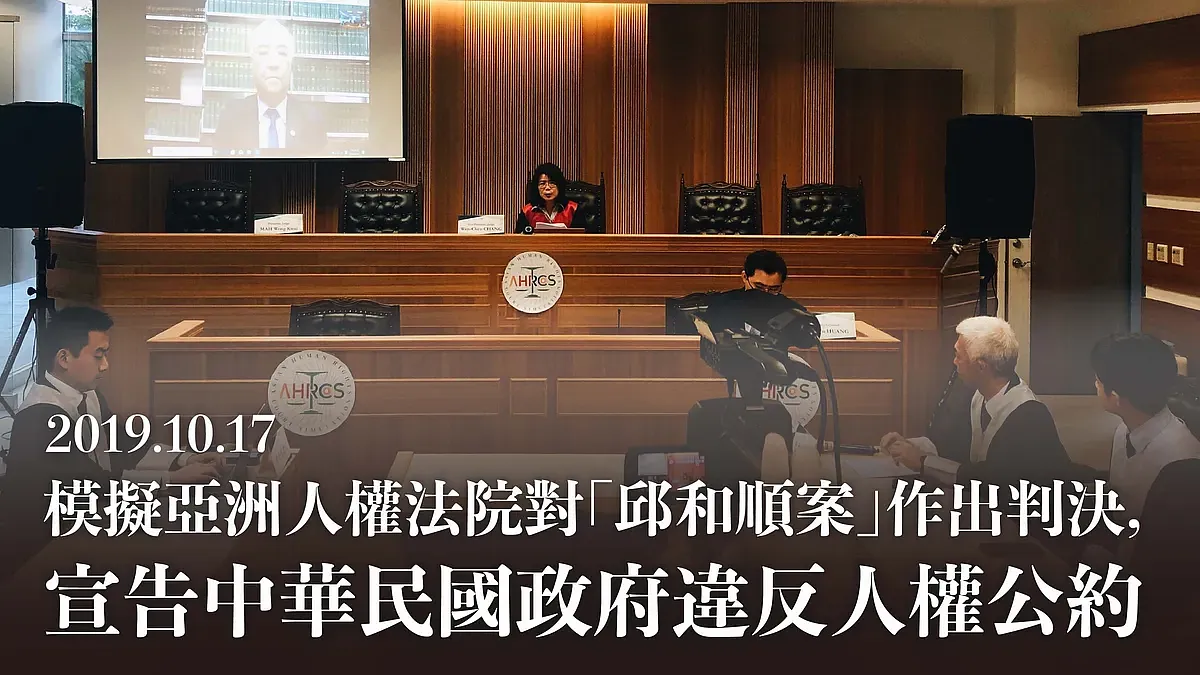
Mock Asian Court of Human Rights Delivers Judgment on the "Chiou Ho-shun Case", Declaring the ROC Government in Violation of Human Rights Covenants
Last edited: 2026-07-27
The Asian Court of Human Rights Simulation—the first human rights court in Asia—selected the Chiou Ho-shun case as its inaugural trial. Chiou Ho-shun accused the Republic of China (ROC) government of violating international human rights covenants during the adjudication of his case. Following months of preparation and a four-day trial, the Simulated Asian Court of Human Rights delivered its judgment on October 17, declaring that the ROC government violated Article 7 and Article 14 of the International Covenant on Civil and Political Rights, which obligate the state to guarantee the right to a fair trial and the freedom from torture and inhuman treatment.
The judges of the Simulated Asian Court of Human Rights unanimously held that Chiou Ho-shun suffered severe unlawful infringement as a result of patent judicial procedural failures, gross errors in the determination of law and facts, excessive procedural delays, and the substantial time consumed by the back-and-forth of appellate proceedings.
Consequently, the judgment requires our Supreme Court to re-examine the conviction and sentence imposed on Chiou Ho-shun in order to remedy and rectify the violations of fundamental human rights he has suffered in a fair and necessary manner. This marks yet another instance of the international community turning its attention to the Chiou Ho-shun case and substantively reviewing the ROC government's violations of its human rights obligations, holding immense historical significance for both the rescue efforts in the Chiou Ho-shun case and Taiwan's judicial reform.
Attachments
This article is an AI-generated translation of the original Chinese text. In the event of any discrepancy, the Chinese version shall prevail.
