
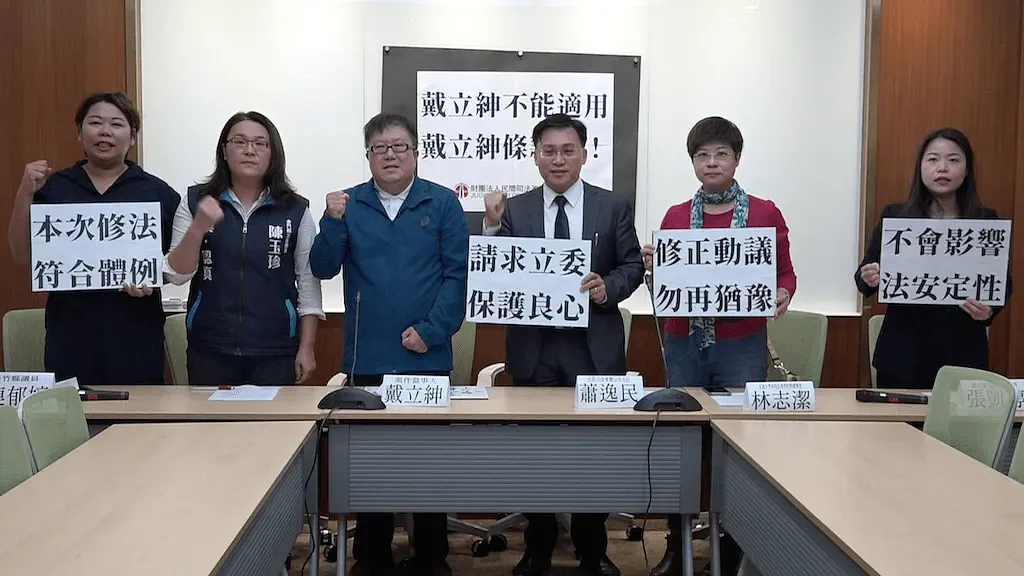
Can T'ai Li-shen Not Benefit from the "T'ai Li-shen Clause"? Press Conference
Last edited: 2026-07-27
The Judicial Reform Foundation (JRF) held a press conference titled "Can T'ai Li-shen Not Benefit from the 'T'ai Li-shen Clause'?!" at the Chung-Hsing Building of the Legislative Yuan today (October 30), arguing that a retroactive provision should be added to the "T'ai Li-shen Clause" in the draft Whistleblower Protection Act to give T'ai Li-shen an opportunity to be reinstated in public office.
-
The draft stipulates enforcement one year after promulgation, preventing T'ai Li-shen from applying the T'ai Li-shen Clause in the draft
The Judiciary and Organic Laws and Statutes Committee of the Legislative Yuan will hold cross-party caucus consultations on the draft Whistleblower Protection Act at 12:30 PM today. Article 13, Paragraph 2 of the Executive Yuan's draft version allows whistleblowers within agencies, once exempted from punishment by a final court judgment, to apply for reinstatement in public office. This is to prevent public servants from being afraid to blow the whistle out of concern for losing their livelihoods, commonly known as the "T'ai Li-shen Clause." However, Article 19 of the draft stipulates that the Act shall take effect one year after its promulgation, meaning T'ai Li-shen, who meets the criteria of Article 13, Paragraph 2, would instead be ineligible to apply it. Therefore, the JRF calls on the legislators of the Judiciary and Organic Laws and Statutes Committee to propose a motion to amend Article 19 by adding a retroactive clause, enabling T'ai Li-shen himself to be protected by the new law.
-
T'ai Li-shen bravely blew the whistle, yet was previously dismissed due to a lack of protection from the Whistleblower Protection Act
Between 2005 and 2016, T'ai Li-shen worked at the Hsinchu County Livestock Disease Control Center. Like most civil servants who study hard to pass the civil service examinations, he thought his life would be stable from then on. However, when he found that his superiors kept demanding him to keep false accounts and use public funds for private purposes, he began to feel an unbearable sense of guilt in his conscience. Driven by his conscience, he surrendered himself to the Agency Against Corruption of the Ministry of Justice through the Department of Government Ethics, and presented strong evidence to assist prosecutors and police in their investigation, allowing the corrupt co-offending network an opportunity to be exposed and subjected to judicial prosecution.
The judge presiding over T'ai Li-shen's corruption case considered that he bravely reported the crime without fear of pressure, and exempted him from individual criminal liability. However, after the judgment became final, T'ai Li-shen was given a "dismissal" with a ban on "future employment" by the Hsinchu County Government in 2016 precisely because of this "judgment exempting him from punishment." After exhausting all judicial remedies and still facing a final defeat in court, T'ai Li-shen ultimately could not change this piece of dismissal order barring him from public service forever.
-
There were only 7 past whistleblowers like T'ai Li-shen; retrospectivity will not affect legal stability
Upon searching the Judicial Yuan's Legal-Data Retrieval System, there are only 7 cases, including T'ai Li-shen, where whistleblowers were exempted from punishment by the court due to whistleblowing. In other words, if the T'ai Li-shen Clause is made retroactive, a maximum of only 7 people will have the opportunity to apply for reinstatement in public office. Furthermore, according to Article 13, Paragraph 2 of the draft, it merely grants whistleblowers the right to apply, while administrative agencies still retain the discretionary authority to review whether to approve reinstatement. Such a systematic design does not affect legal stability, yet it profoundly impacts the major rights of the parties concerned regarding whether they have the opportunity to hold public office. There is truly no justification not to do so.
-
Applying retroactivity in this legislative amendment is the only way to conform to the exception where whistleblowers are not subject to the restrictions of the Civil Service Employment Act
The Directorate-General of Personnel Administration, Executive Yuan, believes that provisions for retroactivity should amend the Civil Service Employment Act instead. However, Article 28, Paragraph 1, Subparagraph 4 of the Civil Service Employment Act stipulates: "A person who has any of the following circumstances shall not be appointed as a public servant: ... 4. Having committed an act of corruption while in public service, confirmed by a final conviction of a guilty verdict, or being wanted under a warrant that remains unsettled." This is a general provision for all corruption cases. Meanwhile, Article 13, Paragraph 2 of the draft Whistleblower Protection Act is an exceptional provision specifically excluding the application of Article 28, Paragraph 1, Subparagraph 4 of the Civil Service Employment Act for cases where the court judgment exempts the whistleblower from punishment. The JRF argues that situations where retroactivity applies should also be strictly limited to whistleblowers exempted from punishment by court judgments. Such exceptional circumstances should naturally also be prescribed in the Whistleblower Protection Act to maintain structural consistency.
-
Urging legislators to protect the conscience of the civil service system!
Driven by a sense of justice, T'ai Li-shen hoped to interrupt longstanding malpractice within the Hsinchu County Livestock Disease Control Center through his report. Yet after reporting, his identity as a whistleblower was unexpectedly exposed. His superiors and colleagues showed no understanding, making things difficult for him in every possible way at work and subjecting him to immense pressure and torment. Moreover, the judgment exempting him from punishment, granted by the judge based on T'ai Li-shen's courage in blowing the whistle, still left him barred from re-entering public office due to the provisions of the Civil Service Employment Act.
T'ai Li-shen's encounter is clear proof of how whistleblowers were wronged in the past. When potential whistleblowers realize that stepping forward to blow the whistle may lead to the same fate as T'ai Li-shen, how many people will still be willing to stand up and expose the dark secrets of their agencies?
To this end, the JRF hopes that legislators can protect the conscience within the public service system, propose amendment motions to make the T'ai Li-shen Clause retroactive, allow T'ai Li-shen to return to the job position he loves, and inspire more conscientious civil servants to bravely stand up to expose agency dark secrets in the future!
Appendix
-
Chronology of the T'ai Li-shen Case
Date Content Case Number 2007.07~2011.04 T'ai Li-shen was ordered by his direct supervisor to keep false accounts and use public funds for private purposes Late 2012 T'ai Li-shen reported the corruption case to the Department of Government Ethics and surrendered himself 2015.11.25 Hsinchu District Court Judgment—Exempted from Punishment 103 Su-Zi No. 65 2016.01.30 Hsinchu County Government approved the dismissal Fu-Jen-Zi No. 1050019480 2016.02.23 T'ai Li-shen applied for a review to the Civil Service Protection and Training Commission 2016.05.10 Civil Service Protection and Training Commission Review Decision—Dismissed 105 Kung-Shen-Chueh No. 0102 2016.07.13 T'ai Li-shen filed an administrative litigation 2017.01.05 Taipei High Administrative Court Judgment—Plaintiff's Action Dismissed 105 Su-Zi No. 1075 2017.03.17 Supreme Administrative Court Ruling—Appeal Dismissed 106 Tsai-Zi No. 295 -
Opinions of the Judicial Reform Foundation on the Draft Whistleblower Protection Act
The Judiciary and Organic Laws and Statutes Committee of the Legislative Yuan completed the review of the Whistleblower Protection Act on May 27, 2019 and forwarded it for caucus consultations. This Foundation expresses the following opinions regarding Article 13, Paragraph 2, commonly known as the "T'ai Li-shen Clause":
Article 13, Paragraph 2 passed by the Committee as proposed by the Executive Yuan reads: "When an agency handles an application for reinstatement in public office filed by a whistleblower referred to in the preceding paragraph who has been exempted from punishment by a final court judgment, it may not be subject to the restrictions of Article 28, Paragraph 1, Subparagraph 4 of the Civil Service Employment Act." This legislative amendment prevents the situation in the T'ai Li-shen case from happening again. However, Article 19 passed by the Committee as proposed by the Executive Yuan merely stipulates: "This Act shall take effect one year after its promulgation." This makes the T'ai Li-shen Clause inapplicable to T'ai Li-shen. Therefore, this Foundation suggests that a retroactive clause should be added to Article 19, allowing persons in the same predicament as T'ai Li-shen to be applicable under the provisions of the new law to be reinstated in public office.
Although the Ministry of Justice opposed this on the grounds that retroactivity affects legal stability, inquiries show that there are only 7 such cases to date (see the table below), which will fundamentally not affect legal stability. Therefore, it should be made retroactive so that those who bravely blew the whistle in the past can also be protected by the new law.
Past Cases Meeting the Criteria of the "T'ai Li-shen Clause" Name High Administrative Court Judgment Supreme Administrative Court Judgment T'ai Li-shen Taipei High Administrative Court 105 Su-Zi No. 1075 Supreme Administrative Court 106 Tsai-Zi No. 295 Jao Jui-i Taipei High Administrative Court 104 Su-Zi No. 1231 Supreme Administrative Court 105 Tsai-Zi No. 530 Not Disclosed Taipei High Administrative Court 95 Su-Zi No. 3445 Not Appealed Not Disclosed Taipei High Administrative Court 95 Su-Zi Nos. 1249 & 1250 Supreme Administrative Court 96 Tsai-Zi No. 3627 Not Disclosed Taipei High Administrative Court 95 Su-Zi No. 602 Supreme Administrative Court 97 P'an-Zi No. 692 Liao Ch'ang-min Taichung High Administrative Court 105 Su-Zi No. 382 Not Appealed -
Suggested Amendments to the Whistleblower Protection Act by the Judicial Reform Foundation
JRF Suggested Provisions Executive Yuan Draft Version Explanation Article 13: Where a whistleblower is a principal offender or accomplice in the crime involved in the whistleblowing content, and meets the requirements of Article 3 and Article 14, Paragraph 1 of the Witness Protection Act, their punishment may be mitigated or exempted pursuant to Article 14, Paragraph 1 of the same Act, without being subject to the restrictions of the offenses listed in Article 2 of the said Act.
Where an agency handles an application for reinstatement in public office filed by a whistleblower referred to in the preceding paragraph who has been exempted from punishment by a final court judgment, it may not be subject to the restrictions of Article 28, Paragraph 1, Subparagraph 4 of the Civil Service Employment Act.Article 13: Where a whistleblower is a principal offender or accomplice in the crime involved in the whistleblowing content, and meets the requirements of Article 3 and Article 14, Paragraph 1 of the Witness Protection Act, their punishment may be mitigated or exempted pursuant to Article 14, Paragraph 1 of the same Act, without being subject to the restrictions of the offenses listed in Article 2 of the said Act.
Where an agency handles an application for reinstatement in public office filed by a whistleblower referred to in the preceding paragraph who has been exempted from punishment by a final court judgment, it may not be subject to the restrictions of Article 28, Paragraph 1, Subparagraph 4 of the Civil Service Employment Act.1. If a whistleblower appears to testify and meets the provisions of Article 14, Paragraph 1 of the Witness Protection Act, the offenses involved shall not be subject to the restrictions of the offenses listed in Article 2 of the Witness Protection Act, and they may also enjoy the leniency of criminal liability mitigation and exemption. Drawing reference from Article 11 of the Act for Prevention of Sexual Exploitation of Children and Youths and Article 23 of the Human Trafficking Prevention Act, Paragraph 1 is hereby prescribed. Furthermore, even if a whistleblower is convicted by a final judgment for principal or accomplice conduct, it shall not affect their rights to protection under Articles 7 to 10.
2. Pursuant to Article 28, Paragraph 1, Subparagraph 4 of the Civil Service Employment Act, which stipulates: "A person who has any of the following circumstances shall not be appointed as a public servant: ... 4. Having committed an act of corruption while in public service, confirmed by a final conviction of a guilty verdict, or being wanted under a warrant that remains unsettled", Paragraph 2 is prescribed to encourage public servants who are principal offenders or accomplices to bravely blow the whistle, and to protect their right to apply for reinstatement in public office after dismissal. This paragraph merely grants the whistleblower the right to apply for reinstatement in public office; as for the receiving employment agency, it may still exercise discretion on a case-by-case basis to consider whether to approve reinstatement.Article 19: This Act shall take effect one year after its promulgation.
Whistleblowers who have been exempted from punishment by a final court judgment prior to the promulgation and implementation of this Act, and who apply for reinstatement in public office within one year after the promulgation and implementation of this Act, shall mutatis mutandis apply the provisions of Article 13, Paragraph 2 of this Act.Article 19: This Act shall take effect one year after its promulgation.
1. It is explicitly stipulated that this Act shall take effect one year after its promulgation, hence prescribed in Paragraph 1.
2. To enable whistleblowers who were exempted from punishment by a final court judgment prior to the amended implementation of this Act to enjoy the same protection under this Act, it is prescribed that those who apply for reinstatement in public office within one year after the promulgation and implementation of this Act shall mutatis mutandis apply the provisions of Article 13, Paragraph 2 of this Act, hence prescribed in Paragraph 2.
3. As for whistleblowers exempted from punishment by a final court judgment prior to the amended implementation of this Act whose applications for reinstatement in public office were already rejected before the promulgation and implementation of this Act, the administrative agency may revoke the original administrative disposition pursuant to Article 122 of the Administrative Procedure Act, and then make a lawful disposition pursuant to this Act, which is hereby noted.
Attendees
T'ai Li-shen / Case Party
Lin Chih-chieh / Distinguished Professor, College of Law, National Chiao Tung University
Hsu Min-hsien / Retained Attorney for the T'ai Li-shen Case
Chang Kai-ting / Co-counsel Attorney for the T'ai Li-shen Case
Lien Yu-ting / Hsinchu County Councilor, Attorney
Hsiao I-min / Office Director, Judicial Reform Foundation
Press Contact
Judicial Reform Foundation / Attorney Ch'en Yen-hsuan (02)2523-1178
This article is an AI-generated translation of the original Chinese text. In the event of any discrepancy, the Chinese version shall prevail.