
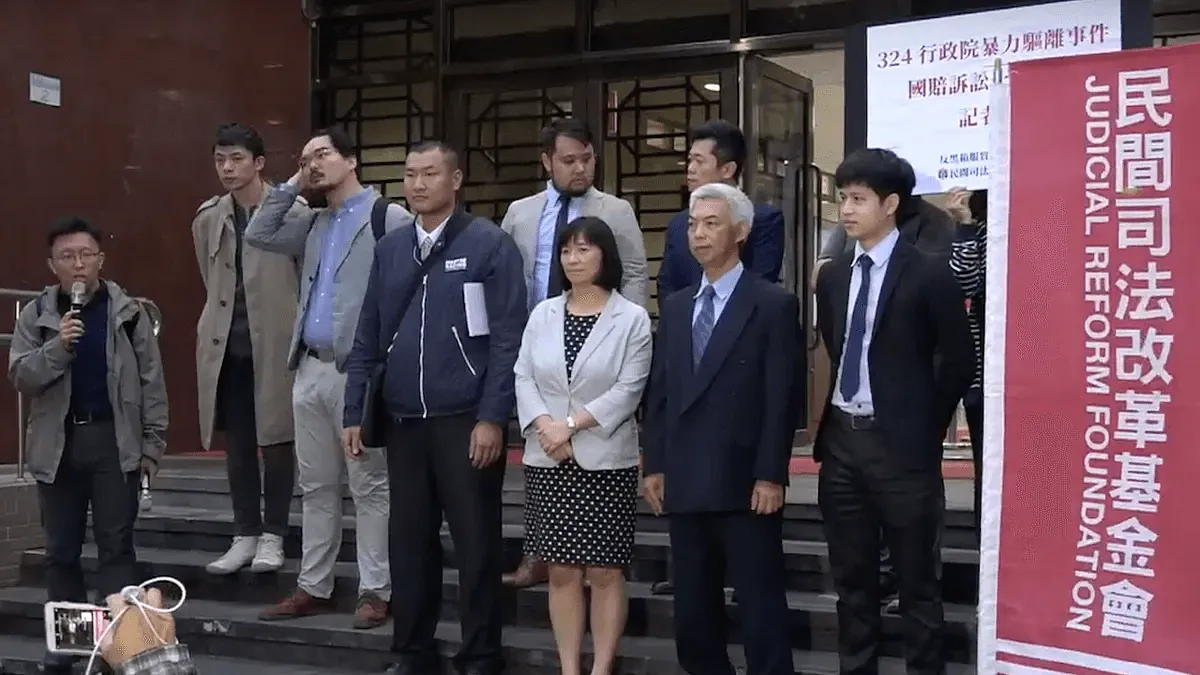
How to Prove I Was Also a Victim?! Press Conference on Partial Victory and Partial Defeat in the First-Instance State Compensation Lawsuit Filed by Citizens over the March 24 Executive Yuan Violent Eviction
Last edited: 2026-07-27
Today, the Civil Division of the Taipei District Court announced its first-instance judgment regarding the state compensation lawsuits filed by 23 citizens against the Taipei City Government and the Taipei City Police Department over the "March 24 Executive Yuan Eviction Incident." While the court dismissed the claims of some plaintiffs, it ruled that the City Police Department must pay a total of over NT$1.1 million to certain plaintiffs. Although the pro bono legal team is gratified that some plaintiffs were granted state compensation, they expressed regret over the dismissal of other plaintiffs' claims.
During the March 24 Executive Yuan Eviction Incident, the police indiscriminately used violence against peacefully gathering and protesting citizens, causing numerous individuals to sustain varying degrees of minor and severe injuries. This fact was not only widely reported by domestic and international media, but was further confirmed after the Criminal Division of the Taipei District Court examined the police's own evidentiary footage. However, it is regrettable that despite the extremely clear facts and evidence of abuse of power and violence, to this day, not a single violent police officer has faced administrative disciplinary action, no prosecutor has initiated a motu proprio investigation, and most of the criminal private prosecutions filed by victims against the responsible officials in the chain of command have yet to receive substantive adjudication. In short, this violent eviction incident, much like the vast majority of state violence incidents from the authoritarian era to the present, has numerous victims, yet simply cannot find the perpetrators.
Today's first-instance judgment ultimately delivers a measure of justice to some of the plaintiffs, forcing the City Police Department to squarely face its improprieties in handling the protest at the time. During the proceedings, the judge spent considerable time personally and meticulously examining the evidentiary video clips of police assaulting people, clearly recording the fact that police officers used batons and riot shields to attack citizens that night. The judge also conducted party interrogations during the proceedings, allowing the plaintiffs to voice the facts of their victimization that night. The litigants and the legal team expressed appreciation for the compensation awarded to some plaintiffs and the dedication shown by the court throughout the proceedings. By ruling in favor of some plaintiffs in this state compensation lawsuit, the court not only confirmed the fact that citizens were victimized, but more importantly, confirmed that the state is the perpetrator.
However, although the court explained in its press release that it allocated the burden of proof by lowering the standard of proof, it still ruled that certain plaintiffs could not obtain compensation on the grounds of insufficient evidence. The litigants and the legal team find this truly difficult to accept. The attorneys of the plaintiffs' pro bono legal team have diligently explained that on that night, the police not only held an obvious advantage in force due to possessing batons and shields, but also prohibited citizens from filming during the acts of violence and dragged the plaintiffs behind police shields, making evidence gathering difficult. The plaintiffs had indeed fulfilled their utmost capacity to produce evidence.
In fact, what the litigants care about has never been the amount of state compensation; rather, in the aftermath of large-scale state violence, can the state's wrongdoing be acknowledged and held accountable? Can we establish the law enforcement standards for assemblies and parades appropriate for a human rights state? The clarification of these related issues is the original intent of the litigants and the legal team in fighting this lawsuit. Taiwan has already domesticated the two Covenants. Article 7 of the International Covenant on Civil and Political Rights clearly states that no one shall be subjected to torture or to cruel, inhuman or degrading treatment or punishment. Riot police beating peaceful demonstrators is the state inflicting torture upon the people. As can be seen from the recent abusive use of force by the Hong Kong police, treating protesting citizens with violence is an attempt to suppress the people's will to participate in assemblies. Once the people become fearful of assembling, the vital cornerstone of freedom and democracy will consequently collapse.
Regarding the dismissal of some plaintiffs' claims, the legal team will study and discuss appeal matters with the litigants. As for the part won in court, we call upon the City Police Department to understand and acknowledge the wrongdoing of the violent eviction on the night of March 24, pay compensation with humility, forgo an appeal, and refrain from using methods that violate human rights and undermine the freedom of assembly to conduct evictions in future street protests. We urge them to ensure that incidents like the one on the night of March 24 at the Executive Yuan—where police in black uniform arbitrarily exercised violence against unarmed protesting citizens—will not and cannot happen again in Taiwan. We sincerely hope that in the future, no one will need to worry about their personal safety before taking to the streets to assemble. Only then can our democracy and rule of law be considered to have a solid foundation.
Attendees
Representatives of the Pro Bono Legal Team
Attorney Yu Po-hsiang
Attorney Kuo Hao-jen
Attorney Chiang Hsin-yu
Attorney Kuo Te-t'ien
Attorney Liu Chi-wei
Attorney Hsu Ming-chih
Attorney Wu Yao-t'ing
Litigant Representatives
Former Legislator Chou Ni-an
Mr. T'ao Han
Mr. Li Meng-jung
Mr. Cheng Yun-yang
Press Contact
Tsai Shang-yu, Specialist, Pro Bono Legal Platform, Judicial Reform Foundation
This article is an AI-generated translation of the original Chinese text. In the event of any discrepancy, the Chinese version shall prevail.