
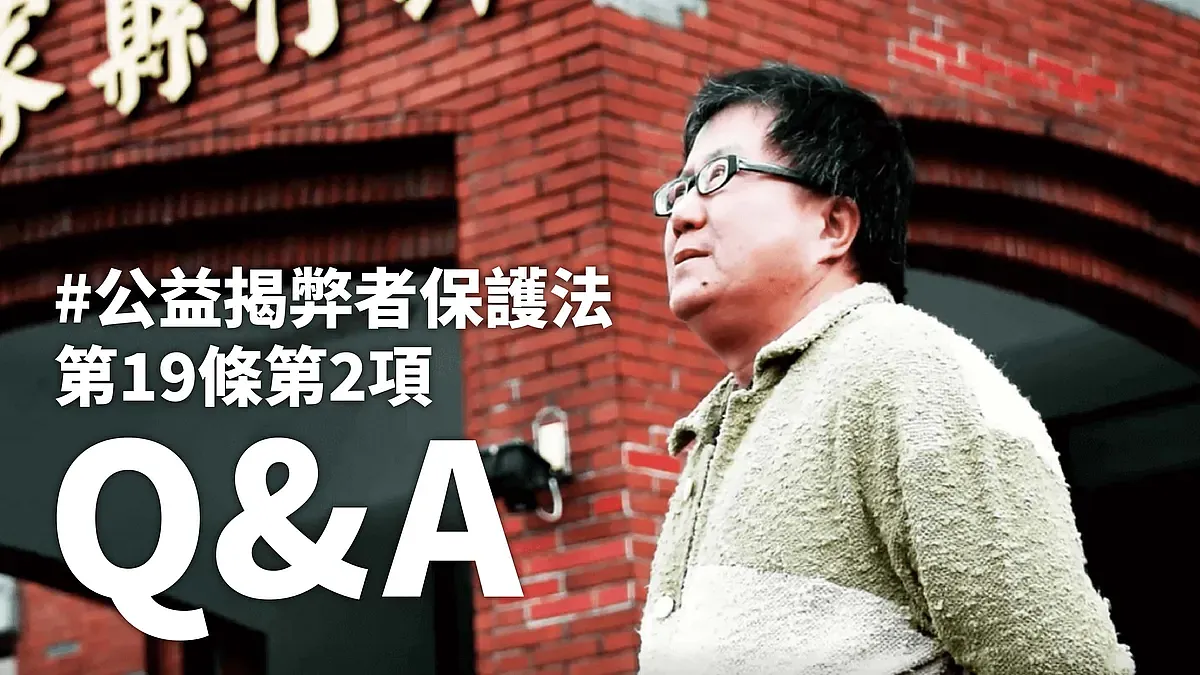
Q&A on Paragraph 2, Article 19 of the Whistleblower Protection Act
Last edited: 2026-07-27
On October 30, the Judiciary and Organic Laws and Statutes Committee of the Legislative Yuan held cross-party caucus consultations regarding the Whistleblower Protection Act. The Judicial Reform Foundation called for the addition of Paragraph 2 to Article 19 to ensure that past whistleblowers of corruption offenses who were exempted from punishment by the court can also be protected under the new law. In response to questions surrounding this proposal, we have compiled the following Q&A:
Whistleblowers prior to the entry into force of the law did not report in accordance with the provisions of the Whistleblower Protection Act, making it inappropriate to grant them protection under the Act?
Whistleblowers prior to the entry into force of the law who seek protection under the Whistleblower Protection Act must still meet requirements such as the definition of corruption cases under Article 3, the reporting agencies under Article 4, the definition of whistleblower under Article 5, and having received a final court judgment exempting them from punishment under Article 13. This is not intended to give pre-enactment whistleblowers preferential treatment over post-enactment whistleblowers, but rather to ensure they receive equal protection.
Tai Li-shen (戴立紳), who would be eligible under Paragraph 2 of Article 19 of the Whistleblower Protection Act, has already applied for a constitutional interpretation. Would legislation at this point potentially conflict with the constitutional interpretation result?
-
Cases undergoing constitutional interpretation have never prohibited the Legislative Yuan from amending laws prior to the delivery of the interpretation result. On the contrary, bills under discussion in the Legislative Yuan should first be determined by the legislature before being submitted to the Grand Justices for review, which aligns with the nature of the judicial power as a post-event remedy rather than prior guidance.
-
Furthermore, if the Legislative Yuan successfully passes the legislation for Paragraph 2 of Article 19, the Grand Justices will dismiss the petition as there will no longer be any necessity to render an interpretation, completely avoiding any inconsistency between the constitutional interpretation and the legislation.
-
Moreover, a constitutional interpretation rendered by the Grand Justices only has retroactive effect regarding the petitioning case itself, and other whistleblowers would still remain unprotected.
-
Finally, Tai Li-shen filed for a constitutional interpretation in January 2018, nearly two years ago, with no end in sight for the interpretation result. Waiting for a constitutional interpretation is of no timely help to Tai Li-shen; legislation is the only way to effectively and immediately protect his rights.
The Civil Service Appointment Act falls under the jurisdiction of the Directorate-General of Personnel Administration (DGPA), and should be handled by the DGPA through the Civil Service Appointment Act?
Subparagraph 4, Paragraph 1, Article 28 of the Civil Service Appointment Act stipulates: "A person who falls under any of the following circumstances shall not be appointed as a civil servant: 4. Having committed an act of corruption while in public service, confirmed by a final conviction, or having an open warrant for arrest that has not yet been closed."
This is a general provision applicable to all corruption cases. Meanwhile, Paragraph 2, Article 13 of the draft Whistleblower Protection Act is an exceptional provision specifically carving out exceptions to Subparagraph 4, Paragraph 1, Article 28 of the Civil Service Appointment Act for cases where courts have exempted the judgment from punishment. The retroactive circumstances advocated by the Judicial Reform Foundation are also strictly limited to whistleblowers exempted from punishment by court judgments. Such exceptional circumstances should naturally be stipulated in the Whistleblower Protection Act to maintain structural consistency.
There may be more than seven past whistleblowers—some who filed administrative appeals but not administrative litigation, or even those who did not file administrative appeals at all—which could affect legal stability?
-
Whistleblowers involved in corruption offenses who were exempted from punishment by courts, if dismissed by administrative authorities, effectively lose their "iron rice bowl." For a whistleblower, this constitutes a severe infringement of rights. If aggrieved, it is hard to imagine that such whistleblowers would not even file administrative litigation. To take a step back, even if such cases existed and no administrative litigation was brought to contest them at the time, the likelihood of them applying to re-enter public office after the legislation passes is extremely minimal. The impact on legal stability would be negligible.
-
Furthermore, Paragraph 2 of Article 13 merely grants whistleblowers the right to apply, while administrative authorities retain the discretionary power of review to decide whether to permit re-appointment to public office. Given how minimal the impact of such a systemic design is on legal stability, contrasted with its profound impact on the fundamental right of the individual to hold public office, there is simply no reason to oppose it.
This article is an AI-generated translation of the original Chinese text. In the event of any discrepancy, the Chinese version shall prevail.