
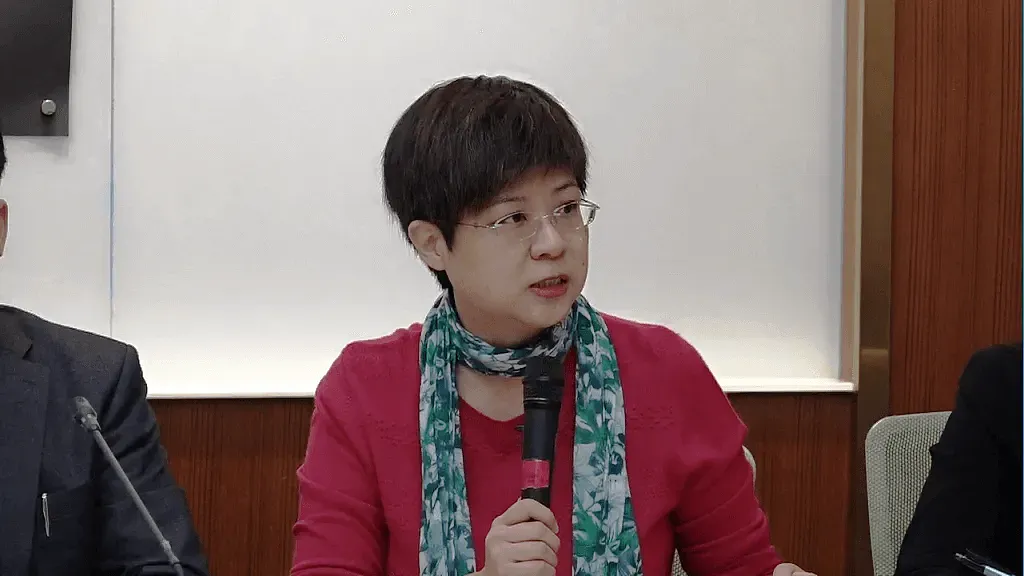
Professor Lin Chih-hsiu: If the Bill Remains Flawed, Who in This Society Will Ever Step Forward to Be a Whistleblower Again?
Last edited: 2026-07-27
First of all, I strongly support what Li-shen just said. During the drafting of the entire bill, I repeatedly suggested that prosecutors' discretionary power for deferred prosecution regarding whistleblowing should be expanded. When discussing whistleblowers, we must keep in mind the "three major protections": confidentiality of identity, protection of personal safety, and job security. In fact, Mr. Tai's case fully exposes the reality that whistleblowers in Taiwan lack even a single one of these three protections—his identity was immediately exposed, he lost his job instantly, and threats to his personal safety along with various attacks poured in like a tidal wave.
About three years ago, after the Judicial Reform Foundation learned about this case, we provided our utmost assistance. Thanks also to many fellow attorneys, when we reached a dead end roughly a year and a half to nearly two years ago, we filed a petition for constitutional interpretation with the Grand Justices. However, up to now, there has been no progress on the constitutional interpretation, and we have yet to receive any response. Fortunately, with the assistance of the Agency Against Corruption and the Ministry of Justice, a draft Whistleblower Protection Act was finally produced and is currently under deliberation in the Legislative Yuan. I personally wish to give credit to the government for this.
However, it is a great pity that despite all precautions, this bill has a loophole. It explicitly mentions Mr. Tai and another whistleblower in history who blew the whistle at the highest level, Mr. Chang Chin-yuan. Seeing these two immensely important whistleblowers in Taiwan—one from the public sector and one from the private sector—both suffer ruthless blows recently, we can understand that if this bill is not enacted, and if the bill remains flawed, who in this society will ever step forward to be a whistleblower again? Who will step forward to protect our public interest?
Just think about it: if a whistleblower steps forward today, they can save government budgets, prevent an airplane crash, or prevent tragedies like the Puyuma derailment. Isn't this an immensely important matter? If there is pollution, food safety scandals, or toxic baby formula incidents, a whistleblower stepping forward can save countless innocent lives and prevent extensive harm. Therefore, we must affirm and recognize whistleblowers.
You might not fully understand why Mr. Tai had to step forward. It is because our whistleblowing mechanism became entangled with the Civil Service Employment Act. At the time, he was the first to blow the whistle, but because he surrendered himself, the evidence of his crime was conclusive, making him remarkably the first among all accomplices to be exempted from punishment. Yet, immediately after being exempted from punishment, he was dismissed from his post. Under the Civil Service Employment Act, he was consequently barred from ever serving as a public servant again. Meanwhile, the other individuals whom he reported and exposed were able to continue serving as public servants because they kept appealing their cases. There is nothing more absurd under the sun. Therefore, in the entire draft Whistleblower Protection Act, we specifically stated that in situations involving the Civil Service Employment Act, to encourage whistleblowers, a certain degree of priority protection should be granted to them. Such a provision was formulated specifically for Mr. Tai, yet in the end, it cannot be applied to him. Isn't this an utterly ridiculous state of affairs?
We can understand that many legislators or the proposing authority might worry whether transitional application clauses—protecting individuals who have blown the whistle in the past—would lead to an overwhelming number of cases. In reality, that would not happen, because statistics show the number of cases is well below ten, representing a very small number of instances.
It was precisely because these individuals stepped forward to make appeals that the whistleblower legislation came into being; yet, they themselves cannot apply this law, and all of the "three major protections" are completely absent. I personally believe this is an extremely unfair and unjust situation. Therefore, I make a solemn appeal here: Mr. Tai's whistleblowing is evident to all. Everyone knows that because of him, our public coffers were saved, and more importantly, Mr. Tai fully met the conditions—he also surrendered all criminal proceeds and did not take a single penny. Because of him, this bill exists, and this bill even contains an exceptional provision specifically because of him, aiming to encourage people in the public sector not to fear losing their civil servant status and to have the courage to blow the whistle. Yet such a provision cannot be applied to him. I personally find this utterly unreasonable, and I sincerely appeal that during the review of this case, a transitional provision regarding the application period be proposed, so that those who truly deserve protection can be protected through the passage of this bill, thereby encouraging the public to bravely blow the whistle. Thank you all.
This article is an AI-generated translation of the original Chinese text. In the event of any discrepancy, the Chinese version shall prevail.