

Visual Science in the Courtroom from the Perspective of the Ch'en Ching-k'ai Case
Last edited: 2026-07-27
Ch'en Ching-k'ai, a former national handball athlete, suffered severe visual impairment due to a traffic accident. Afterward, Ch'en made an effort to make his behavior resemble that of a normal person, but he was accused of feigning blindness in order to defraud insurance payouts.
On February 14, 2018, the second-instance judgment ultimately found Ch'en Ching-k'ai guilty, sentencing him to 1 year and 2 months of imprisonment. However, a careful reading of the judgment reveals that the judges actually acknowledged Ch'en's vision was indeed impaired due to the traffic accident. Yet, was the degree of impairment severe enough to meet the insurance claim standard of 'International Visual Acuity below 0.02'? The judges held that the medical testing data and appraisal reports related to the case were insufficient to make such a determination.
'...Although the defendant sought medical treatment at multiple hospitals after the traffic accident... and submitted electroretinogram test charts and diagnostic certificates from several hospitals; while the results of the aforesaid instrument tests can indeed establish that the defendant's vision differs from and is weaker than that of ordinary people, none of the aforesaid instruments can read whether the defendant's visual acuity had already reached a state of total blindness below the International Visual Acuity standard of 0.01...'
'...The conclusion of the appraisal report from the Department of Psychology of National Taiwan University is manifestly inconsistent with the defendant's objective daily life behavioral expressions as captured on video, nor does it accord with the defendant's arguments; it is difficult to recognize the findings of the aforesaid appraisal as conforming to the defendant's true visual condition, and therefore the appraisal conclusion stating that the defendant's visual acuity is even lower than the International Visual Acuity standard of 0.01 cannot be adopted.'
'After deliberation by this Court, it is deemed that none of these are sufficient to serve as a basis for determining whether the defendant's visual acuity in this case is below the International Visual Acuity standard of 0.01 or constitutes total blindness in both eyes. Moreover, while the defendant's visual acuity is indeed impaired, the precise degree of such impairment is likewise not a matter that ought to be investigated and confirmed in this case.'
—Excerpted from the Judgment of the Taiwan High Court Kaohsiung Branch Court (103-Shu-Yi-574) [1]
In the Ch'en Ching-k'ai case, the most core question has always been: 'What is the numerical value of his visual acuity?' This article attempts to summarize and explain this issue.
International Visual Acuity 0.01
Visual Acuity (VA) was defined in 1862 by the Dutch ophthalmologist Snellen. He defined 20/20 vision—or 1.0—as the ability to distinguish the direction of the gap in a letter at a distance of 20 feet, where the gap subtends an angle of 5 arcminutes (1 degree equals 60 arcminutes, so 5 arcminutes equals 1/12 of a degree) (Figure 1). If this can only be distinguished at a distance of 10 feet, the visual acuity is 10/20, or 0.5. Therefore, visual acuity of 0.01 means that the gap direction of the letter can only be distinguished at a distance of 0.2 feet (approximately 6 centimeters). [2]
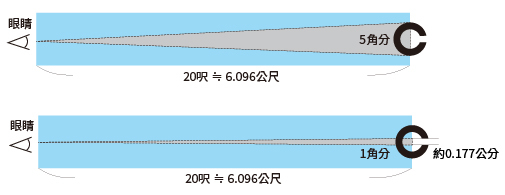
Figure 1 / International Visual Acuity 1.0 refers to the ability to distinguish the direction of the gap in a letter subtending 5 arcminutes at a distance of 20 feet.
- 20 feet: approximately 6.096 meters
- 5 arcminutes: A complete circle is 360 degrees, and 1 degree is 60 arcminutes, so 5 arcminutes equals 1/12 of a degree.
- The size of a letter gap subtending 1 arcminute at a distance of 20 feet is approximately 0.177 centimeters.
- Diameter * 3.14 * proportion of the circle = arc length
- (6.096 * 100 * 2) * 3.14 * (1 / 60) / 360 = 0.177
Next, let us understand the visual stimulus used in the International Visual Acuity chart—the letter C or E, where the width of the gap is 1/5 of the entire letter (Figure 2). Furthermore, for the sake of calculation convenience, 1 arcminute at a distance of 20 feet is defined as 1 minute of arc (MAR), and visual acuity of 1.0 corresponds to the ability to recognize a gap of 1 MAR. Having 'minutes of arc' eliminates the need to constantly convert distances and the sizes of visual stimuli.
- Visual Acuity Value = 1 ÷ Minutes of Arc (MAR)
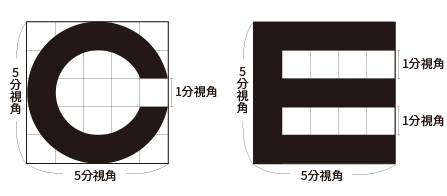
Figure 2 / Visual stimuli: letters C and E
After understanding the definition of 'visual acuity', one can comprehend that the essence of visual acuity is a subjective sensation, which requires feedback from the subject to be ascertained. Incidentally, many people may confuse 'myopic diopters' with 'visual acuity'; these two concepts are different and cannot be converted into one another. [3]
The subsequent question is: Is it possible to objectively ascertain a subjective sensation that requires the subject's feedback? This part involves the field of psychology.
Psychophysics – Behavioral Assessment Experiments
Precisely because 'sensation' requires a response from the subject to be known, and yet every individual has different response standards, the answers obtained cannot be meaningfully discussed and concluded. To solve this dilemma, the discipline of 'psychophysics' was developed to study the relationship between stimuli and sensations using scientific methods. In the visual system function appraisal report for the Ch'en Ching-k'ai case, the behavioral assessment experiments applied this very method.
The experiment utilized the 'method of constant stimuli' in psychophysics. Scientists selected several stimuli of varying intensities based on the perceptual capacity they wished to understand, and these selected stimuli were presented randomly to the subject during the experiment. The range of stimuli was set such that roughly half of the stimuli would be difficult for the subject to perceive (hard to see), while the other half would be easy to perceive (easy to see).
Moreover, the experimental process restricted the subject's mode of response by conducting a '2-alternative-forced-choice (2AFC)' test. The subject was not allowed to answer whether they could or could not see, but was instead required to answer the 'actual state' of the stimulus, and there were only two possible states for the stimulus. If the subject continuously pretended not to see and guessed randomly, their accuracy would constantly hover around 50%. The 'forced-choice' method allows the experimenter to ascertain from the test results whether the subject has responded 'truthfully'. For example, the online experiment shared below requires subjects to respond whether a dot of light is to the 'right' or 'left' of a cross.
Friends who wish to experience this firsthand can visit SAGE edge to play an online experiment [4] and test 'How bright does it have to be to see it?' Light spots of varying brightness will appear on the screen to test your perceptual capacity. You can select 'Forced-Choice' on the 'Method Settings' page, set the relative brightness of the light spot, the number of repetitions, the maximum and minimum values of the light spot, etc. Once configured, click 'Experiment' to begin the experiment!
The light spot will flash on the screen. Under the 'Forced-Choice' setting, the experimental question is 'To which side was the dot?', forcing you to respond whether the light spot is to the 'right' or 'left' of the cross, and requiring a guessed response even if it cannot be seen.
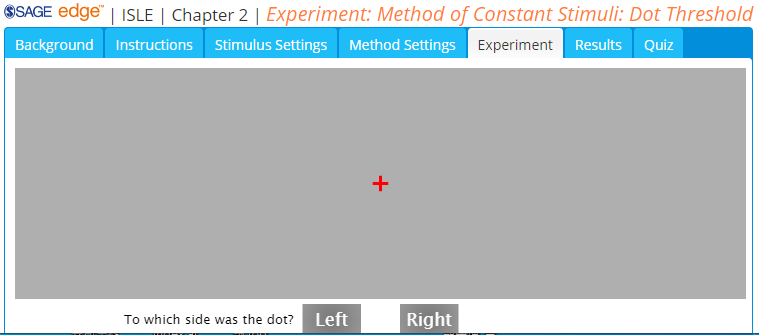
Figure 3 / SAGE edge online experiment
The blue curve in Figure 4 is a chart generated by the author under conditions of active cooperation with the experiment. The X-axis represents stimulus brightness intensity, the Y-axis represents accuracy, and the red line marks the 'threshold', which refers to the brightness level at which the author achieved a 75% recognition accuracy rate.
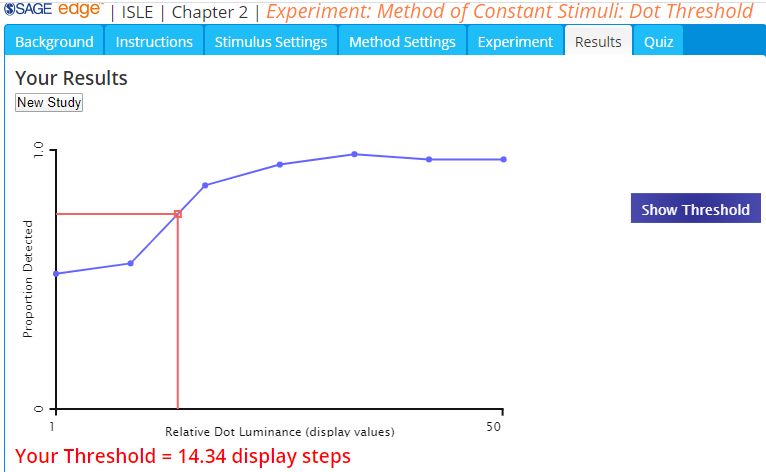
Figure 4 / Chart generated from the SAGE edge online experiment under active cooperation.
The 'method of constant stimuli' enables scientists to 'present the subject's perceptual capacity for specific stimuli using objective indicators', while the '2-alternative-forced-choice' solves the dilemma of 'different subjects and different response criteria'. Through the application of these two experimental designs, the perceptual capacities of different subjects can thus be objectively compared and evaluated.
Behavioral Assessment Experiments in the Ch'en Ching-k'ai Case
Having understood the basic concepts of psychophysics, let us examine how they were applied in Ch'en Ching-k'ai's case.
The purpose of the experiment was to 'understand the numerical value of Ch'en Ching-k'ai's visual acuity'. According to the definition of international visual acuity, visual acuity is the ability to discern specific sizes at a specific distance. Therefore, in Ch'en's experiment, the visual stimuli chosen were 'random, differently sized upright or inverted triangles'. The base widths of the triangles came in five different sizes: 30, 60, 120, 180, and 240 pixels, and they appeared randomly on the screen as either upright or inverted (Figure 5). During the experiment, Ch'en was only permitted to answer 'upright' or 'inverted', and even if he could not see them, he was forced to guess and choose one answer. A total of 150 trials were conducted, and upon completion, the subject's accuracy in responding to 'triangles of different sizes' was calculated.
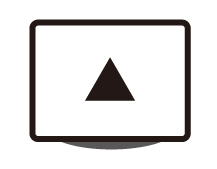
Figure 5 / Random, differently sized upright or inverted triangles appear on the screen,
and the subject is forced to answer 'upright' or 'inverted'.
Because human visual detection capability for 'triangles of varying sizes' is continuous, if the X-axis of the curve represents triangle size and the Y-axis represents accuracy, when the subject actively cooperates, the measurement results will yield a smooth curve. This curve gradually rises from 'almost imperceptible' (hard to see) to 'almost entirely perceptible' (visible). Through this curve, scientists can determine the subject's perceptual capacity at a specific accuracy rate.
Let us look directly at Ch'en Ching-k'ai's test results (Figure 6). The X-axis represents minutes of arc (stimulus size); the Y-axis represents accuracy. There are two curves in the figure, representing different testing distances: Curve A was tested at a distance of 12 cm, and Curve B at 30 cm. It can be observed that accuracy rises from 50% (chance level) as the stimulus size increases. This experimental result showed that Ch'en was actively cooperating with the experiment. Once Ch'en's perceptual capacity curve was obtained, we could define what constitutes 'being able to see' at a given accuracy rate. If accuracy is set at 90%, it can be deduced from the curve that the triangle size Ch'en could recognize was approximately 2,350 minutes of arc.
Reviewing the definition of visual acuity mentioned earlier—'visual acuity of 1.0 is the ability to recognize 1 minute of arc, and visual acuity value = 1 ÷ minutes of arc'—therefore, at a 90% accuracy rate, Ch'en Ching-k'ai's visual acuity value was approximately 1 / 2,350 = 0.00042, which is far below the insurance claim standard of 0.02. [5]
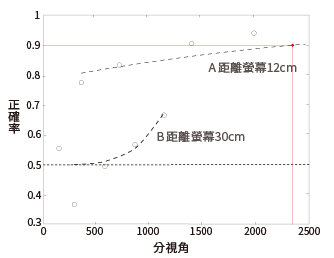
Figure 6 / Psychometric function curve of Ch'en Ching-k'ai's accuracy in judging
'whether the stimulus is upright or inverted' for stimuli of various angular sizes.
The larger the stimulus in minutes of arc, the higher the accuracy.
Triangles vs. The Letter C
At this point, attentive readers may have noticed that the visual stimuli used in the international visual acuity chart differ from those used in Ch'en's experiment. The international visual acuity chart generally uses the 'letter C', whereas the experiment used 'triangles'. Why did the experiment not use the letter C, but triangles instead? (Figure 7)
When using the letter C, the visual stimulus the subject discriminates is the 'gap of the C', but the size of the 'entire letter C' is 5 times that of the gap. Conversely, when discriminating the direction of a triangle (upright or inverted), the subject discriminates the 'difference between the apex and base width of the triangle', and the width of the entire triangle is simply its base width. When using a triangle as a visual stimulus, the same perceptual capacity (visual acuity) can be measured using only 1/5 of the layout width required by the letter C.
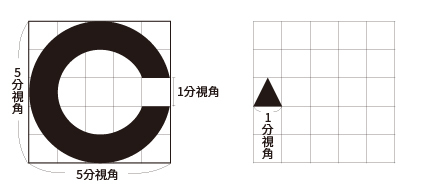
Figure 7 / 'Letter C' and 'Triangle'
As mentioned earlier, the range of stimulus sizes selected in 'behavioral assessment experiments' is set such that about half of the stimuli are difficult for the subject to perceive (hard to see), while the other half are easy to perceive (easy to see). This means that the selected stimuli must be large enough for the subject to perceive, but when a subject's visual acuity is extremely low, the letter C might become too large to fit on the experimental screen.
Furthermore, using the letter C or E may introduce another problem. Because the subject is only 12 cm and 30 cm away from the screen, and the middle of visual stimuli like 'letters C and E' is blank, when the testing distance is this close, if the spot the subject happens to be looking at falls precisely on the middle blank space, they will fail to receive this visual stimulus (Figure 8). Such an issue does not arise when using triangles.
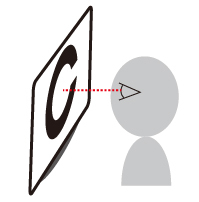
Figure 8 / If the 'letter C' is used,
the subject may be looking at a blank space during close-range testing.
Reflection—Blindness is Not Incapacity
'...This demonstrates that instrumental measurements such as functional MRI (fMRI) scans and visual evoked potentials (VEP) focus merely on measuring and judging how nerves in certain regions of the brain react to visual stimuli and what signal reactions occur in the brain when visual stimuli appear, and cannot serve as a basis for determining the defendant's specific degree of visual acuity based on the results obtained from such measurements—meaning it is impossible to hastily infer whether the defendant's visual acuity has reached the state of total blindness below the International Visual Acuity standard of 0.01...'
'...The conclusion of the appraisal report from the Department of Psychology of National Taiwan University is manifestly inconsistent with the defendant's objective daily life behavioral expressions as captured on video, nor does it accord with the defendant's arguments; it is difficult to recognize the findings of the aforesaid appraisal as conforming to the defendant's true visual condition, and therefore the appraisal conclusion stating that the defendant's visual acuity is even lower than the International Visual Acuity standard of 0.01 cannot be adopted.'
—Excerpted from the Judgment of the Taiwan High Court Kaohsiung Branch Court (103-Shu-Yi-574) [1]
Looking back at the second-instance judgment of the Ch'en Ching-k'ai case, one can observe the judges' misunderstanding of the 'definition of visual acuity'. 'Visual acuity' is 'perceptual capacity', which requires feedback from the subject to be known. Currently, there is no instrument that can 'directly measure' perceptual capacity. Precisely for this reason, the appraisal experiment conducted by the Department of Psychology at National Taiwan University was designed in three parts: the first part observed the subject's cerebral visual responses using fMRI; the second part observed potential changes in brain nerve cells using EEG; and the third part measured the subject's visual sensitivity (visual acuity) using psychophysical behavioral assessments. These three parts of the experiment mutually supported one another. [5]
The judges did not trust the results of the behavioral assessment appraisal, yet they did not challenge the principles or methods of the experiment at all. Instead, they directly used the 'objective daily life behavioral expressions captured on video' to conclude that Ch'en's visual acuity was not below 0.01, dismissing the behavioral assessment appraisal results with a single sentence.
Looking further at the court's 2018 ruling dismissing the motion for a retrial in this case, the court went so far as to deem video footage of daily life behaviors more credible than scientific appraisal.
So-called 'scientific appraisal' refers to judgments and opinions made by persons possessing special knowledge and experience regarding appraisal facts, under current conditions (not at the time the facts occurred), subsequently utilizing their knowledge and experience based on equivalent reasoning regarding specific facts they cognize. Its nature is inherently that of indirect evidence, and its probative force obviously cannot override 'direct evidence' (namely, the video footage of the applicant's daily conduct in this case) which can be witnessed firsthand and reproduced in the courtroom.
Moreover, so-called 'science' does not seek absolute, infallible truth; it merely gropes forward to continuously approach the truth on the basis of existing foundations, and is not immune to questioning. Therefore, if the results of a 'scientific appraisal' do not conform to the true situation, one should naturally turn back to examine whether there are errors in the appraisal process, methods, or judgments. To stubbornly treat it as correct manifestly violates the scientific spirit of seeking truth from facts.
—Excerpted from the Criminal Ruling of the Taiwan High Court Kaohsiung Branch Court (107-Sheng-Tsai-187) [7]
However, what kind of 'behavioral expression' truly counts as having visual acuity below 0.01? And how is the correlation between 'behavioral expression' and 'visual acuity value' established? The judgments and rulings provide zero explanation. Furthermore, the judges' conclusion actually presupposes a certain imagination of 'how blind people behave'.
People often ignore the limitations of their own life experiences due to their trust in seeing is believing. After witnessing 'shocking' imagery—such as a blind person catching a frisbee or playing table tennis—it becomes difficult to be convinced by deeply rooted prejudices, even in the face of scientific argumentation. In fact, throughout the history of scientific development, scientific discoveries that violated people's 'seeing and hearing' have been ubiquitous, ranging from the heliocentric theory of the 16th century to quantum mechanics in the 20th century. Science is certainly not an absolute, infallible truth, but precisely because seeing and hearing are unreliable, humanity has established scientific methods to help us draw closer to the truth.
Moreover, the behavioral manifestations of the visually impaired involve yet another distinct profession—special education. Special education professionals have labored in this field for a long time, assisting many individuals who lost their vision midway through life in rebuilding their living capabilities after losing their sight. In fact, during the first instance, a special education expert from the Taiwan Foundation for the Blind testified to offer opinions, but regrettably failed to persuade the court either.
Observing the adjudication process of this case, one finds that not only are the professions of visual science and special education misunderstood, but more fundamentally, sighted people harbor preconceived notions about the visually impaired. Not only does Ch'en Ching-k'ai continue to fight through litigation, but the confrontation between the gazes of the visually impaired and the sighted takes place every single day.
'A blind person is not equivalent to a person with an incapacity. When you are doing something that other visually impaired persons have not done, you will find yourself surrounded by countless doubts and suspicions. In fact, to this day, I am still constantly fighting, and it is always through numerous fights that I prove that visually impaired people can indeed do this.'
—Li Ping-hung / Taiwan's First Blind Lawyer
※ This article was published in PanSci on March 6, 2020.
Notes
[1] Judgment of the Taiwan High Court Kaohsiung Branch Court (103-Shu-Yi-574)
[2] "Visual Acuity ≠ Diopters—Myopic Diopters Cannot Be Converted into Visual Acuity" by Lin Chang-p'ing, Ophthalmologist at Changhua Christian Hospital
[3] Diopter (Wikipedia)
[4] Psychophysics Online Experiment
[5] Visual System Function Appraisal Report for the Ch'en Ching-k'ai Case
[6] "A Study on Functional Visual Ability Assessment and Observation" by Chang Ch'ien-hui, Department of Special Education, National Taiwan Normal University
[7] Criminal Ruling of the Taiwan High Court Kaohsiung Branch Court (107-Sheng-Tsai-187)
This article is an AI-generated translation of the original Chinese text. In the event of any discrepancy, the Chinese version shall prevail.