
An Open Letter to Presidential Candidates: How Will You Reform the Judiciary? Press Conference by the Alliance for Monitoring the Implementation of Judicial Reform National Consultative Conference Resolutions
Last edited: 2026-07-27
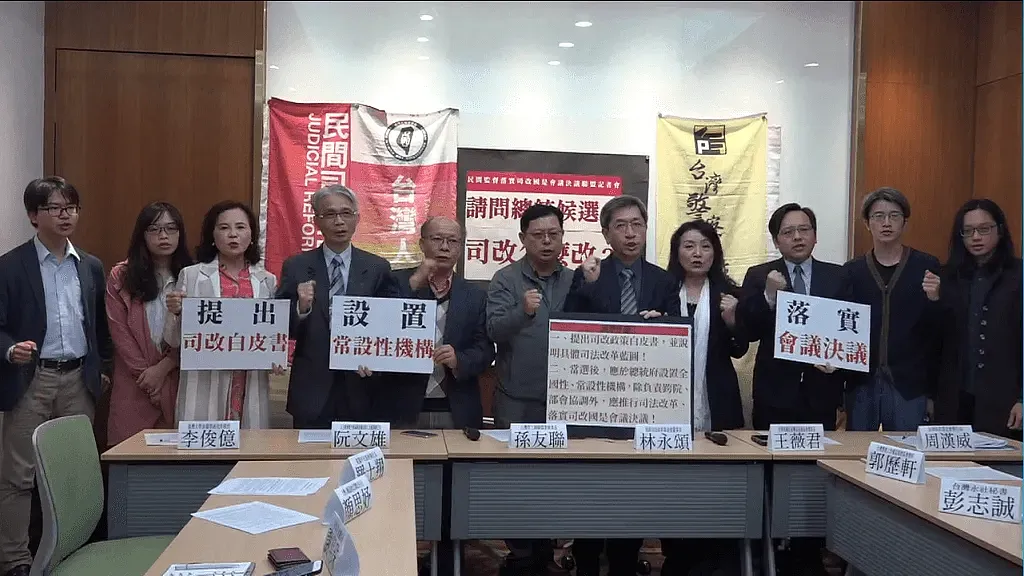
The Alliance for Monitoring the Implementation of Judicial Reform National Consultative Conference Resolutions held a press conference titled "An Open Letter to Presidential Candidates: How Will You Reform the Judiciary?" this morning (November 19) at Room 101, Chung-hsing Building, Legislative Yuan. The Alliance sought to meet with various presidential candidates, calling upon them to propose a "Judicial Reform Policy White Paper" that can be implemented within four years of taking office, clearly outlining their blueprint for judicial reform. In addition, the Alliance urged presidential candidates to commit to establishing a national, permanent institution under the Office of the President to effectively drive judicial reform forward.
With the 2020 presidential election just over a month away and presidential candidates from various political parties rolling out their campaigns, many policies have been proposed. However, regarding judicial reform, none of the candidates have put forward a concrete and viable judicial reform policy white paper, leading to a lack of attention from presidential candidates toward an issue of long-standing public concern. Since the conclusion of the National Consultative Conference on Judicial Reform in 2017, numerous reforms remain uncompleted. Looking at the current attitudes of the presidential candidates toward judicial reform, the future trajectory of judicial reform over the next four years appears ambiguous and inconsistent.
The Alliance believes that presidential candidates must squarely address the deeply rooted problems within Taiwan's judicial system and propose a practical, verifiable judicial reform policy white paper to demonstrate that they are prepared to govern. Therefore, the Alliance sincerely calls upon the following:
- Presidential candidates should issue a judicial reform policy white paper detailing a concrete blueprint for judicial reform.
- Upon election, presidential candidates should establish a national, permanent institution under the Office of the President. In addition to coordinating across different branches and ministries, this body should actively drive judicial reform and implement the resolutions of the National Consultative Conference on Judicial Reform.
To directly present our demands on judicial policy to the presidential candidates, we have contacted and sought meetings with candidates from all political parties in hopes of understanding and communicating the content and direction of their judicial reform policies for the next four years. The Alliance makes the following recommendations:
-
The judicial reform policy white paper should prioritize enhancing public trust in the judiciary and safeguarding the plight of vulnerable groups within the justice system.
As the 2020 presidential and legislative elections approach, the Alliance has observed that judicial reform issues have not received sufficient attention from presidential candidates, raising concerns about whether the next president and legislature will continue to advance judicial reform. The Alliance believes that the current progress of judicial reform falls short of expectations. Regardless of who wins the next presidency, we expect them to value the public's aspirations for judicial reform, promptly adjust policy directions and progress, and continue pursuing judicial reform to fulfill the goals of the National Consultative Conference on Judicial Reform.
In a video featuring random interviews conducted by the Alliance, it was found that interviewed citizens still feel disconnected from judicial reform. The Alliance believes that overly complex, lengthy judicial judgments—once presented through one-sided media reports that project a negative image of the judiciary—further widen the gap between the public and the legal system. Therefore, we hope that the government will incorporate public voices widely when implementing resolutions, accelerate the pace, make the judiciary more accessible to the public, and strengthen the dissemination of accurate information and education to raise the visibility of judicial reform, thereby allowing the public to better understand its impact and truly feel its effects.
In the video, the Alliance also cited child abuse cases as an example, noting that while news media frequently report on legal news concerning child abuse, related problems show no improvement. Issues continue to occur, such as inconsistencies between hospital and forensic judgments leading to perpetrators escaping justice, or abusive parents continuing to have more children, thereby generating even more child abuse cases. Regarding victim protection, the families of victims are often unable to obtain the deceased's autopsy report or case files prior to court hearings, infringing upon the victims' right to know. Relevant agencies often excuse themselves by claiming that existing systems are already complete, failing to recognize the systemic dilemmas faced by vulnerable individuals within the justice system.
Therefore, to ensure that judicial reform continues and the rights of vulnerable groups are protected, the Alliance sincerely calls on presidential candidates to issue a judicial reform policy white paper. This white paper should explain a concrete judicial reform blueprint, clearly informing the public of the judicial reform initiatives and schedules during the upcoming four-year presidential term, so that people can truly perceive judicial reform and, in turn, rebuild their trust in the judiciary.
-
The permanent supervisory institution established under the Office of the President should comprise a majority of non-governmental members and non-lawyers.
Among the resolutions adopted at the 2017 National Consultative Conference on Judicial Reform, the majority required joint deliberation across different branches and ministries, often consuming substantial time in coordination and communication. Differences in opinions among various agencies also made these resolutions difficult to implement. Looking at the implementation of the Conference resolutions over the past two years, we have witnessed only slow progress or a complete lack of advancement for numerous resolutions, with many lingering indefinitely in the seminar or study phase. Consequently, only a dedicated agency responsible for integrating the various branches and ministries, and for setting rigorous schedules for the items mentioned in the resolutions, can truly fulfill judicial reform resolutions.
Although official-civilian communication platforms currently exist, the aforementioned problems still urgently require resolution. Therefore, the Alliance calls for the establishment of a permanent institution under the Office of the President, as it is essential for overseeing the implementation of the resolutions from the National Consultative Conference on Judicial Reform. This is necessary to ensure the scheduling of various resolutions and to provide oversight, coordination, and integration; otherwise, the implementation of these resolutions cannot be sustained. Furthermore, to ensure that this permanent institution meets public expectations, its membership should include a majority of non-governmental members and non-lawyers to prevent bureaucratic insularity.
Finally, the Alliance will also meet with presidential candidates to engage in direct communication and understanding, exchanging views on the judicial reform policy white paper and the permanent institution under the Office of the President, thereby raising the candidates' awareness and prioritization of judicial reform.
Attending Representatives
Wang Wei-chün / Member of the National Consultative Conference on Judicial Reform, Chairperson of the Taiwan Association for the Promotion of Children's Rights
Li Chün-yi / Member of the National Consultative Conference on Judicial Reform, Professor at the Graduate Institute of Forensic Medicine, National Taiwan University
Sun Yu-lien / Member of the National Consultative Conference on Judicial Reform, Secretary-General of the Taiwan Labor Front
Nguyen Van Hung / Member of the National Consultative Conference on Judicial Reform, Vietnamese Migrant Workers and Brides Office, Catholic Diocese of Hsinchu
Sie Ming-jhu / Member of the National Consultative Conference on Judicial Reform, Vice President of Tokyo Language School
Yen Szu-yü / Director of the Northern Office, Taiwan Association for Human Rights
Chou Han-wei / CEO of the Legal Aid Foundation
Lo Shih-hsiang / CEO of the Taiwan Innocence Project
Peng Chih-cheng / Secretary of Taiwan Association for Liberation
Kuo Li-hsuan / Supervisor of the Taiwan Police Rights Promotion Association
Lin Yung-sung / Chairperson of the Judicial Reform Foundation
Hsiao I-min / Office Director of the Judicial Reform Foundation
Press Contacts
Judicial Reform Foundation / Director Hsiao I-min (02)2523-1178#25
This article is an AI-generated translation of the original Chinese text. In the event of any discrepancy, the Chinese version shall prevail.