
Valuing "People": Between Ideals and Pragmatism
Last edited: 2026-07-27
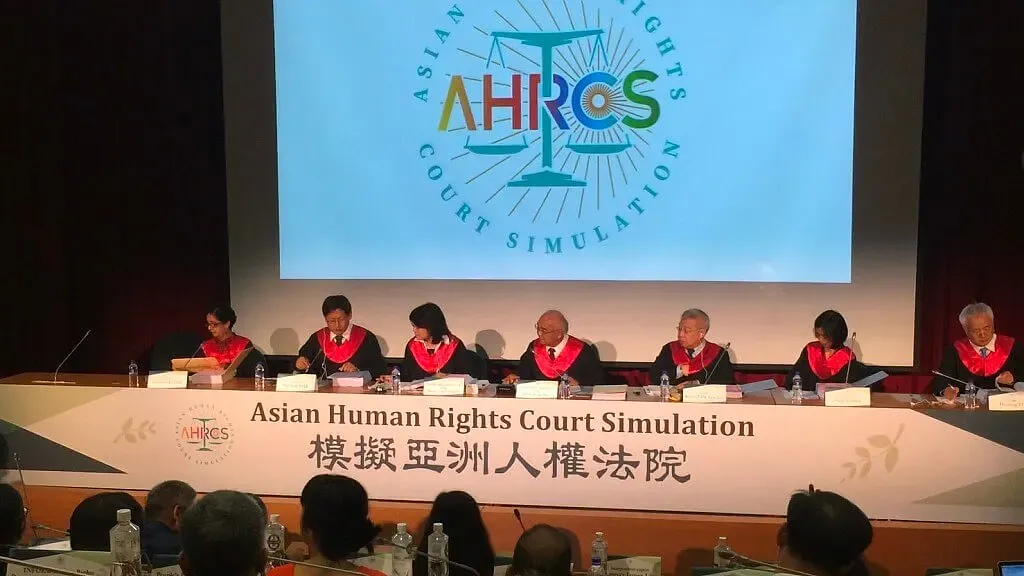
Photo / Mock trial of the Chiuch'iu Ho-shun case at the Asian Court of Human Rights (Simulation)
It has been over a month since my internship at the JRF ended, but I still feel as though those issues concerning judicial reform, human rights, and policy continue to tightly surround and remind me that there is a group of people working tirelessly every single day toward the goal of a better judiciary and a better society, while also reminding me that I am a part of that.
An Emphasis on "People"
I still remember when I first submitted my internship application, my sole desire was to infuse a bit of the "human" element into the experience while getting a taste of the JRF's operations. I had thought that judicial reform meant finding a better alternative for the existing system, then burying our heads in hard work to urge systemic change, without delving too deeply into the interactions between people and society. My subsequent two months at the JRF proved this notion to be terribly naive and ridiculous, because the JRF's establishment, operations, and daily affairs are built upon "people." The JRF is essentially doing social movement work; because the judicial system has so severely ignored "people," this group of legal and non-legal professionals—convinced that greater attention must be given to "people" within the system—initiated judicial reform with the goal of earning public trust in the judiciary, dedicating themselves to improving and transforming the judicial system.
Honestly, why work so hard? There is a well-paved path within the system—why not just walk it obediently?
The judiciary often projects an image of being untouchable and beyond reproach—"if you follow the rules, you won't need to cross paths with the judiciary." But in reality, the judiciary is not only omnipresent, but often appears when least expected. When you are forced to confront the judiciary, only to find that it is inherently unfriendly to you, what should you do? Just as A-chiang described his initial decision to walk into the police station as stemming from a "lack of understanding of the judiciary," only to end up spending 16 years in a detention center. As a government department, the judicial system sometimes exists merely for the sake of existing, or serves only power. If you are nothing more than an object or a case file within the judicial system, how can you cry out and ask the judiciary to see the "human" side of you? In my view, this is precisely what the JRF and judicial reform are striving to do. Judicial reform is dedicated to placing "people" back into the focus by improving the judicial system.
However, factoring in "people" is by no means an easy task, let alone urging the system to move in the direction of elevating its regard for "people." Judge Lin Meng-huang mentioned in a guest lecture that "just as life is difficult, sentencing is equally difficult"; in the heavy-felon visiting room of the Tucheng Detention Center, A-shun told me that he dared not make friends in detention lest he go mad. How can we demand that the judicial system take such hard-to-quantify factors into account? I do not know, and I believe the JRF and those engaged in judicial reform do not know either. But of one thing we are certain: the precious value of a democratic society lies in the fact that these "human" dimensions have room to survive.
The Accumulation of Broad Directions and Small Strategies
Perhaps because they know these "human" dimensions have room to survive within the judicial system, those engaged in judicial reform do not blindly trust the judiciary, yet neither do they succumb to uncritical distrust. During an event hosting the President of the Supreme Court of Paraguay, Director Hsiao I-min specially introduced that the JRF is dedicated to judicial "reform," rather than "advancement" or "revolution." But how on earth should intra-systemic reform be carried out? In truth, most people do not know. Director Hsiao might seem to have an endless stream of ideas, but he still told me that most of the time he has no idea what to do—“if we knew how to do it, there wouldn't be any need to turn to the JRF.” Fair enough. Yet over these past two months, I have still witnessed everyone being extraordinarily busy every single day. Gradually, I came to realize that judicial reform is the cumulative result of strategy after strategy whose effectiveness remains unknown. The pace of "change" is truly slow, requiring massive amounts of manpower, resources, time, strategic planning, and multilateral support.
For Chiuch'iu Ho-shun, who has been detained for 31 years and whose extraordinary appeal was dismissed, the JRF brought the first simulated trial of the Asian Court of Human Rights to Taiwan to have the court adjudicate his case. Will this prompt the court to open a retrial? Perhaps not. To express support for Hong Kong's anti-government and pro-democracy movement, multiple human rights and social movement groups gathered for a meeting to hold a character-mosaic support event on a rainy August afternoon just after a typhoon. After shedding so much sweat, will the Hong Kong government change its mind? Also no. Although engaging in judicial reform is truly grueling and thankless, "the right thing must still be done"—I have heard this phrase more than once. What should be done if putting a strategy into action fails to yield the expected benefits? "Then we try another one." During my two months at the JRF, I witnessed boundless passion. Why work at the JRF, at an NGO? Specialist Chang Ch'ih said it is for that sense of mission and fulfillment. I suppose this is also the driving force sustaining the vast majority of NGO workers and individuals engaged in judicial reform—whether within or outside the judicial system. Between incurable idealism and pragmatism, how on earth does one find a balance? I witnessed this dilemma every single day at the JRF. So how is it to be resolved? Probably just as difficult as life itself.
Every single day at the JRF, I saw every person participating in judicial reform bravely pursue a goal that the system does not expect them to hold. Through valuing "people," doing what must be done, and drawing upon experience, wisdom, and brainstorming with partners, the JRF and those engaged in judicial reform believe in themselves and in others—and to a certain extent, believe that the existing judicial system still has room for improvement—and put these beliefs into action. If someone were to ask me what my biggest takeaway from interning at the JRF is, I would probably reply that it is the relief of realizing one does not necessarily have to sell one's entire soul and conscience upon entering society.
This article is an AI-generated translation of the original Chinese text. In the event of any discrepancy, the Chinese version shall prevail.