
A World of Difference: The Protection of Personal Liberty Across the Taiwan Strait
Last edited: 2026-07-27
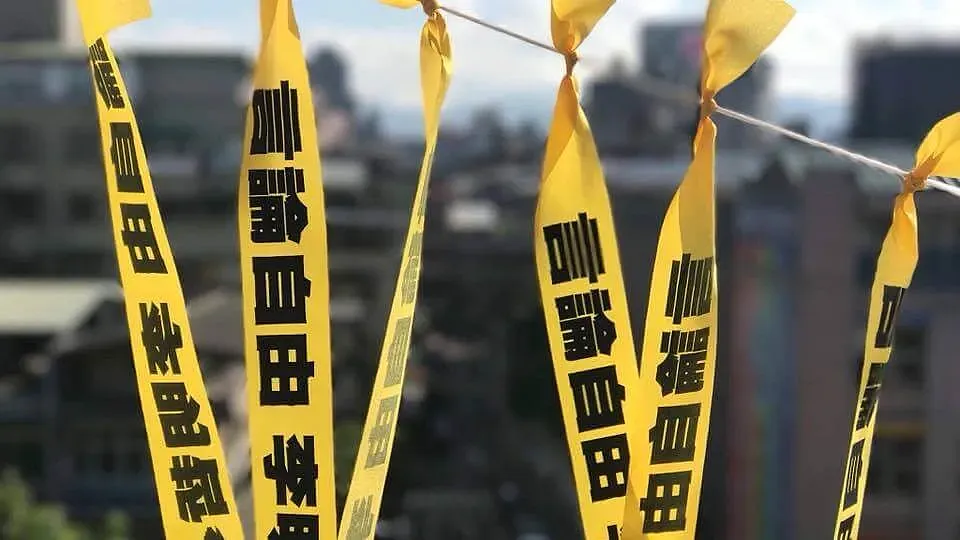
Photo / NGOs jointly launched a yellow ribbon campaign to support Li Ming-che
Hsiang Hsin and Kung Ch'ing, a couple heading the Hong Kong-listed company China Innovation Investment, were implicated in a Chinese spy case. They were intercepted at the airport before leaving Taiwan, handed over to prosecutors and investigators for questioning, and subjected to exit bans. In stark contrast, Taiwanese NGO worker Li Ming-che, township advisor Li Meng-chu, scholars Tsai Chin-shu and Shih Cheng-ping, and former British diplomatic staffer Simon Cheng all "went missing" after visiting China. A comparison of these two situations offers a chance to put the legal systems protecting personal liberty on both sides of the Taiwan Strait to the "ultimate test."
Article 9 of the Universal Declaration of Human Rights proclaims that "[n]o one shall be subjected to arbitrary arrest, detention or exile," and Article 9 of the International Covenant on Civil and Political Rights (ICCPR) similarly stipulates that "[e]veryone has the right to liberty and security of person," that "[n]o one shall be deprived of his liberty except on such grounds and in accordance with such procedure as are established by law," and that "[a]nyone arrested or detained on a criminal charge shall be brought promptly before a judge or other officer authorized by law to exercise judicial power and shall be entitled to trial within a reasonable time or to release."
Although Taiwan remains excluded from international organizations, it enacted the Enforcement Act of the International Covenant on Civil and Political Rights and the International Covenant on Economic, Social and Cultural Rights, declaring that the human rights provisions of the two Covenants possess domestic legal effect. Article 8 of the current Constitution explicitly guarantees the people's freedom of the person. The arrest, detention, interrogation, and punishment of any individual must be conducted in accordance with due process prescribed by laws such as the Code of Criminal Procedure. Furthermore, when a person is arrested or detained by "any authority other than a judicial tribunal," they may still apply for habeas corpus to a "court" in accordance with the Habeas Corpus Act.
China's Detention Decisions Are Not Made by Courts
During criminal investigation proceedings, if a defendant is summoned or arrested, and the prosecutor—after interrogation—deems it necessary to restrict the defendant's personal liberty beforehand to prevent flight or preserve evidence, the prosecutor may apply to a "court" for a warrant (detention warrant) to place the defendant in custody. In the court's review proceedings regarding whether to approve custody, defense counsel (attorneys or public defenders) must, in principle, be present. To achieve a full and effective defense, a legal amendment in April 2017 permitted defense counsel to inspect case files and evidence.
Current law provides that after interrogating a defendant, if a prosecutor determines that grounds for custody exist but there is no necessity to apply for custody, the prosecutor may directly order a restriction on residence (which, by interpretation, includes an exit ban). The new law, set to take effect on December 19 of this year (2019), explicitly defines the exit ban as an independent type of coercive measure that restricts a defendant's freedom of movement and travel (entering and leaving national borders) to prevent the defendant from fleeing abroad. Whether it is a court ruling for custody or a prosecutor's order for an exit ban, as long as the defendant objects, they may seek legal remedies to have the decision rescinded.
The businesses operated by Hsiang Hsin and Kung Ch'ing maintained close ties with the Chinese military and were accused of acting as intelligence operatives targeting Taiwan, allegedly endangering national security. Nevertheless, they still enjoy personal liberty, are protected by legal due process, and have the right to retain lawyers they deem most suitable to defend them.
As for China, it holds a seat on the United Nations Human Rights Council and has signed the International Covenant on Civil and Political Rights. However, because its current legal system largely conflicts with the Covenant's provisions, despite over a hundred scholars jointly petitioning for its prompt ratification, the State Council has yet to submit it to the National People's Congress for ratification.
The Constitution of the People's Republic of China explicitly states that "[t]he personal freedom of citizens of the People's Republic of China is inviolable." At the statutory level, the primary instruments used to restrict citizens' personal liberty are "criminal detention" under the Criminal Procedure Law of the People's Republic of China and "administrative detention" under the Law of the People's Republic of China on Public Security Administration Punishments. The former consists of criminal coercive measures adopted by "public security organs," "national security organs," or "people's procuratorates" during the investigation of criminal cases; the latter consists of administrative penalties decided by "public security organs" to sanction behaviors deemed to "possess social harmfulness." Those authorized to decide on criminal and administrative detentions are not "courts"!
While the law stipulates that the aforementioned organs should, in principle, promptly notify the family members of the detained person after deciding on a detention, criminal detentions "suspected of endangering national security crimes or terrorist activities where notification may impede the investigation" must wait until "circumstances impeding the investigation have disappeared" before notifying family members. Under this provision, the state holds the power to engage in "secret detention," completely isolating the detained person from the outside world (family members). This is tantamount to "enforced disappearance" and deprives them of the right to seek competent counsel for a full and effective defense.
Taiwanese Detained in China Face Indefinite Release
Li Ming-che, Li Meng-chu, Tsai Chin-shu, and Shih Cheng-ping all "went missing" upon entering China, yet Chinese authorities remained tight-lipped, failing to notify the Taiwanese government and their families in accordance with cross-strait agreements. Only long after did Beijing announce that they were being investigated according to law on "suspicion of engaging in criminal activities endangering national security." Among them, Li Ming-che was charged with "subversion of state power"; the presence of his defense counsel merely served as a prop for a forced "guilty plea," and he was ultimately sentenced by a court to five years in prison. The specific charges and investigation progress for the other three remain unclear, with no release in sight.
In contrast, Simon Cheng's experience could be described as fortunate. In a recent interview, he stated that upon returning to Hong Kong via the West Kowloon High Speed Rail Station after a business trip, he was intercepted by Chinese authorities under the "co-location" (one-land, two-checks) arrangement and immediately escorted back to Shenzhen. There, he was interrogated under torture by "national security organs" demanding to know whether Britain funded Hong Kong's civil movement. After days of "missing" status, and following diplomatic protests by the British government, "public security organs" finally stepped forward to announce that he had been caught "soliciting prostitutes" and was subjected to 15 days of administrative detention before being released upon completion.
Judging from Cheng's case, Chinese authorities arbitrarily jump between criminal detention (criminal coercive measures) and administrative detention (administrative penalties) procedures. They treat legal provisions merely as tools to self-justify and govern (fool) the people, rather than to protect human rights. Such unbridled power evidently lacks "predictability," leaving the populace completely at a loss! Furthermore, even though Tsai Chin-shu and Shih Cheng-ping harbor distinct pro-China leanings yet still suffered criminal detention, it is all the more apparent that Taiwanese and Hong Kong citizens now travel in and out of China at their own peril, fraught with "risk." Confucius said: "Do not enter a state in danger, do not dwell in a state under social unrest." These are truly words of wisdom.
※ This article was published in the Apple Daily on November 30, 2019
This article is an AI-generated translation of the original Chinese text. In the event of any discrepancy, the Chinese version shall prevail.