
Did Last Year's Women's Day Disgrace in the Disciplinary Court Come to an End? Investigation Report on Judge Ch'en Chih-hsiang Released by the Control Yuan!
Last edited: 2026-07-27
Last year, in the case of former judge Ch'en Hung-pin, who was dismissed from his judicial post for sexually harassing his judicial assistant, the Disciplinary Court once commuted Ch'en Hung-pin's penalty to a salary fine. Following the verdict, Judge Ch'en Chih-hsiang of the same court accepted media interviews a total of eight times. His interview statements went beyond the text of the judgment, and he even made remarks severely lacking in gender awareness, such as describing "workplace sexual harassment" as an "attempted extramarital affair." Consequently, in July of last year, the JRF requested a individual judge evaluation of Judge Ch'en Chih-hsiang by the Judges Evaluation Committee (JEC). On March 28 this year, the JEC resolved to refer the case to the Judicial Yuan to be submitted to the Control Yuan for review, while recommending a reprimand.
On the 13th of last month, the Control Yuan released its investigation report on this case. Addressing the lack of regulations regarding matters such as the deliberation methods and deadlines of the Judicial Yuan's Disciplinary Court, as well as the deadlines and restrictions for drafting and amending the original judgment text, it requested the Judicial Yuan to review and improve them. Regarding Judge Ch'en Chih-hsiang's improper interview remarks, it officially requested the Judicial Yuan to conduct official supervision.
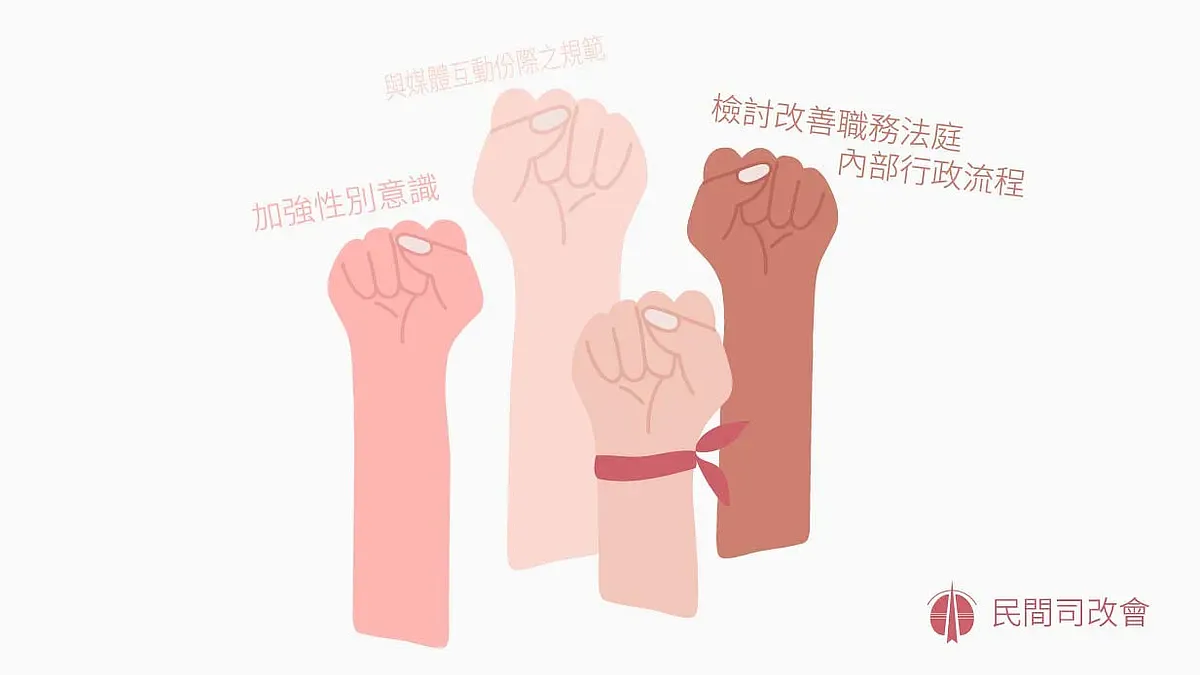
The Judicial Yuan has not yet announced the results of its review and official supervision. To our understanding, the Personnel Review Committee of the Judicial Yuan did not schedule this case for review at its last meeting before the Lunar New Year, which is this month's meeting. Regarding this case, the JRF makes the following three calls:
-
The Judicial Yuan Should Continuously Strengthen Measures to Improve the Gender Awareness of Judicial Personnel
The State Review Report for the Convention on the Elimination of All Forms of Discrimination against Women (CEDAW) was just completed last year. The review committee mentioned in observation point 18 that although the Judicial Yuan and the Executive Yuan of Taiwan have conducted numerous training sessions, stereotypes and gender biases still persist within the judicial system. This demonstrates that promoting gender awareness training requires long-term, continuous effort. Remarks lacking gender awareness not only harm the victims of the case, but may also reinforce society's stereotypes regarding specific genders, thereby exacerbating structural gender inequality. An unfriendly judicial environment will only drive victims of sexual harassment further away from seeking help. Therefore, the Judicial Yuan should continuously promote gender awareness training for judicial personnel so that they become more sensitive to unequal power dynamics and gender, thereby making it possible to establish a gender-friendly judicial system.
-
The Judicial Yuan Should Strengthen Deliberation and Implementation of Regulations on the Boundaries of Interaction Between Judicial Personnel and the Media
Judge Ch'en Chih-hsiang's remarks were inappropriate not only in their content, but also in the form in which they were expressed. The investigation report cites Article 4.6 of The Bangalore Principles of Judicial Conduct (2002), acknowledging that while judges enjoy freedom of speech like other citizens, they shall exercise such rights in a manner that preserves the dignity of the office. In this case, Judge Ch'en Chih-hsiang clearly accepted public media interviews after issuing a press release and without notifying or receiving authorization or consensus from other members of the panel; the ethical violation was clear. As a senior judicial personnel, Judge Ch'en Chih-hsiang still misunderstood these regulations, which clearly demonstrates the necessity of strengthening education and implementation regarding the boundaries and guidelines for interaction between judicial personnel and the media. The Judicial Yuan should also strengthen discussions on this issue to prevent judicial personnel from being at a loss as to what to do, while simultaneously having the opportunity to build a judicial system close to the people.
-
The Judicial Yuan Should Review and Improve the Internal Administrative Procedures of the Disciplinary Court
This incident also highlighted numerous problems within the internal procedures of the Disciplinary Court. The investigation report pointed out that several regulations of the Disciplinary Court are looser than general administrative procedures, such as unclear deadlines for revisions after submitting the initial draft of a judgment and unclear scopes for recording in deliberation records. The ambiguity of administrative procedures also led to doubts in this case regarding whether Judge Ch'en Chih-hsiang had modified the initial draft of the judgment after the pronouncement, which directly relates to the rights and interests of the people. In response to this, the Judicial Yuan indeed has the responsibility to deliberate, review, and improve detailed regulations such as the deadlines and restrictions for producing and modifying original judgments, the conduct of deliberations, and the preservation and management of deliberation records, so as to effectively safeguard basic administrative procedures and uphold public trust in the judiciary.
Related Information Control Yuan Investigation Report Reference Number: 108 Si-Diao 0067
This article is an AI-generated translation of the original Chinese text. In the event of any discrepancy, the Chinese version shall prevail.